


















Lesson 11 of 48 · Nouns, Articles and Adjectives
Chapter 3 overview: Nouns, Articles and Adjectives
Preview chapter 3 of French for Beginners: why every French noun has a gender, how articles and adjectives agree with it, and a first dialogue describing things.
In English, a noun is mostly just a noun. You say "the cat", "the table", "the house", and the word "the" never changes. French works differently. Every noun has a gender, masculine or feminine, and the words around it change to match: the article ("the", "a"), the adjective ("small", "red"), and the possessive ("my", "your"). This agreement is the beating heart of French grammar, and it is the first big grammatical idea in the course.
It sounds like a heavy load, but there is a trick: you never learn a noun alone. You learn it with its article, le chat, la maison, and the gender comes with it. In this chapter you will build that habit, learn the patterns that predict gender and plurals, and use adjectives to describe the world around you.
What you will learn
- The big picture of the French noun group: article, noun, adjective.
- Why gender exists and how to learn it painlessly.
- What each lesson in this chapter covers.
- A first dialogue that describes objects.
Key terms
Noun names a person, place, thing or idea: chat, Paris, liberté.
Gender is the grammatical class of a noun: masculine (le) or feminine (la).
Article is the small word before a noun: le, la, un, une.
Adjective describes a noun: petit, rouge.
Agreement is the matching of gender and number between words.
The noun group
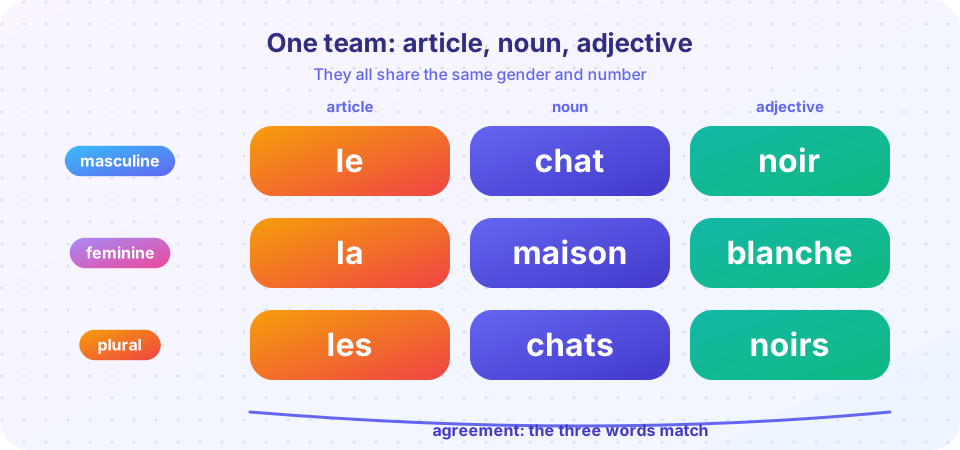
The basic building block of a French sentence is the noun group (groupe nominal): a determiner such as an article or a possessive, then the noun, then often an adjective. Three words, one team.
| Determiner | Noun | Adjective | Meaning |
|---|---|---|---|
| le | chat | noir | the black cat |
| la | maison | blanche | the white house |
| les | chats | noirs | the black cats |
| une | voiture | rouge | a red car |
| un | oiseau | bleu | a blue bird (note un before a vowel sound) |
Some adjectives go before the noun (un petit chat, une jolie maison); lesson 3 explains which. Notice what changes when the noun changes: noir becomes blanche because maison is feminine, and noir becomes noirs when the noun is plural. In English, "black" and "white" never change; in French, they must agree.
Why gender?
French inherited gender from Latin, which had three genders (masculine, feminine and neuter). French reduced them to two. Gender does not mean the thing has a sex. A table is feminine (la table), a desk is masculine (le bureau), and neither has a body. For people and animals gender usually follows sex (un homme, une femme), but for things it is a label you simply learn.
Two comforting facts. First, many nouns can be guessed by their ending: -tion and -té words are feminine, -ment and -age words are masculine. Second, French people disagree about some genders themselves and have fun with it. If you get one wrong, you will almost always be understood.
Chapter 3 at a glance
- Nouns: gender and plurals (Nouns: gender and plurals): how to recognize and learn gender, feminine forms of jobs, and the plural rules (-s, -x, -aux).
- Articles (Articles: le, la, un, des, du): definite, indefinite and partitive articles, and the contractions au, aux, du, des.
- Adjectives (Adjectives: agreement and position): feminine and plural forms, irregular adjectives, and where adjectives go.
- Possessives and demonstratives (Possessives and demonstratives): mon, ma, mes; ce, cette, ces.
- Review (Chapter 3 review): a one-page summary and a long quiz.
Three jobs for a noun group
Gender clues
Making plurals
Match your adjectives
A first dialogue: describing things
Two friends, Inès and Paul, are tidying a room. Notice the articles and the adjectives.
| Français | English |
|---|---|
| Tu as un livre rouge ? | Do you have a red book? |
| Oui, voici le livre rouge et la lampe bleue. | Yes, here is the red book and the blue lamp. |
| C'est une jolie lampe ! | It is a pretty lamp! |
| Merci. Et ce sont des chaises neuves. | Thanks. And those are new chairs. |
| Elles sont belles, ces chaises. | They are beautiful, those chairs. |
| Oui, et l'armoire est très grande. | Yes, and the wardrobe is very big. |
You will meet c'est and ce sont ("it is", "those are") and voici ("here is") as chunks now and study the verb être in chapter 4. Note how rouge did not change for livre (masculine) or lampe (feminine) because adjectives ending in a silent e are the same in both genders, while bleu became bleue for the feminine lampe.
How to practice
Always write a noun with its article in your vocabulary list: le livre, la table, l'ami(e). Use two colors, blue for masculine and pink for feminine, or put the genders in two columns. Say the noun with its article out loud. When you meet a new word, ask yourself whether its ending gives a clue, then check a dictionary. Over a few weeks, your ear will start to feel which article "sounds right" with a given word.
Why agreement is a feature, not a flaw
Agreement may feel like extra work, but it has a purpose: redundancy makes speech easier to understand. In la petite fille, the feminine gender is marked three times: la, petite (with its pronounced t) and fille itself. If a noisy bus drowns out one of the clues, you still catch the others. In English "the small girl" carries no such backup, so speakers rely on word order alone. Once you hear French as a language that deliberately repeats information, agreement stops feeling like a trap and starts feeling like a safety net.
It also helps your listening. When you hear une you know that the next noun is feminine and singular; when you hear des you know a plural noun is coming. You can predict what follows, and prediction is what makes fast speech understandable.
How to study the chapter
Work through the five lessons in order, spending three or four days on each. Build a small vocabulary notebook with two columns, masculine and feminine, and add about fifteen nouns per lesson, always with their article. Use the flashcards in each Try it section for review. Every day, look around and describe three objects in French with an article and an adjective: une lampe bleue, un grand livre, des chaises blanches. This tiny habit makes the grammar automatic far faster than doing exercises alone.
Common misconceptions
"Gender follows meaning." It rarely does for things. La sentinelle (the guard) is feminine even if the guard is a man; le mannequin (the model) is masculine even for a woman. The label is grammatical, not biological.
"I can learn the noun and add the article later." That is the hardest way. Learn them together from the start.
"Adjectives never change, like in English." In French they agree in gender and number, with a few invariable ones.
Try it
Learn ten common nouns with their articles. Say the whole phrase aloud, and notice that the article tells you the gender.
Now guess the gender from the ending. Choose masculine or feminine in each box, then check. We will explain the endings in the next lesson; this is a warm-up.
Check your understanding
Quick check · 4 questions
of 4 answered You scored / 4 · perfect!
-
1. What does 'agreement' mean in French grammar?
Articles and adjectives change to match the noun's gender and number. -
2. How should you learn a new noun?
The article tells you the gender, so learn them together. -
3. Is a table masculine or feminine in French?
La table is feminine. Grammatical gender does not follow meaning for things. -
4. In 'la maison blanche', why does blanche end in e?
The adjective agrees with the feminine noun maison.
Summary
- A French noun group is article + noun + adjective, and all three agree in gender and number.
- Gender is grammatical; learn each noun with its article.
- Endings help: -tion and -té are feminine, -ment and -age masculine.
- Chapter 3 covers gender and plurals, articles, adjectives, possessives and demonstratives.
Track your progress
Create a free account to tick off lessons and pick up where you left off on any device.
of French for Beginners lessons completed