


















Lesson 9 of 48 · Sounds, Greetings and Basics
Numbers from 0 to 100
Learn to count from 0 to 100 in French, including the unusual seventy, eighty and ninety, rules for et and hyphens, and how to say prices, ages and phone numbers.
Numbers are among the first things you need: prices at the market, your age, a phone number, a street address, the time of a train. French numbers are mostly regular, but they hide one famous surprise. Seventy is "sixty-ten", eighty is "four-twenties" and ninety is "four-twenties-ten". Once you see why, the pattern is easy to learn, and it is much less scary than its reputation.
In this lesson you will learn 0 to 100 in three steps: the numbers you must memorize (0 to 16), the regular pattern for 17 to 69, and the system for 70 to 99. Then you will use them for prices, ages and phone numbers.
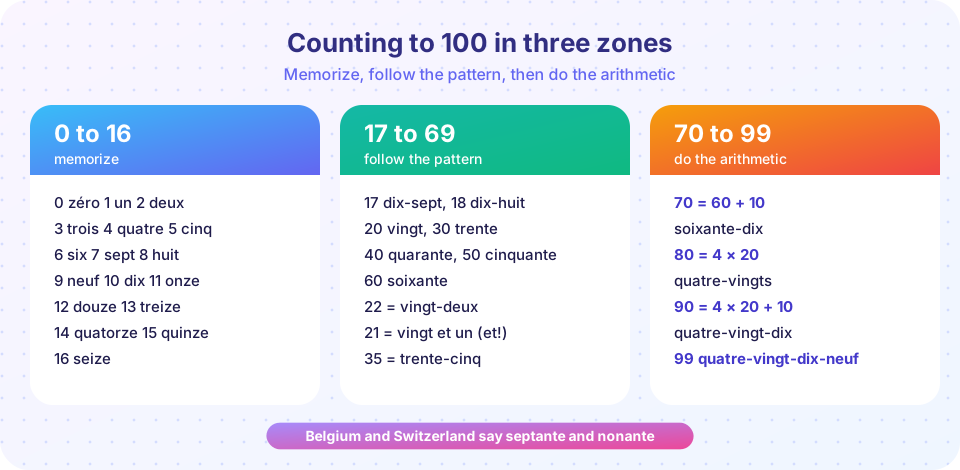
What you will learn
- The numbers 0 to 16 with their pronunciation.
- The regular pattern for 20 to 69 and the et rule.
- Why 70, 80 and 90 look as they do, and how to build 71 to 99.
- How to say prices, ages and phone numbers.
Key terms
Cardinal number is a counting number: one, two, three.
Vigesimal means based on twenty; quatre-vingts is a trace of an old base-20 counting system.
Septante, octante/huitante, nonante are the regular words for 70, 80 and 90 in Belgium, Switzerland and some other regions.
Euro, centime: one euro is 100 cents (centimes).
Zone 1: 0 to 16
These are the building blocks. Learn them with their sounds.
| Number | French | IPA | Number | French | IPA |
|---|---|---|---|---|---|
| 0 | zéro | /zeʁo/ | 9 | neuf | /nœf/ |
| 1 | un (une) | /œ̃/ (/yn/) | 10 | dix | /dis/ |
| 2 | deux | /dø/ | 11 | onze | /ɔ̃z/ |
| 3 | trois | /tʁwa/ | 12 | douze | /duz/ |
| 4 | quatre | /katʁ/ | 13 | treize | /tʁɛz/ |
| 5 | cinq | /sɛ̃k/ | 14 | quatorze | /katɔʁz/ |
| 6 | six | /sis/ | 15 | quinze | /kɛ̃z/ |
| 7 | sept | /sɛt/ | 16 | seize | /sɛz/ |
| 8 | huit | /ɥit/ |
Notice that the p in sept is silent, the x in six and dix is /s/ when the number stands alone, and the final consonant of cinq, six, huit and dix often disappears when a noun beginning with a consonant follows: six chats /si ʃa/, huit livres /ɥi livʁ/. Before a vowel, the liaison returns: deux amis /døz‿ami/, trois heures /tʁwaz‿œʁ/, dix ans /diz‿ɑ̃/, six heures /siz‿œʁ/. The number neuf before ans and heures turns its f into /v/: neuf ans /nœv‿ɑ̃/.
The number un is also the article "a" and has a feminine form, une: un livre, une table. In a list you say un.
Zone 2: 17 to 69
From 17 to 19 French says "ten-seven", "ten-eight", "ten-nine": dix-sept /disɛt/, dix-huit /dizɥit/, dix-neuf /diznœf/. Then comes the pattern of tens:
| Ten | French | IPA |
|---|---|---|
| 20 | vingt | /vɛ̃/ |
| 30 | trente | /tʁɑ̃t/ |
| 40 | quarante | /kaʁɑ̃t/ |
| 50 | cinquante | /sɛ̃kɑ̃t/ |
| 60 | soixante | /swasɑ̃t/ |
The pattern is tens + unit, joined by a hyphen: vingt-deux (22), trente-cinq (35), quarante-sept (47), cinquante-neuf (59). The exception is a unit of one, where the word et ("and") appears without hyphens: vingt et un (21), trente et un (31), quarante et un (41), cinquante et un (51), soixante et un (61). In et (pronounced /e/) the t is always silent, even before a vowel.
Notice that vingt is pronounced /vɛ̃/ alone, but the t returns in numbers from 21 to 29: vingt-deux /vɛ̃tdø/, and in liaison, vingt ans /vɛ̃t‿ɑ̃/ (twenty years).
Zone 3: 70 to 99, the arithmetic zone
French stops inventing new words after soixante (60) and builds the next numbers by addition and multiplication. This is a legacy of a base-20 counting habit that also left traces in other European languages.
- 70 is soixante-dix: 60 + 10.
- 71 is soixante et onze: 60 + 11, with et.
- 72 to 76 are soixante-douze, soixante-treize, soixante-quatorze, soixante-quinze, soixante-seize.
- 77 to 79 are soixante-dix-sept, soixante-dix-huit, soixante-dix-neuf.
- 80 is quatre-vingts: 4 × 20. The s appears only when nothing follows.
- 81 is quatre-vingt-un (no et, and no s), 82 is quatre-vingt-deux, and so on up to 89.
- 90 is quatre-vingt-dix: 4 × 20 + 10.
- 91 to 99 are quatre-vingt-onze, quatre-vingt-douze, ... quatre-vingt-dix-neuf.
- 100 is cent /sɑ̃/.
In Belgium, in some regions of Switzerland and in parts of Africa people use the regular forms septante (70), nonante (90) and, in some Swiss cantons, huitante (80). French in France uses soixante-dix and quatre-vingt-dix, and never septante. Both are correct in their regions; as a visitor, either will be understood, though people may smile if you use the other in the wrong country.
A sample of full counting to check your memory: quatre-vingt-quinze (95), soixante-dix-huit (78), quatre-vingt-un (81), quatre-vingts (80).
Using numbers
Prices. A price in euros uses the word euro (plural euros) and centimes: 3,50 € is trois euros cinquante; 12 € is douze euros; 0,80 € is quatre-vingts centimes. In French the decimal separator is a comma and the currency sign follows the number: 3,50 €. To ask a price, say Combien ça coûte ? (How much is it?) or C'est combien ?, and answer Ça coûte douze euros or C'est douze euros cinquante.
Age. French says "I have ... years": J'ai vingt-cinq ans. (I am 25.) The verb is avoir ("to have") and the word ans ("years") cannot be omitted. You will study avoir in chapter 4. Ask: Quel âge as-tu ? (informal) or Quel âge avez-vous ? (formal).
Phone numbers. In France, a ten-digit number is spoken in five pairs: 06 12 34 56 78 is zéro six, douze, trente-quatre, cinquante-six, soixante-dix-huit. The first pair is usually "zero six" or "zero one" and so on. Phone numbers keep their pairs, so you must recognize numbers up to 99 quickly by ear.
Simple arithmetic. Plus is plus, minus is moins, times is fois, divided by is divisé par, equals is égale (or font with a plural total): Deux plus trois font cinq (2 + 3 = 5). Dix moins quatre égale six.
How to learn the numbers
Do not try to memorize 100 words in one sitting. Learn 0 to 20 first, add the tens, then spend a day on the 70 to 99 zone using the arithmetic: say soixante plus dix, soixante-dix; quatre fois vingt, quatre-vingts. Then practice with real numbers: read the numbers you see around you, such as bus numbers, prices on packaging, house numbers and the date. A good game is to count backward from 100 to 0 in tens: cent, quatre-vingt-dix, quatre-vingts, soixante-dix, soixante...
Common misconceptions
"The numbers 70 to 99 are random." They follow arithmetic: 70 = 60 + 10, 80 = 4 × 20, 90 = 4 × 20 + 10.
"Quatre-vingts always ends in -s." It loses the s when another number follows: quatre-vingt-un, quatre-vingt-deux.
"Soixante-et-un and quatre-vingt-et-un are both correct." Soixante et un (61) and soixante et onze (71) take et; 81 and 91 do not: quatre-vingt-un, quatre-vingt-onze.
Try it
This Python converter spells any number from 0 to 100 in French by applying exactly the rules above. Compare its output with the table, then try your own numbers.
Press Run (or Ctrl + Enter) to see the result here.
Program input · what you'd type while the program runs
Type the answers before you press Run, one per line. Each time the program reads a line (with input()), it gets the next line from this box.
Now a number game. The page picks a random number from 0 to 100 and asks you to type it in French. Accents are not an issue here, because numbers have none apart from zéro, and hyphens and capital letters are optional.
Finally, match the French numbers with their digits.
Check your understanding
Quick check · 5 questions
of 5 answered You scored / 5 · perfect!
-
1. How do you say 70 in standard French (France)?
Soixante-dix is 60 + 10. Septante is used in Belgium and Switzerland. -
2. What is 81 in French?
Quatre-vingt-un: no et, and no s on vingt because another number follows. -
3. Which numbers take 'et' before 'un' or 'onze'?
The et appears for 21, 31, 41, 51, 61 and 71, but not for 81 and 91. -
4. How do you read the phone number 06 12 34 56 78?
French phone numbers are read in five pairs of digits. -
5. How do you say 'I am 25 years old'?
French uses avoir: J'ai vingt-cinq ans. The word ans is required.
Summary
- Learn 0 to 16 by heart; 17 to 19 are dix-sept, dix-huit, dix-neuf.
- From 20 to 69, tens plus units with hyphens; et un for 21, 31, 41, 51 and 61.
- 70 = 60 + 10, 80 = 4 × 20, 90 = 4 × 20 + 10; septante and nonante exist in Belgium and Switzerland.
- Age uses avoir (J'ai vingt ans), prices use euros and centimes, and phone numbers are read in pairs.
Track your progress
Create a free account to tick off lessons and pick up where you left off on any device.
of French for Beginners lessons completed