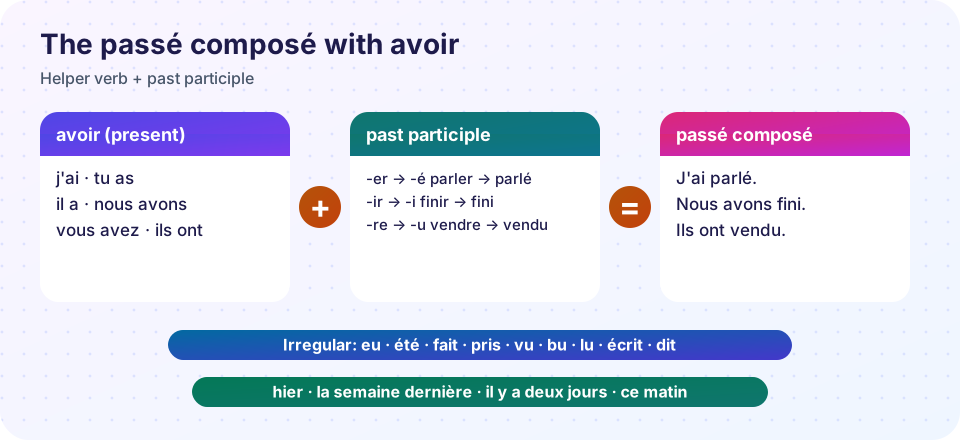
Learn the French passé composé with avoir: auxiliary plus past participle, regular and irregular participles, negation, questions and time words.
The passé composé is the tense you will use most when you talk about the past in French. It is also one of the easiest to build, because it follows a formula: the present tense of a helper verb plus a past participle. For most verbs the helper is avoir, and you already know avoir from Chapter 4.
One form covers three English ideas. J'ai mangé can mean "I ate", "I have eaten" or "I did eat". French does not separate them, so you only learn one pattern. In this lesson you will learn how to form the participle of regular verbs, memorize the most common irregular ones, and put the pieces into statements, negations and questions.
The formula: avoir in the present + past participle = passé composé.
le passé composé: the compound past tense. le participe passé: the past participle, the verb form that follows the auxiliary. l'auxiliaire (m.): the helper verb (here avoir). un verbe irrégulier: a verb whose participle does not follow the standard endings. hier: yesterday.
The auxiliary changes with the subject. The participle stays the same: parlé never changes in this pattern (a rare exception is below). Examples: Tu as mangé ? (Did you eat?), Nous avons visité Rome. (We visited Rome.), Elles ont écouté la radio. (They listened to the radio.)
Listen to the -er verbs: parler and parlé sound identical, like "par-lay". So in speech Je vais parler and J'ai parlé differ only by the helper verb. In writing, check which one you mean: the infinitive -er or the participle -é. A quick trick: replace the verb with vendre / vendu. If vendre fits (to sell), you need -er. If vendu fits (sold), you need -é.
Negation wraps the auxiliary, because that is the conjugated verb: *Je **n'*ai pas mangé. *Nous **n'*avons jamais vu la mer. *Elle **n'*a rien dit. (Personne goes after the participle: Je n'ai vu personne.)
Questions have the same three patterns as before:
Intonation: Tu as mangé ?
Est-ce que: Est-ce que tu as mangé ?
Inversion: As-tu mangé ? (the auxiliary and subject swap; the participle stays after)
Adverbs. Short, common adverbs go between the auxiliary and the participle: J'ai déjà mangé. (I have already eaten.) Il a bien dormi. (He slept well.) Nous avons trop mangé. (We ate too much.) Elle n'a pas encore fini. (She hasn't finished yet.) Time words like hier go at the beginning or the end: Hier, j'ai travaillé or J'ai travaillé hier.
When the direct object comes before the verb, the participle agrees with it: La pizza que j'ai mangée était délicieuse. (mangée agrees with pizza, feminine.) With les as a pronoun: Je les ai vus (I saw them, masculine). You will learn the pronouns in Chapter 7; for now, it is enough to know the rule exists and to leave participles unchanged in simple sentences.
"The participle changes with the subject." With avoir, no: elle a parlé, ils ont parlé. The agreement rule only applies when a direct object comes first.
"J'ai été means I was in the past only like English 'I have been'." It can mean both, and it uses avoir: j'ai été, never je suis été.
"Parlé and parler are different sounds." They sound the same. Use the vendre / vendu test when you write.
"I translate each English past form separately." French uses one form (passé composé) for "I ate", "I have eaten", "I did eat".
First, drill the irregular participles with flashcards.
Irregular participles
<style>:root{--ink:#1e1b4b;--mut:#475569;--a:#4f46e5;--b:#db2777}*{box-sizing:border-box}body{margin:0;padding:14px;font-family:system-ui,-apple-system,'Segoe UI',sans-serif;background:linear-gradient(135deg,#faf5ff,#eff6ff);color:var(--ink)}.wrap{max-width:640px;margin:0 auto}button{font:inherit;cursor:pointer;border:0;border-radius:999px;padding:8px 16px;color:#fff;background:linear-gradient(135deg,#4f46e5,#7c3aed);box-shadow:0 4px 10px rgba(79,70,229,.25)}button.alt{background:#fff;color:var(--a);border:1px solid #c7d2fe;box-shadow:none}button:disabled{opacity:.45;cursor:default}.row{display:flex;gap:8px;flex-wrap:wrap;justify-content:center;margin:12px 0}.card{background:#fff;border-radius:18px;box-shadow:0 10px 24px rgba(67,56,202,.16);padding:26px 18px;text-align:center;min-height:130px;display:flex;flex-direction:column;justify-content:center;align-items:center;width:100%;color:var(--ink);cursor:pointer;border:0}.card .big{font-size:28px;font-weight:700}.card .sm{font-size:14px;color:var(--mut);margin-top:6px}.cnt{text-align:center;color:var(--mut);font-size:14px;margin-bottom:8px}.msg{text-align:center;min-height:22px;color:var(--mut);font-size:14px}.ok{color:#047857;font-weight:600}.bad{color:#be123c;font-weight:600}input[type=text]{font:inherit;border:2px solid #c7d2fe;border-radius:10px;padding:5px 8px;width:150px;background:#fff;color:var(--ink)}input.good{border-color:#10b981;background:#ecfdf5}input.wrong{border-color:#ef4444;background:#fef2f2}.item{background:#fff;border-radius:14px;padding:10px 14px;margin:8px 0;box-shadow:0 4px 12px rgba(67,56,202,.10);line-height:2}.item small{display:block;color:var(--mut);line-height:1.3}.keys{display:flex;flex-wrap:wrap;gap:6px;justify-content:center;margin:8px 0}.keys button{padding:4px 11px;background:#fff;color:var(--a);border:1px solid #c7d2fe;box-shadow:none;border-radius:8px}.cols{display:grid;grid-template-columns:1fr 1fr;gap:10px}.cols button{display:block;width:100%;border-radius:12px;background:#fff;color:var(--ink);border:2px solid #c7d2fe;box-shadow:none;padding:10px 8px;margin-bottom:8px;text-align:center}.cols button.sel{border-color:#4f46e5;background:#eef2ff}.cols button.done{border-color:#10b981;background:#ecfdf5;color:#047857;cursor:default}.cols button.no{border-color:#ef4444;background:#fef2f2}</style><divclass="wrap"><divclass="cnt"id="cnt"></div><buttonclass="card"id="card"aria-live="polite"><spanclass="big"id="big"></span><spanclass="sm"id="sm"></span></button><divclass="row"><buttonclass="alt"id="prev">Back</button><buttonid="flip">Flip</button><buttonclass="alt"id="next">Next</button></div><divclass="row"><buttonclass="alt"id="dir">French first</button><buttonclass="alt"id="shuf">Shuffle</button><buttonclass="alt"id="say">Listen</button></div><divclass="msg"id="msg"></div></div><script>constD=[["avoir","eu"],["être","été"],["faire","fait"],["prendre","pris"],["voir","vu"],["boire","bu"],["lire","lu"],["écrire","écrit"],["dire","dit"],["pouvoir","pu"],["vouloir","voulu"],["devoir","dû"],["savoir","su"],["mettre","mis"],["ouvrir","ouvert"]];let i=0,showFr=true,fr=true;const$=id=>document.getElementById(id);functiondraw(){const c=D[i];$('cnt').textContent='Card '+(i+1)+' of '+D.length;const q=fr?c[0]:c[1],a=fr?c[1]:c[0];$('big').textContent=showFr?q:a;$('sm').textContent=showFr?'Tap to flip':(fr?'English':'French');}functionflip(){showFr=!showFr;draw();}$('card').onclick=flip;$('flip').onclick=flip;$('next').onclick=()=>{i=(i+1)%D.length;showFr=true;draw();};$('prev').onclick=()=>{i=(i-1+D.length)%D.length;showFr=true;draw();};$('dir').onclick=()=>{fr=!fr;$('dir').textContent=fr?'French first':'English first';showFr=true;draw();};$('shuf').onclick=()=>{for(let k=D.length-1;k>0;k--){const j=Math.floor(Math.random()*(k+1));[D[k],D[j]]=[D[j],D[k]];}i=0;showFr=true;draw();};$('say').onclick=()=>{try{if(!('speechSynthesis'in window))throw0;const u=newSpeechSynthesisUtterance(D[i][0]);u.lang='fr-FR';speechSynthesis.cancel();speechSynthesis.speak(u);$('msg').textContent='';}catch(e){$('msg').textContent='Speech is not available in this preview. Say it aloud yourself.';}};draw();</script>
This Python helper builds the passé composé with avoir. It chooses the participle from the ending, checks the list of irregular verbs, and applies a negation if you ask for one. Add your own verbs to the dictionary.
Python
Passé composé builder (avoir)
AVOIR ={"je":"ai","tu":"as","il":"a","elle":"a","on":"a","nous":"avons","vous":"avez","ils":"ont","elles":"ont"}
IRREGULAR ={"avoir":"eu","être":"été","faire":"fait","prendre":"pris","comprendre":"compris","apprendre":"appris","mettre":"mis","voir":"vu","boire":"bu","lire":"lu","écrire":"écrit","dire":"dit","vouloir":"voulu","pouvoir":"pu","devoir":"dû","savoir":"su","connaître":"connu","ouvrir":"ouvert"}defparticiple(verb):if verb in IRREGULAR:return IRREGULAR[verb]if verb.endswith("er"):return verb[:-2]+"é"if verb.endswith("ir"):return verb[:-2]+"i"if verb.endswith("re"):return verb[:-2]+"u"raise ValueError("unknown verb: "+ verb)defpasse_compose(subject, verb, rest="", neg=None):
aux = AVOIR[subject]
vowel = aux[0]in"aeiouh"if neg:
aux =("n'"if vowel else"ne ")+ aux +" "+ neg
if subject =="je"and vowel andnot neg:
head ="J'"+ aux
else:
head = subject.capitalize()+" "+ aux
if subject =="je":
head ="Je "+ aux
return(head +" "+ participle(verb)+" "+ rest).strip()+"."print(passe_compose("je","parler","français"))print(passe_compose("tu","finir","tes devoirs"))print(passe_compose("nous","vendre","la voiture"))print(passe_compose("ils","prendre","le train"))print(passe_compose("elle","boire","un café"))print(passe_compose("je","voir","", neg="pas"))print(passe_compose("vous","dire","la vérité", neg="jamais"))print(passe_compose("on","faire","une promenade"))
Press Run (or Ctrl + Enter) to see the result here.
Program input · what you'd type while the program runs
Type the answers before you press Run, one per line. Each time the program reads a line (with input()), it gets the next line from this box.
Finally, a gap-fill for avoir and the participles.
Passé composé with avoir
<style>:root{--ink:#1e1b4b;--mut:#475569;--a:#4f46e5;--b:#db2777}*{box-sizing:border-box}body{margin:0;padding:14px;font-family:system-ui,-apple-system,'Segoe UI',sans-serif;background:linear-gradient(135deg,#faf5ff,#eff6ff);color:var(--ink)}.wrap{max-width:640px;margin:0 auto}button{font:inherit;cursor:pointer;border:0;border-radius:999px;padding:8px 16px;color:#fff;background:linear-gradient(135deg,#4f46e5,#7c3aed);box-shadow:0 4px 10px rgba(79,70,229,.25)}button.alt{background:#fff;color:var(--a);border:1px solid #c7d2fe;box-shadow:none}button:disabled{opacity:.45;cursor:default}.row{display:flex;gap:8px;flex-wrap:wrap;justify-content:center;margin:12px 0}.card{background:#fff;border-radius:18px;box-shadow:0 10px 24px rgba(67,56,202,.16);padding:26px 18px;text-align:center;min-height:130px;display:flex;flex-direction:column;justify-content:center;align-items:center;width:100%;color:var(--ink);cursor:pointer;border:0}.card .big{font-size:28px;font-weight:700}.card .sm{font-size:14px;color:var(--mut);margin-top:6px}.cnt{text-align:center;color:var(--mut);font-size:14px;margin-bottom:8px}.msg{text-align:center;min-height:22px;color:var(--mut);font-size:14px}.ok{color:#047857;font-weight:600}.bad{color:#be123c;font-weight:600}input[type=text]{font:inherit;border:2px solid #c7d2fe;border-radius:10px;padding:5px 8px;width:150px;background:#fff;color:var(--ink)}input.good{border-color:#10b981;background:#ecfdf5}input.wrong{border-color:#ef4444;background:#fef2f2}.item{background:#fff;border-radius:14px;padding:10px 14px;margin:8px 0;box-shadow:0 4px 12px rgba(67,56,202,.10);line-height:2}.item small{display:block;color:var(--mut);line-height:1.3}.keys{display:flex;flex-wrap:wrap;gap:6px;justify-content:center;margin:8px 0}.keys button{padding:4px 11px;background:#fff;color:var(--a);border:1px solid #c7d2fe;box-shadow:none;border-radius:8px}.cols{display:grid;grid-template-columns:1fr 1fr;gap:10px}.cols button{display:block;width:100%;border-radius:12px;background:#fff;color:var(--ink);border:2px solid #c7d2fe;box-shadow:none;padding:10px 8px;margin-bottom:8px;text-align:center}.cols button.sel{border-color:#4f46e5;background:#eef2ff}.cols button.done{border-color:#10b981;background:#ecfdf5;color:#047857;cursor:default}.cols button.no{border-color:#ef4444;background:#fef2f2}</style><divclass="wrap"><divclass="keys"id="keys"></div><divid="list"></div><divclass="row"><buttonid="chk">Check answers</button><buttonclass="alt"id="show">Show answers</button></div><divclass="msg"id="msg">Type each answer. Use the accent buttons if your keyboard has no accents.</div></div><script>constD=[{"s":"Hier, nous ___ mangé au restaurant. (we ate)","a":["avons"],"h":"avoir with nous."},{"s":"Tu ___ fini ? (Did you finish?)","a":["as"],"h":""},{"s":"Elle a ___ un livre. (read)","a":["lu"],"h":"Participle of lire."},{"s":"J’ai ___ un café. (drank)","a":["bu"],"h":"Participle of boire."},{"s":"Ils n’ont pas ___ la réponse. (understood)","a":["compris"],"h":"Participle of comprendre."},{"s":"Vous ___ vendu la maison ?","a":["avez"],"h":""}];const$=id=>document.getElementById(id);let last=null;constnorm=s=>s.trim().toLowerCase().replace(/[\u2019\u2018]/g,"'").replace(/\s+/g,' ');D.forEach((d,k)=>{const p=d.s.split('___');const div=document.createElement('div');div.className='item';
div.append(p[0]);const inp=document.createElement('input');inp.type='text';inp.id='i'+k;inp.autocomplete='off';inp.spellcheck=false;inp.setAttribute('aria-label','Answer '+(k+1));inp.onfocus=()=>last=inp;div.append(inp);div.append(p[1]||'');if(d.h){const s=document.createElement('small');s.textContent=d.h;div.append(s);}$('list').append(div);});['é','è','ê','à','â','ç','î','ï','ô','ù','û','œ'].forEach(ch=>{const b=document.createElement('button');b.textContent=ch;b.setAttribute('aria-label','Insert '+ch);b.onmousedown=e=>e.preventDefault();b.onclick=()=>{const t=last||$('i0');t.focus();const s=t.selectionStart,e=t.selectionEnd;t.setRangeText(ch,s,e,'end');};$('keys').append(b);});$('chk').onclick=()=>{let n=0;D.forEach((d,k)=>{const t=$('i'+k);const ok=d.a.some(a=>norm(a)===norm(t.value));t.className=ok?'good':'wrong';if(ok)n++;});$('msg').innerHTML=n===D.length?'<span class="ok">All '+n+' correct. Bravo !</span>':'<span class="bad">'+n+' of '+D.length+' correct.</span> Check accents and endings.';};$('show').onclick=()=>{D.forEach((d,k)=>{$('i'+k).value=d.a[0];$('i'+k).className='good';});$('msg').textContent='Answers shown. Reload the preview to reset.';};</script>