


















Lesson 15 of 48 · Nouns, Articles and Adjectives
Possessives and demonstratives: my, your, this, those
Learn the French possessive adjectives (mon, ma, mes, son, notre...) and demonstratives (ce, cet, cette, ces), with the rule that they agree with the noun, plus family vocabulary.
Once you have articles and adjectives, two more small word families complete the noun group. Possessives say whose something is (my book, your sister) and demonstratives point at things (this book, those chairs). Both follow the pattern you already know: they replace the article and agree with the noun. The twist is that French possessives agree with the thing owned, not with the owner, which surprises English speakers because "his" and "her" are different in English.
By the end of this lesson you will be able to talk about your family and your belongings, and to point at things: ce livre, cette maison, ces enfants.
What you will learn
- The possessive adjectives for all six owners.
- Why son, sa, ses can mean "his" or "her".
- The demonstratives ce, cet, cette, ces and the -ci / -là tags.
- Family vocabulary for talking about people close to you.
Key terms
Possessive adjective shows ownership and replaces the article: mon livre.
Demonstrative adjective points to something: ce livre ("this/that book").
Owner is the person who has the thing; possessed noun is the thing owned. In French, agreement follows the possessed noun.
Mute h is a silent h that acts like a vowel, as in cet hôtel.
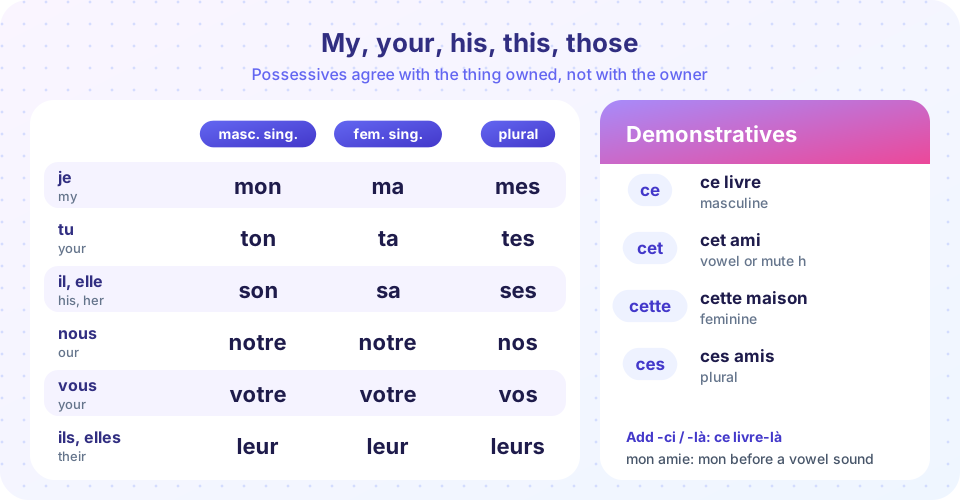
The possessives
| Owner | Masc. singular | Fem. singular | Plural (both) | Meaning |
|---|---|---|---|---|
| je | mon | ma | mes | my |
| tu | ton | ta | tes | your (informal) |
| il, elle | son | sa | ses | his, her, its |
| nous | notre | notre | nos | our |
| vous | votre | votre | vos | your (formal or plural) |
| ils, elles | leur | leur | leurs | their |
Read the table across. "My brother" is mon frère (masculine), "my sister" is ma sœur (feminine), "my parents" is mes parents (plural). "Our" and "your" (plural) have only two forms, one singular and one plural: notre maison, nos amis; votre père, vos enfants.
Whose gender counts?
In English, "his" and "her" depend on the owner: his car, her car. In French, son, sa and ses do not tell you whether the owner is a man or a woman. They agree with the noun:
- Paul a un frère. Son frère (his brother).
- Marie a un frère. Son frère (her brother), exactly the same.
- Paul a une sœur. Sa sœur (his sister).
- Marie a une sœur. Sa sœur (her sister).
So sa sœur can be "his sister" or "her sister", and context tells you which. The same logic applies for mon, ma, mes: the ma in ma voiture is feminine because voiture is feminine, not because the speaker is a woman.
The vowel exception
Before a feminine singular noun starting with a vowel sound (or mute h), French uses the masculine forms mon, ton, son to avoid two vowels clashing: mon amie (not ma amie), ton école, son histoire, mon habitude. The noun is still feminine, and its adjective follows the feminine: mon amie préférée.
Possession with de
French has no apostrophe-s. To say "Marie's book", use de: le livre de Marie, la voiture de mon père, les amis de Karim. Remember the contractions from the articles lesson: le livre du professeur, la maison des voisins.
The demonstratives
The demonstrative adjective replaces the article and means "this", "that", "these" or "those":
| Singular | Plural | |
|---|---|---|
| Masculine | ce livre | ces livres |
| Masculine before a vowel or mute h | cet ami, cet hôtel | ces amis |
| Feminine | cette maison | ces maisons |
Notice that cet and cette sound the same, /sɛt/, and that ce before h-aspirated words stays ce: ce héros. Ces is the plural for both genders, /se/, with liaison before a vowel: ces amis /sezami/.
French does not normally distinguish "this" from "that". Ce livre can mean either. To be precise, add -ci (here) or -là (there) to the noun: ce livre-ci (this book here) and ce livre-là (that book there). In everyday speech, -là is used all the time as a casual pointer: cette fille-là.
A confusing pair: ce and c'est. Ce livre est bon uses the demonstrative adjective. C'est un livre ("it is a book") uses the pronoun ce plus est, and you cannot replace it with the demonstrative.
Talking about your family
Family vocabulary is the best practice for possessives. Say it aloud with mon/ma/mes.
| Masculine | Feminine | Plural |
|---|---|---|
| mon père (my father) | ma mère (my mother) | mes parents |
| mon frère | ma sœur | mes frères et sœurs |
| mon grand-père | ma grand-mère | mes grands-parents |
| mon oncle | ma tante | mes oncles et tantes |
| mon cousin | ma cousine | mes cousins |
| mon fils | ma fille | mes enfants |
| mon mari | ma femme | mes amis |
Note that les parents means "the parents" (mother and father); for relatives in general, say la famille or les proches. Mari and femme mean husband and wife, and femme also means "woman".
A dialogue with a photo
| Français | English |
|---|---|
| Qui est cette femme sur la photo ? | Who is this woman in the photo? |
| C'est ma mère. Et voici mon père et mes deux frères. | That is my mother. And here is my father and my two brothers. |
| Et cet homme, là ? | And that man there? |
| C'est mon oncle Paul. Sa fille, ma cousine Lucie, habite à Lyon. | That is my uncle Paul. His daughter, my cousin Lucie, lives in Lyon. |
| Vous êtes une grande famille ! | You are a big family! |
| Oui ! Nos grands-parents habitent aussi à côté. | Yes! Our grandparents also live next door. |
Whose is it? Clearing up son, sa and ses
Because son, sa and ses do not show whether the owner is male or female, French speakers sometimes need to clarify. Imagine Paul and Marie are talking about their mother-in-law. If you say sa mère, listeners must rely on context to know whether you mean Paul's mother or Marie's mother. To make it clear, add an emphatic pronoun after the noun: sa mère à lui (his mother) and sa mère à elle (her mother). You will use this rarely, but it is a good example of how French solves a built-in ambiguity.
Body parts and clothes: the article takes over
One more surprise: French often uses the definite article instead of a possessive for parts of the body. English says "my head hurts" and "I wash my hands". French says J'ai mal à la tête (literally "I have pain at the head") and Je me lave les mains ("I wash the hands to myself"). The reflexive pronoun already shows whose hands they are, so mes is not needed. The same logic applies to Elle ferme les yeux ("She closes her eyes") and Il lève la main ("He raises his hand"). When the owner is obvious, French prefers le, la, les.
Pointing with demonstratives in conversation
The -ci and -là tags are very useful in shops and markets. A customer might say Je prends ces pommes-ci, mais pas ces poires-là ("I'll take these apples, but not those pears"). In casual speech, speakers also use -là alone as a pointer: Cette fille-là est ma cousine. Remember to apply the vowel rule: cet homme-là, cet hôtel-ci.
Common misconceptions
"Sa is for women, son is for men." No: son and sa agree with the noun that follows, not with the owner. Son père can be her father or his father.
"Ma amie is the feminine form." Before a vowel, French uses mon amie, ton école, son idée. This is a sound rule, not a gender change.
"Ce means that and cet means this." Ce and cet are both "this/that"; cet is ce before a vowel sound.
Try it
First, a Python helper that picks the right possessive for an owner and a noun, including the vowel exception. Change the list to practise.
Press Run (or Ctrl + Enter) to see the result here.
Program input · what you'd type while the program runs
Type the answers before you press Run, one per line. Each time the program reads a line (with input()), it gets the next line from this box.
Next, fill in the missing possessive or demonstrative word.
Finally, learn the family words as flashcards, with the right possessive.
Check your understanding
Quick check · 5 questions
of 5 answered You scored / 5 · perfect!
-
1. How do you say 'her brother'?
Frère is masculine, so son frère, whether the owner is a man or a woman. -
2. Which is correct?
Before a vowel sound, a feminine singular noun uses mon, ton or son. -
3. How do you say 'Marie's book'?
French uses de: le livre de Marie. -
4. Which form do you use for 'this hotel'?
Hôtel starts with a mute h, so ce becomes cet. -
5. What does 'ce livre-là' emphasize?
-là means there, so ce livre-là is 'that book'.
Summary
- Possessives: mon/ma/mes, ton/ta/tes, son/sa/ses, notre/nos, votre/vos, leur/leurs; they agree with the thing owned.
- Son/sa/ses can mean his or her; context decides.
- Use mon, ton, son before a feminine noun beginning with a vowel sound.
- Demonstratives: ce, cet, cette, ces; add -ci or -là to be specific.
- Show possession with de: le livre de Marie.
Track your progress
Create a free account to tick off lessons and pick up where you left off on any device.
of French for Beginners lessons completed