


















Lesson 47 of 48 · Projects and Practice
One-Page Cheat Sheet: Chapters 5 to 8
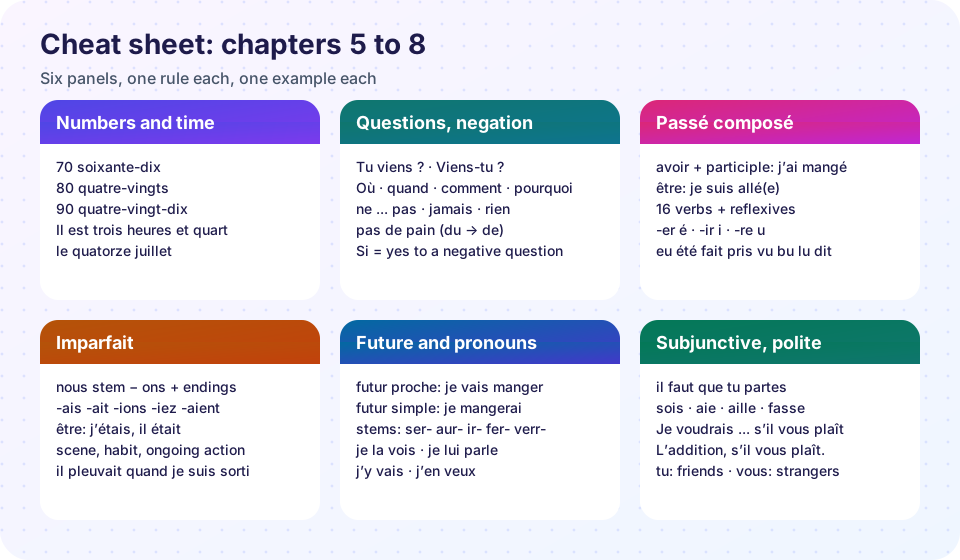
A one-page French cheat sheet for beginners covering numbers, questions, negation, passé composé, imparfait, future, pronouns, subjunctive and polite phrases.
A cheat sheet is not a way to avoid learning; it is a way to see the whole system on one page. Once the pieces are familiar, a single overview shows how they fit together, which is the best state for review the night before a conversation, a trip or a test. Print the picture below, stick it on a wall, or copy the tables into your notebook.
The big picture comes first. After it you will find the same content as compact tables, a Python tool that prints a complete conjugation grid for any regular verb, and a short list of the ten mistakes that cost learners the most.
What you will learn
- See every pattern of Chapters 5 to 8 side by side
- Review the endings of four tenses and moods in one grid
- Recall the most important polite phrases at a glance
- Avoid the ten most common mistakes
Key terms
l'aide-mémoire (m.): the cheat sheet. la terminaison: the ending. le radical: the stem. le déclencheur: the trigger (for the subjunctive). à retenir: to remember.
Numbers, time and questions
| Topic | Remember |
|---|---|
| 70 / 80 / 90 | soixante-dix · quatre-vingts · quatre-vingt-dix |
| et un | 21, 31, 41, 51, 61, 71 (not 81, 91) |
| Time | Il est trois heures et quart / et demie / quatre heures moins le quart |
| Date | le quatorze juillet, le premier mai |
| Age | J'ai vingt ans |
| 3 question forms | Tu viens ? · Est-ce que tu viens ? · Viens-tu ? |
| Question words | qui, que, où, quand, comment, pourquoi, combien, quel |
| Negation | ne ... pas / jamais / plus / rien / personne / que |
| After negation | du / de la / des / un / une → de (not after être) |
Verb endings at a glance
| Form | Rule | je | tu | il | nous | vous | ils |
|---|---|---|---|---|---|---|---|
| Present (-er) | stem + | -e | -es | -e | -ons | -ez | -ent |
| Passé composé | avoir / être + participle | ai | as | a | avons | avez | ont |
| Imparfait | nous stem + | -ais | -ais | -ait | -ions | -iez | -aient |
| Futur simple | infinitive + | -ai | -as | -a | -ons | -ez | -ont |
| Subjonctif | ils stem + | -e | -es | -e | -ions | -iez | -ent |
Participles: -er → é, -ir → i, -re → u; irregular eu, été, fait, pris, vu, bu, lu, écrit, dit, pu, voulu, dû, su. Être verbs: aller, venir, arriver, partir, entrer, sortir, monter, descendre, naître, mourir, rester, tomber, rentrer, retourner, devenir, revenir and all reflexives; they agree with the subject.
Irregular future stems: ser-, aur-, ir-, fer-, pourr-, voudr-, devr-, saur-, viendr-, verr-. Irregular subjunctives: sois, aie, aille, fasse, puisse, sache.
Pronouns and small words
| Job | Forms | Example |
|---|---|---|
| Direct object | me, te, le/la/l', nous, vous, les | Je la vois. Je l'ai vue. |
| Indirect object | me, te, lui, nous, vous, leur | Je lui parle. |
| Place | y | J'y vais. |
| Quantity / de + noun | en | J'en veux deux. |
| Position | before the conjugated verb or the infinitive | Je veux le voir. |
| After an affirmative command | after the verb, with a hyphen | Regarde-le ! |
Polite phrases for travel, food and shops
| Situation | Phrase |
|---|---|
| Ask the way | Excusez-moi, où est la gare ? Pour aller à la poste ? |
| Understand | tout droit · à gauche · à droite · tournez · traversez |
| Order | Je voudrais ... / Je vais prendre ... |
| Pay | L'addition, s'il vous plaît. / Vous acceptez les cartes ? |
| Shop | Combien ça coûte ? Je peux essayer ? Je le prends. |
| Greet | Bonjour (Madame / Monsieur) on entering; Au revoir, bonne journée on leaving |
| Register | tu friends and family; vous strangers, elders, staff, groups |
The ten mistakes to avoid
- Je suis vingt ans → J'ai vingt ans.
- J'ai allé → Je suis allé(e).
- Je ne mange pas du pain → de pain.
- Je ne vois pas personne → Je ne vois personne.
- Si tu viendras → Si tu viens.
- Quand je suis grand (future meaning) → Quand je serai grand.
- Je vois la → Je la vois.
- Je le parle (to him) → Je lui parle.
- J'espère que tu viennes → J'espère que tu viendras.
- Je veux un café (to a server) → Je voudrais un café, s'il vous plaît.
How to use this page. Cover the right-hand side of a table and try to produce it from memory. Anything you miss goes on tomorrow's flashcards. Ten minutes on one panel per day is more useful than an hour on the whole sheet.
How the pieces relate
The tables above look like many separate things, but they come from only a few sources. The infinitive gives you the future (parler becomes parlerai). The nous form of the present gives you the imparfait (nous parlons becomes je parlais). The ils form of the present gives you the subjunctive (ils parlent becomes que je parle), and the past participle gives you the passé composé with avoir or être. Once you know the present tense of a verb, you can usually build all the other forms, so the most valuable thing to memorize is the present of the most common irregular verbs.
The endings also repeat. The -ons and -ez of nous and vous appear in the present and the future, and as -ions and -iez in the imparfait and the subjunctive. The future endings are the present of avoir, and the passé composé uses that same avoir. Seeing the repetition turns a pile of facts into a small system: a handful of sources, a handful of endings, and a few irregular stems.
Try it
This Python tool prints the complete grid for a regular -er, -ir or -re verb: present, passé composé, imparfait, futur simple and subjunctive. Change the verb and compare how the endings line up.
Press Run (or Ctrl + Enter) to see the result here.
Program input · what you'd type while the program runs
Type the answers before you press Run, one per line. Each time the program reads a line (with input()), it gets the next line from this box.
Check your understanding
Quick check · 4 questions
of 4 answered You scored / 4 · perfect!
-
1. Which ending set belongs to the imparfait?
The imparfait takes -ais, -ais, -ait, -ions, -iez, -aient. The first set is the futur simple, the third the subjunctive. -
2. Which sentence is correct?
Si + present + future. -
3. Where does the object pronoun go in 'Je veux ___ voir' (him)?
The pronoun goes directly before the infinitive it belongs to: je veux le voir. -
4. Which is the polite way to order a coffee?
Je voudrais plus s'il vous plaît is polite.
Summary
- The four forms to compare: imparfait -ais, futur -ai, subjunctive -e, passé composé with avoir/être.
- Pronouns go before the verb; y and en follow the same rule.
- Learn the ten classic mistakes and check your own writing against them.
- One panel a day, ten minutes, beats a long review once a month.
Next: Further study
Track your progress
Create a free account to tick off lessons and pick up where you left off on any device.
of French for Beginners lessons completed