


















Lesson 43 of 48 · Conversation and Culture
Chapter 8 Review: Conversation and Culture
Review French directions, tickets, restaurants, shopping, tu and vous, greetings and the Francophone world, with a summary picture and a ten-question quiz.
This chapter was about using French with people. You have handled directions, trains, restaurants, shops and the choice between tu and vous, and you have learned that French is a worldwide language with many accents. Before the final projects, use this review to check that the phrases are ready in your head and your mouth.
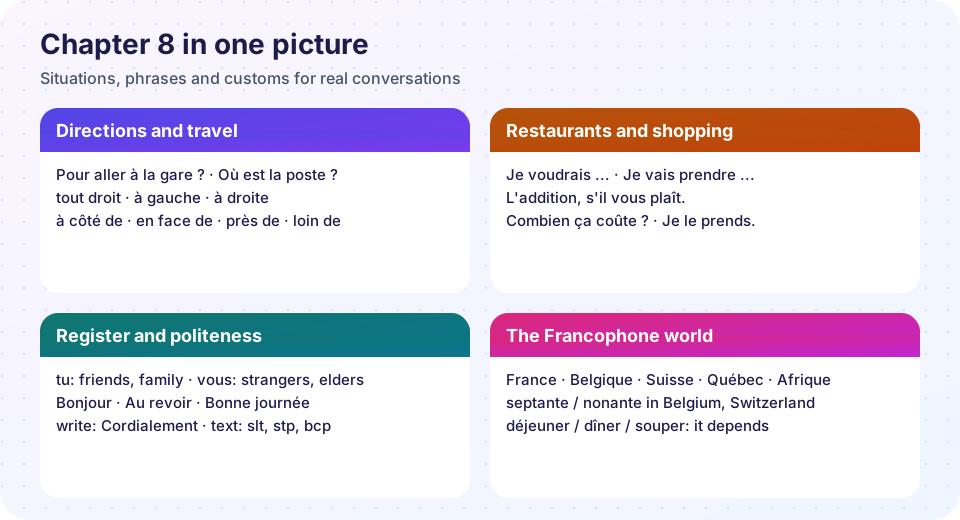
What you will learn
- Which situations and phrases from Chapter 8 are secure
- How to combine them in a mini role play
- The cultural habits to keep in mind in real conversations
Recap table
| Area | Key phrases | Remember |
|---|---|---|
| Asking the way | Où est la gare ? Pour aller à la poste ? | Excusez-moi first |
| Understanding directions | tout droit, à gauche, à droite, tournez, traversez | commands use vous |
| Places | à côté de, en face de, près de, loin de | au, aux, du, des fuse |
| Trains | un aller simple, un aller-retour, le quai, la voie | à quelle heure part le train ? |
| Restaurants | Je voudrais ..., Je vais prendre ..., L'addition, s'il vous plaît | une entrée = starter |
| Shopping | Combien ça coûte ? Je peux essayer ? Je le prends. | greet on entering |
| Quantities | un kilo de, cent grammes de | de without article |
| Register | tu friends, vous strangers and groups | when in doubt, vous |
| Greetings | Bonjour, Bonsoir, Au revoir, Bonne journée | la bise only for friends |
| Francophonie | septante, nonante, souper, dépanneur | many countries, many accents |
Mini role play
Try this scenario out loud, then write your own version. You arrive in Lyon and you need to buy a ticket, find a café and order lunch.
- At the station: Bonjour, un aller simple pour Paris, s'il vous plaît. À quelle heure part le prochain train ?
- In the street: Excusez-moi, où est un café, s'il vous plaît ? — Allez tout droit, puis tournez à gauche.
- In the café: Bonjour. Une table pour une personne. Je voudrais un café et un croissant. L'addition, s'il vous plaît.
- Leaving: Merci, au revoir, bonne journée !
Add one detail each time. Change the city, the price, the time or the drink, and say the scene again. Small changes force your brain to build sentences instead of replaying memory.
Worked examples
Three short exchanges, analyzed.
- Excusez-moi, pour aller à la gare, s'il vous plaît ? (Excuse me, how do I get to the station, please?) The sentence starts with the polite attention-getter Excusez-moi, uses the fixed pattern pour aller à ... and ends with s'il vous plaît. It is a vous sentence, which is right for a stranger. If the other person gives directions quickly, you can ask Pouvez-vous répéter, s'il vous plaît ?
- Je vais prendre le menu à vingt-deux euros. Vous acceptez les cartes ? (I'll have the 22-euro set menu. Do you accept cards?) Je vais prendre is as polite as je voudrais in a restaurant, and the second sentence uses intonation, the casual question pattern, but with vous, which keeps the register respectful. Registers can mix like this.
- Tu peux m'aider ? versus Vous pouvez m'aider ? (Can you help me?) These mean the same thing but belong to different relationships: the first to friends and classmates, the second to strangers and staff. The same applies to s'il te plaît and s'il vous plaît.
Practice saying each version aloud, because register lives in your mouth as much as on paper.
Try it
A mixed gap-fill for the chapter.
And flashcards for the vocabulary.
Check your understanding
Quick check · 10 questions
of 10 answered You scored / 10 · perfect!
-
1. How do you politely ask where the station is?
Excusez-moi followed by Où est la gare, s'il vous plaît ? is polite and natural. -
2. What is 'à + le musée'?
À and le fuse into au. -
3. Which verb form do you hear in 'Tournez à gauche' and why?
Directions to strangers use the vous command form. -
4. What is 'une entrée' on a French menu?
Une entrée is a starter. The main course is le plat. -
5. How do you say 'a kilo of apples'?
After a quantity word, use de without an article. -
6. Which is the polite way to order?
Je voudrais is polite; je veux and donne-moi are blunt. -
7. Whom do you address with 'vous'?
Vous is for strangers, elders, staff and for groups. -
8. What does 'actuellement' mean?
It means currently. It is a false friend. -
9. In Belgium and Switzerland, what is 'septante'?
Septante is 70 (and nonante is 90). -
10. Which closing fits a formal email?
Cordialement is neutral-formal; Bises and À plus are for friends.
Summary
- Directions use vous commands; au, aux, du, des appear with places.
- Order with Je voudrais ..., remember une entrée is a starter, and greet the staff.
- Choose tu or vous with care; when in doubt use vous.
- French is global: many countries, many small differences, one shared core.
- Next, Chapter 9 brings everything together in projects, a practice set, a glossary and a cheat sheet.
Track your progress
Create a free account to tick off lessons and pick up where you left off on any device.
of French for Beginners lessons completed