


















Lesson 17 of 48 · Present Tense Verbs
Chapter 4 overview: Present Tense Verbs
Preview chapter 4 of French for Beginners: how French verbs are built, the subject pronouns, the three regular verb families and the key irregular verbs, with a first dialogue.
Verbs are the engine of a sentence, and in French they change their endings according to who is acting. In English the verb hardly changes: "I speak, you speak, we speak, they speak", with only "he speaks" different. In French the same verb has up to six different forms in the present tense: je parle, tu parles, il parle, nous parlons, vous parlez, ils parlent. Once you know how those endings work, you can build thousands of sentences, because most verbs follow a few patterns.
Chapter 4 is the heart of beginner French. It teaches the present tense, which does the work of both "I speak" and "I am speaking". By the end you will be able to say what you do, what you have, what you are, where you are going, and what you are not doing.
What you will learn
- How French verbs are built from a stem and an ending.
- The subject pronouns and the three regular verb families.
- Which irregular verbs you cannot avoid.
- What each lesson in this chapter covers.
Key terms
Infinitive is the dictionary form of a verb: parler ("to speak").
Conjugation is the set of forms a verb takes for each subject.
Stem is the infinitive without its ending: parl-. Ending is what you add: -e, -es, -ent.
Subject pronoun replaces the subject: je, tu, il, elle, on, nous, vous, ils, elles.
Irregular verb is one that does not follow a regular pattern, such as être and aller.
The shape of a French verb
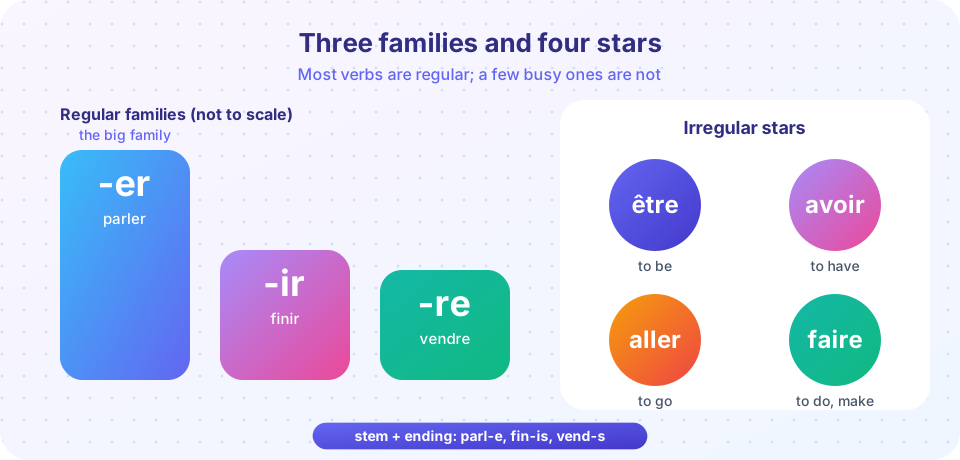
Every French verb has an infinitive that ends in -er, -ir or -re (a few end in -oir). To conjugate a regular verb, remove the ending to find the stem, then add the present tense endings.
| Infinitive | Stem | je | tu | il / elle / on | nous | vous | ils / elles |
|---|---|---|---|---|---|---|---|
| parler (to speak) | parl- | parle | parles | parle | parlons | parlez | parlent |
| finir (to finish) | fin- | finis | finis | finit | finissons | finissez | finissent |
| vendre (to sell) | vend- | vends | vends | vend | vendons | vendez | vendent |
You do not need to memorize these now; each is the subject of a lesson. The point is that there are only three big patterns. More than ninety percent of French verbs are regular -er verbs, so learning that one pattern gets you very far. New verbs entering French, such as googler or liker, always follow the -er pattern.
The subject pronouns
| Singular | Plural |
|---|---|
| je (I) | nous (we) |
| tu (you, informal) | vous (you, formal or plural) |
| il (he, it), elle (she, it), on (one, we, people) | ils (they, masculine or mixed), elles (they, feminine) |
The pronoun on deserves attention. In careful writing it means "one" (On ne sait jamais, "You never know"), but in everyday speech it is the usual way to say "we": On mange ensemble ? ("Shall we eat together?"). It takes the same verb form as il and elle. Notice that ils means "they" for a group of men or a mixed group, and elles only for a group of women. Also note that tu and vous carry the same choice of formality you learned in chapter 2.
Present tense meaning
The French present tense covers three English forms:
- Je parle français. I speak French. / I am speaking French. / I do speak French.
- Il mange. He eats. / He is eating.
- Nous habitons à Lyon. We live in Lyon.
There is no separate "-ing" form, so Je mange can mean "I eat" or "I am eating". To stress an action in progress, say Je suis en train de manger ("I'm in the middle of eating").
Chapter 4 at a glance
- Être and avoir (Être and avoir): the two most important verbs, used on their own and later as helpers; identity, age, feelings, il y a.
- Regular -er verbs (Regular -er verbs): the biggest family and its spelling changes.
- Regular -ir and -re verbs (Regular -ir and -re verbs): finir, choisir, vendre, attendre and their patterns.
- Key irregular verbs (Key irregular verbs): aller, faire, prendre, venir, pouvoir, vouloir.
- Negation (Saying no): ne ... pas and its relatives.
- Review (Chapter 4 review): a one-page summary and a long quiz.
Who is acting?
Three families
The stars
Saying no
A first dialogue
Sarah meets a colleague, Jean, in the office kitchen. Every verb is in the present tense.
| Français | English |
|---|---|
| Bonjour Jean, tu travailles ici ? | Hello Jean, do you work here? |
| Oui, je travaille au troisième étage. Et toi ? | Yes, I work on the third floor. And you? |
| Je suis nouvelle. J'habite à Lyon avec mon mari. | I'm new. I live in Lyon with my husband. |
| Tu parles français ? | Do you speak French? |
| Un peu. J'étudie le français le soir. | A little. I study French in the evening. |
| Moi, je ne parle pas bien anglais ! | Me, I don't speak English well! |
Spot the verbs: travailles (tu), travaille (je), suis (être), habite (j'), parles (tu), étudie, ne parle pas. You will be able to build all of these by the end of the chapter.
How to practice
Learn verbs in full phrases, not as lists of endings. Je parle français, tu parles anglais, nous parlons ensemble teaches more than parle, parles, parle. Say the whole conjugation aloud, but notice the pattern of sounds: in the -er family four of the six forms sound identical, so the spoken language is easier than the written one. Make a verb card each day, with the infinitive and a sample sentence, and use the conjugators on this site to check your forms.
Learning verbs efficiently
Language frequency studies show that a small number of verbs account for a large share of everyday speech. Être, avoir, aller, faire, pouvoir, vouloir, savoir, voir, venir and dire are among the most frequent verbs in French, so every minute you invest in them pays off quickly. This chapter follows that logic: it starts with être and avoir, then the big regular family, then the smaller families, then the other frequent irregular verbs. When you learn a new verb, always learn it in a sentence you might actually say. Je prends le train à huit heures sticks better than the bare form prends, because the sentence gives your brain a story to attach the form to.
Common misconceptions
"I must memorize six forms for every verb." For regular verbs you learn a pattern once, then apply it. Irregular verbs need individual learning, but there are not many common ones.
"The present tense is just 'I do'." It also covers "I am doing", and French often uses it for the near future in speech too.
"Je always shortens to j'." Je shortens only before a vowel or mute h: j'aime, j'habite, but je parle, je mange.
Try it
Learn the six subject pronouns, with the pronunciation reminders, as cards.
Now try a simple conjugator. This Python helper builds the present tense of any regular -er verb from its infinitive. We shall refine it in the next lessons, adding spelling changes.
Press Run (or Ctrl + Enter) to see the result here.
Program input · what you'd type while the program runs
Type the answers before you press Run, one per line. Each time the program reads a line (with input()), it gets the next line from this box.
Check your understanding
Quick check · 4 questions
of 4 answered You scored / 4 · perfect!
-
1. How do you find the stem of the verb parler?
The stem is the infinitive without -er; endings are added to it. -
2. What does on mean in everyday speech?
In everyday French, on is the usual way to say we, with the il/elle verb form. -
3. What does 'Je mange' mean?
The French present covers both English present forms. -
4. Which verb family is the largest?
The vast majority of French verbs end in -er.
Summary
- A French verb has an infinitive ending in -er, -ir or -re; remove the ending to find the stem and add the present endings.
- The subject pronouns are je, tu, il, elle, on, nous, vous, ils, elles; on is the everyday "we".
- The present tense covers "I speak" and "I am speaking".
- Most verbs are regular -er verbs; the few irregular stars (être, avoir, aller, faire) must be learned individually.
Next: Être and avoir
Track your progress
Create a free account to tick off lessons and pick up where you left off on any device.
of French for Beginners lessons completed