


















Lesson 14 of 48 · Nouns, Articles and Adjectives
Adjectives: agreement and position
Learn how French adjectives agree in gender and number, the regular and irregular feminine forms, the plural rules, and where adjectives go in the sentence, including BAGS.
An adjective describes a noun: a big house, a red car, a very good idea. In English adjectives never change and nearly always come before the noun. In French they do the opposite: they change form to agree with the noun, and most of them come after it. A "small cat" is un petit chat, but a "small house" is une petite maison and "small cats" are des petits chats. The "red car" is la voiture rouge, with rouge after the noun.
This lesson explains the three things you need to describe the world in French: how to make an adjective feminine, how to make it plural, and where to put it. You will also learn a handy mnemonic, BAGS, and see how the position of some adjectives changes their meaning.
What you will learn
- How adjectives agree in gender and number.
- Regular and irregular feminine forms.
- Plural forms, including -x and -aux.
- Where adjectives go, with BAGS and meaning changes.
Key terms
Agreement (accord): an adjective takes the gender and number of its noun.
Invariable adjective: one that does not change, such as many color words made from nouns (orange, marron).
BAGS: Beauty, Age, Goodness, Size, the groups of adjectives that usually precede the noun.
Predicate adjective: an adjective after être: La maison est grande. It also agrees.
Basic agreement
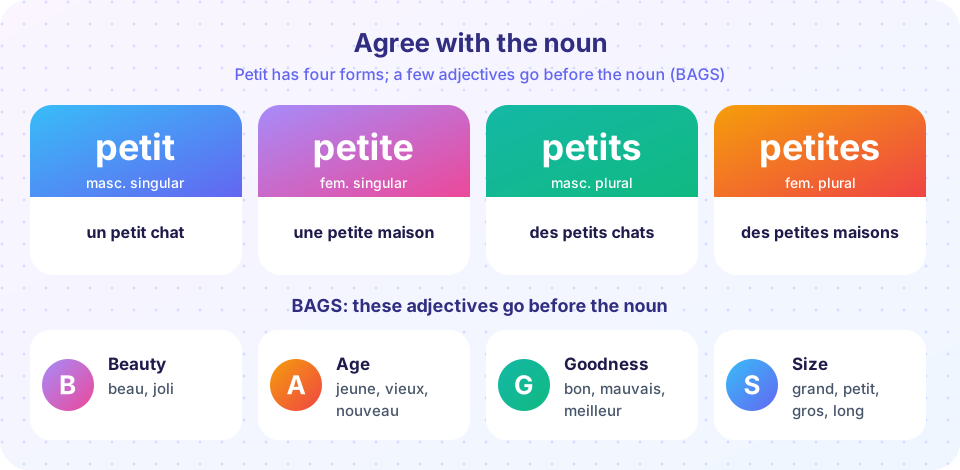
Take the adjective petit (small). The base form is masculine singular. Then:
| Singular | Plural | |
|---|---|---|
| Masculine | petit | petits |
| Feminine | petite | petites |
So we say un petit chat, une petite maison, des petits chats, des petites maisons. The adjective also agrees when it follows être: Le chat est petit, La maison est petite, Les chats sont petits, Les maisons sont petites. When an adjective describes a mixed group, the masculine plural wins: Marie et Paul sont contents.
In speech you often hear the feminine, because the added -e makes the previous consonant pronounced: petit /pəti/ versus petite /pətit/, grand /ɡʁɑ̃/ versus grande /ɡʁɑ̃d/, vert /vɛʁ/ versus verte /vɛʁt/, gris /ɡʁi/ versus grise /ɡʁiz/. The plural -s is silent, so petit and petits sound the same.
Feminine forms
Rule 1: add -e. Most adjectives: grand/grande, petit/petite, content/contente, fort/forte, français/française.
Rule 2: adjectives already ending in -e do not change. Rouge, jeune, triste, facile, riche, simple, timide are the same for both genders: un livre rouge, une robe rouge.
Rule 3: some endings change.
| Masculine ending | Feminine ending | Examples |
|---|---|---|
| -eux | -euse | heureux / heureuse, sérieux / sérieuse |
| -if | -ive | actif / active, sportif / sportive |
| -er | -ère | cher / chère, premier / première |
| -eur | -euse | menteur / menteuse |
| -teur | -trice | créateur / créatrice |
| -on, -en, -el | -onne, -enne, -elle | bon / bonne, ancien / ancienne, cruel / cruelle |
| -et | -ette (or -ète) | muet / muette, but complet / complète |
| -s | -sse | gros / grosse, bas / basse |
Rule 4: irregular but common.
| Masculine | Feminine | Meaning |
|---|---|---|
| blanc | blanche | white |
| long | longue | long |
| doux | douce | soft, gentle |
| frais | fraîche | fresh, cool |
| sec | sèche | dry |
| gentil | gentille | kind |
| public | publique | public |
| beau (bel) | belle | beautiful |
| nouveau (nouvel) | nouvelle | new |
| vieux (vieil) | vieille | old |
Three adjectives have an extra masculine form used before a vowel sound: bel, nouvel, vieil: un bel homme, un nouvel ami, un vieil arbre. This is the same logic as ce becoming cet (next lesson).
Plural forms
Add -s to the singular: petit, petits; grande, grandes. Adjectives that already end in -s or -x do not change: un gros chat, des gros chats; un homme heureux, des hommes heureux. Adjectives in -eau take -x: beau, beaux; nouveau, nouveaux. Adjectives in -al change to -aux: national, nationaux; original, originaux. A few in -al, such as final and fatal, take -s in the plural (finals, fatals). When you are not sure, add -s and check.
Color adjectives
Colors are adjectives: une voiture rouge, des livres bleus. Basic colors agree: vert/verte, gris/grise, noir/noire, blanc/blanche, jaune, rouge, bleu/bleue, violet/violette, rose. But adjectives made from nouns, such as orange, marron (chestnut) and citron, are invariable: des chaussures marron, des pulls orange. When two words describe a color, the whole phrase is invariable: des yeux bleu clair, une robe vert foncé.
Position of adjectives
Most adjectives go after the noun: colors, nationalities, shapes, and most longer adjectives: une voiture rouge, un étudiant américain, une table ronde, un film intéressant.
A small group of common, short adjectives go before the noun. The mnemonic BAGS helps:
| Group | Examples |
|---|---|
| Beauty | beau, joli |
| Age | jeune, vieux, nouveau |
| Goodness | bon, mauvais, meilleur |
| Size | grand, petit, gros, long |
So we say un beau jardin, une jolie robe, un jeune homme, une vieille maison, un bon repas, une grande ville, un petit café. Other adjectives that usually go before: autre (other), même (same), premier (first) and dernier (last). BAGS is a tendency, not a law, and you can place many of these adjectives after the noun for emphasis or in formal writing.
Position can change the meaning
| Before the noun | After the noun |
|---|---|
| un grand homme (a great man) | un homme grand (a tall man) |
| un ancien élève (a former pupil) | un bâtiment ancien (an old building) |
| un pauvre homme (an unfortunate man) | un homme pauvre (a man without money) |
| mon cher ami (my dear friend) | un livre cher (an expensive book) |
| ma propre chambre (my own room) | ma chambre propre (my clean room) |
In formal writing, when an adjective comes before a plural noun, des becomes de: de jolies fleurs, de beaux jours. In everyday speech most people say des jolies fleurs.
Putting it together: describing a person and a room
Here is a short portrait that uses most of the rules above. Read it slowly and check each adjective against its noun.
Marie est grande et mince. Elle a de longs cheveux bruns et de grands yeux verts. C'est une jeune femme sportive et très gentille. Sa petite maison est blanche, avec des volets bleus et un jardin fleuri.
In English: "Marie is tall and slim. She has long brown hair and big green eyes. She is a young, sporty and very kind woman. Her small house is white, with blue shutters and a flowery garden." Notice how the adjectives behave. Grande and mince describe Marie after est, so they agree with a feminine subject (mince does not change). Longs and grands come before the plural masculine nouns cheveux and yeux, and de replaces des in careful writing. Bruns and verts follow the nouns and take the masculine plural. Une jeune femme has jeune before the noun (Age), and sportive and gentille come after, in the feminine. In sa petite maison, petite sits between the possessive and the noun, and blanche is the feminine of blanc. Every adjective follows the pattern, and you could now write a description of your own in the same style.
Common misconceptions
"The adjective agrees with the speaker or the owner." It agrees with the noun it describes. Un ami a une voiture rouge: rouge describes the car, and ends with a silent e in both genders.
"All adjectives go after the noun." The BAGS group goes before: une grande maison, not une maison grande (though that may appear in careful style).
"Adding -e is always enough for the feminine." Many endings change (heureuse, active, bonne, blanche), so learn the patterns.
Try it
This helper applies the agreement rules to a list of adjectives. It uses the regular patterns and the irregular table above, so it is a good way to study them. Change the list and see what it produces.
Press Run (or Ctrl + Enter) to see the result here.
Program input · what you'd type while the program runs
Type the answers before you press Run, one per line. Each time the program reads a line (with input()), it gets the next line from this box.
Now add the adjective yourself. Choose the right form of the adjective in brackets.
Finally, learn useful opposites as cards. Remember to use the right form with a feminine noun.
Check your understanding
Quick check · 5 questions
of 5 answered You scored / 5 · perfect!
-
1. What is the feminine of heureux?
Adjectives in -eux become -euse in the feminine. -
2. Which sentence is correct?
Colors follow the noun, and rouge does not change in the feminine. -
3. What does 'un homme grand' mean?
After the noun, grand means tall; before it (un grand homme), it means great. -
4. Which is the correct form before a vowel for 'new'?
Nouveau becomes nouvel before a vowel sound, like beau becomes bel. -
5. What is the plural of national?
Adjectives in -al usually change to -aux.
Summary
- Adjectives agree in gender and number with their noun and with être.
- Feminine: usually add -e; no change if it ends in -e; patterns -euse, -ive, -ère, -onne, plus irregulars like blanche, belle.
- Plural: add -s; no change after -s/-x; -eau gives -eaux and -al gives -aux.
- Most adjectives follow the noun; BAGS adjectives go before it; some change meaning with position.
Track your progress
Create a free account to tick off lessons and pick up where you left off on any device.
of French for Beginners lessons completed