


















Lesson 8 of 48 · Sounds, Greetings and Basics
Greetings, politeness and introductions
Learn essential French greetings, polite phrases, the difference between tu and vous, and how to introduce yourself with your name, nationality and home town.
The first thing you say in French matters more than almost anything else. In France and in most French-speaking countries, a greeting is not a small extra: it is the entrance ticket to every interaction. Walk into a shop and say nothing, and you will feel the temperature drop; say Bonjour first, and the same assistant is helpful. This lesson gives you the greetings for every time of day, the polite phrases that smooth every request, the choice between tu and vous, and the sentences you need to introduce yourself.
All of it is made of whole phrases you can learn as chunks. The grammar behind je m'appelle and je suis comes later, in chapter 4, so for now treat them as ready-made pieces you can plug names and places into.
What you will learn
- Greetings and goodbyes for different times of day and levels of formality.
- When to use tu and when to use vous.
- Polite phrases: please, thank you, excuse me, you are welcome.
- How to give your name, nationality, age, and where you live and come from.
Key terms
Tutoiement is using tu; vouvoiement is using vous. The verbs are tutoyer and vouvoyer.
La bise is the light cheek kiss friends and family give in greeting.
Register is how formal or casual your language is.
Enchanté(e) means "delighted" and is said when you meet someone; the final e is added if you are a woman.
Greetings and goodbyes
| Situation | French | Notes |
|---|---|---|
| Hello (day) | Bonjour | Standard from morning until evening; formal and informal |
| Good evening | Bonsoir | Used from about the late afternoon on, when you meet |
| Hi / bye (casual) | Salut | Friends and young people; means both hello and goodbye |
| Very casual hi | Coucou | Friends, family, messages |
| Goodbye | Au revoir | Standard, for any situation |
| See you soon | À bientôt | |
| See you tomorrow | À demain | |
| See you later (casual) | À plus tard, À plus | À plus is very casual |
| Good night | Bonne nuit | Only when parting for the night or going to sleep |
| Have a good day / evening | Bonne journée / Bonne soirée | Said as a goodbye, often by shop staff |
Two points trip up beginners. First, Bonjour is not only "good morning"; it works all day, and Bonsoir takes over once evening starts. Second, Bonne nuit is not a greeting at night; it is a wish for good sleep. If you meet someone at 9 p.m., say Bonsoir, not Bonne nuit.
When entering a small shop, café or doctor's waiting room, a quick Bonjour (and Bonjour, madame or monsieur if you like) is expected. When leaving, say Merci, au revoir or Bonne journée. Doing this alone makes French people far more welcoming.
Polite phrases
| English | French |
|---|---|
| Please | S'il vous plaît (formal) / s'il te plaît (informal) |
| Thank you | Merci |
| Thank you very much | Merci beaucoup |
| You are welcome | De rien (casual) / Je vous en prie (formal) |
| Excuse me | Excusez-moi (formal) / Excuse-moi (informal) / Pardon |
| Sorry | Désolé (man) / Désolée (woman) |
| Yes / No | Oui / Non |
| Of course | Bien sûr |
| I do not understand | Je ne comprends pas |
| Can you repeat, please? | Vous pouvez répéter, s'il vous plaît ? |
Notice that s'il vous plaît is literally "if it pleases you" (s'il is si il with elision, as you learned). The polite vous version is the safe default with strangers.
Tu or vous?
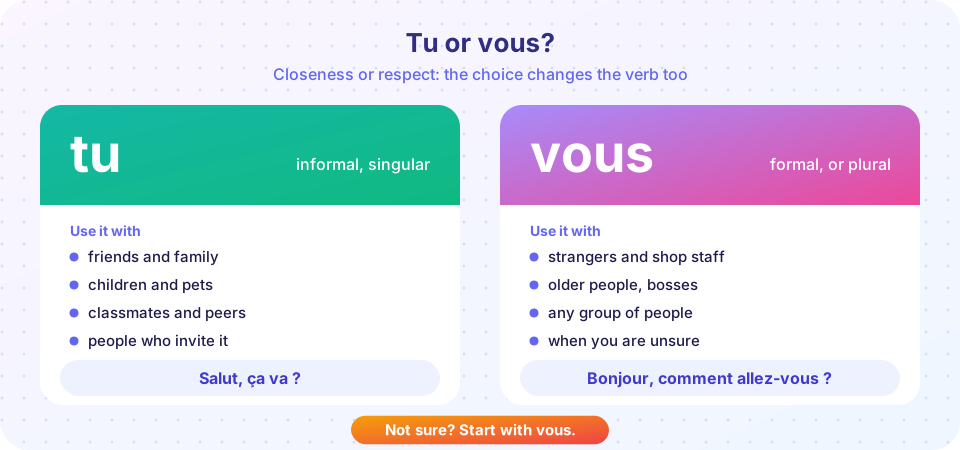
French has two words for "you". Tu is singular and informal: use it with friends, family, children, classmates and, in many places, colleagues of your own age. Vous is formal singular (a stranger, an older person, a customer, a boss, a teacher) and also the plural for any group, formal or informal. If you talk to your two friends, they are vous as a group, even though each one individually is tu.
The choice affects the verb: Tu parles but vous parlez. It also affects phrases:
| Informal (tu) | Formal (vous) |
|---|---|
| Salut, ça va ? | Bonjour, comment allez-vous ? |
| Comment tu t'appelles ? | Comment vous appelez-vous ? |
| Merci, à bientôt. | Je vous remercie, à bientôt. |
When in doubt, start with vous. Switching to tu is a step in a relationship: the older or more senior person usually proposes it with a phrase like On peut se tutoyer ? ("Can we use tu with each other?") or simply starts using tu. Rules vary by country and context. In Quebec, many people use tu more readily; in French workplaces and shops, vous remains the norm; in young groups and online, tu is common. Treat these as tendencies and follow the lead of the people around you.
How are you? and the answers
The question Ça va ? (how's it going?) is casual and works with tu. More formal: Comment allez-vous ? ("How are you?"), or informal Comment vas-tu ? Answers:
- Ça va bien, merci. Et toi ? (I'm fine, thanks. And you?)
- Très bien, merci. (Very well, thanks.)
- Comme ci, comme ça. (So-so.)
- Pas mal. (Not bad.)
- Pas très bien. (Not very well.)
In a formal setting, return the question with Et vous ?; with a friend, Et toi ?. Note that when French people say Ça va ? in passing, they often only want a short answer, not a health report.
La bise and handshakes
Friends and family greet with la bise, a light kiss on each cheek, often accompanied by the sound of a kiss. The number of kisses varies by region (two is common in Paris and many other places; some regions use three or four). Strangers, business contacts and the first meeting with a formal person usually involve a handshake (une poignée de main). If you are unsure, offer a handshake and let the other person lead.
Introducing yourself
Here is the set of ready-made phrases:
| English | French |
|---|---|
| My name is Léa. | Je m'appelle Léa. |
| What is your name? | Comment tu t'appelles ? (informal) / Comment vous appelez-vous ? (formal) |
| Nice to meet you. | Enchanté (man) / Enchantée (woman) |
| I am American. | Je suis américain (man) / américaine (woman) |
| I come from London. | Je viens de Londres. |
| I live in Paris. | J'habite à Paris. |
| I am twenty years old. | J'ai vingt ans. |
| And you? | Et toi ? / Et vous ? |
| Me too. | Moi aussi. |
In je m'appelle, notice the elision: me becomes m' before the vowel of appelle. The phrase literally means "I call myself". With cities, use à ("in, at"): à Paris, à Lyon, à Montréal. For countries you will need different words; en France, au Canada, aux États-Unis, which chapter 5 covers.
Nationalities
Nationality adjectives change with the speaker's gender: add e for a woman and sometimes double the consonant. The pronounced consonant is what you hear.
| Masculine | Feminine | Meaning |
|---|---|---|
| français | française | French |
| anglais | anglaise | English |
| américain | américaine | American |
| canadien | canadienne | Canadian |
| allemand | allemande | German |
| espagnol | espagnole | Spanish |
| italien | italienne | Italian |
| chinois | chinoise | Chinese |
| japonais | japonaise | Japanese |
| belge | belge | Belgian |
| suisse | suisse | Swiss |
Notice that adjectives of nationality are written in lowercase: je suis français. (A capital letter appears for the people as a noun: les Français.) Titles: monsieur, madame, mademoiselle (the last is rarely used for adults nowadays, and official forms in France dropped it in 2012).
Two short dialogues
Formal (at a hotel reception):
| Français | English |
|---|---|
| Bonsoir, madame. Vous avez une réservation ? | Good evening, madam. Do you have a booking? |
| Bonsoir. Oui, je m'appelle Claire Martin. | Good evening. Yes, my name is Claire Martin. |
| Merci. Comment ça s'écrit ? | Thank you. How is that spelled? |
| M, a, r, t, i, n. | M, a, r, t, i, n. |
| Parfait. Bienvenue, madame Martin. | Perfect. Welcome, Mrs. Martin. |
Informal (two students):
| Français | English |
|---|---|
| Salut ! Comment tu t'appelles ? | Hi! What's your name? |
| Salut ! Je m'appelle Karim. Et toi ? | Hi! My name is Karim. And you? |
| Moi, c'est Sophie. Tu viens d'où ? | I'm Sophie. Where do you come from? |
| Je viens de Casablanca. Et toi ? | I come from Casablanca. And you? |
| J'habite à Lyon. Enchantée ! | I live in Lyon. Nice to meet you! |
Common misconceptions
"Bonne nuit is the way to say hello at night." It is only said when going to bed or leaving for the night. Use bonsoir when you arrive.
"Tu is rude." It is simply informal. Using it with a stranger or an older person, without being invited, can sound over-familiar, but it is not an insult.
"Mademoiselle is the polite word for any young woman." It is now much less common; madame is the safe choice for adult women.
Try it
First, a greeting picker. Choose the time of day and how formal you want to be, and the helper builds a greeting. This is a model of the typical choices described above.
Press Run (or Ctrl + Enter) to see the result here.
Program input · what you'd type while the program runs
Type the answers before you press Run, one per line. Each time the program reads a line (with input()), it gets the next line from this box.
Second, introduce yourself in French. Choose a name, gender, nationality and city; the page builds your introduction with the correct masculine or feminine form. All the French here is exactly what you have just learned.
Last, match each situation with the right phrase.
Check your understanding
Quick check · 5 questions
of 5 answered You scored / 5 · perfect!
-
1. You arrive at a restaurant at 8 p.m. What do you say?
Bonsoir is the evening greeting; bonne nuit is only for parting at night. -
2. Which word do you use for a single stranger, in a polite conversation?
Vous is formal singular and the plural of you. -
3. How does a woman say 'I am delighted to meet you'?
A woman adds e: enchantée (the sound does not change, but the spelling does). -
4. What does 'Je m'appelle Claire' mean?
Literally 'I call myself Claire', the idiom for My name is Claire. -
5. Which is the feminine form of 'canadien'?
Canadien doubles the n and adds e: canadienne.
Summary
- Always greet: Bonjour by day, Bonsoir in the evening, Salut among friends, Au revoir or À bientôt when leaving.
- Tu is informal singular; vous is formal singular and any plural. Start with vous if unsure.
- Polite chunks: s'il vous plaît, merci, de rien, excusez-moi, pardon.
- Introduce yourself with Je m'appelle..., Je suis..., J'habite à..., Je viens de...; nationality adjectives change with gender.
Next: Numbers from 0 to 100
Track your progress
Create a free account to tick off lessons and pick up where you left off on any device.
of French for Beginners lessons completed