


















Lesson 18 of 48 · Present Tense Verbs
Être and avoir: to be and to have
Learn the two most important French verbs, être (to be) and avoir (to have): present tense forms, pronunciation, identity, age, feelings, il y a and c'est versus il est.
If you could learn only two French verbs, they would be être ("to be") and avoir ("to have"). They appear in almost every conversation, and later they become the helping verbs that build the past tense (j'ai mangé, il est parti). Both are irregular, so there is no shortcut: you simply learn their six forms. But because you will meet them thousands of times, they stick quickly.
In this lesson you will learn their conjugations and pronunciations, the many jobs être does (identity, nationality, jobs, descriptions, place), and the surprising jobs of avoir (age, hunger, thirst, cold, fear). You will also learn il y a, "there is, there are", and the difference between c'est and il est.
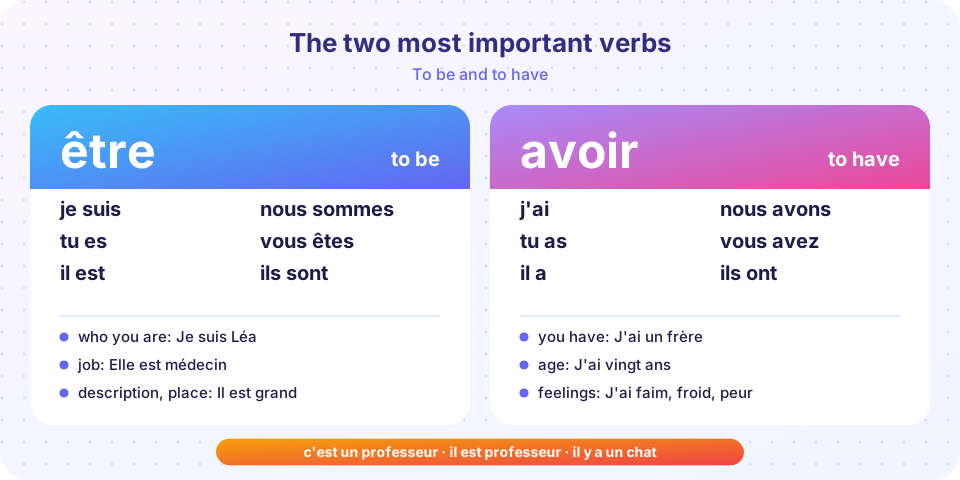
What you will learn
- The present tense of être and avoir, with pronunciation.
- How to use être for identity, nationality, jobs, description and place.
- How to use avoir for possession, age and physical states.
- Il y a, and how to choose between c'est and il/elle est.
Key terms
Copula is a verb that links a subject to a description: être is the main French copula.
Auxiliary (helping) verb is a verb used with another to form a tense; être and avoir serve this role in chapter 6.
Idiom is a fixed expression with its own meaning, like avoir faim ("to be hungry", literally "to have hunger").
Stress pronoun is a strong pronoun like moi and toi, used after c'est.
Être: to be
| Pronoun | Form | Pronunciation | Example |
|---|---|---|---|
| je | suis | /ʒə sɥi/ | Je suis étudiant. |
| tu | es | /ty ɛ/ | Tu es content. |
| il / elle / on | est | /il ɛ/ | Elle est française. |
| nous | sommes | /nu sɔm/ | Nous sommes à Paris. |
| vous | êtes | /vu zɛt/ | Vous êtes professeur. |
| ils / elles | sont | /il sɔ̃/ | Ils sont fatigués. |
Notice that tu es and il est sound the same, /ɛ/, and that vous êtes has a liaison, /vu zɛt/. The form ils sont /il sɔ̃/ has no liaison; compare it with ils ont from avoir, which has a /z/. That pair is the most useful thing to listen for in this lesson.
What être does. It links the subject to a description or identity:
- Identity: Je suis Léa. (I am Léa.)
- Nationality: Nous sommes canadiens. (We are Canadian.)
- Job: Elle est ingénieure. (She is an engineer.) No article after être with a job.
- Description: La maison est grande. The adjective agrees with the subject.
- State: Ils sont contents. (They are happy.)
- Place: Je suis à la maison. (I am at home.) Nous sommes en France.
- Origin: Je suis de Marseille. (I am from Marseille.)
Questions of agreement matter here: Je suis fatigué (a man) and Je suis fatiguée (a woman) differ in spelling, though they sound the same.
Avoir: to have
| Pronoun | Form | Pronunciation | Example |
|---|---|---|---|
| je | ai | /ʒe/ (j'ai) | J'ai un chien. |
| tu | as | /ty a/ | Tu as une voiture. |
| il / elle / on | a | /il a/ | Il a deux frères. |
| nous | avons | /nuz avɔ̃/ | Nous avons du temps. |
| vous | avez | /vuz ave/ | Vous avez des questions ? |
| ils / elles | ont | /ilz ɔ̃/ | Elles ont raison. |
Note the elision j'ai /ʒe/, the liaison in nous avons and vous avez and ils ont, and the fact that il a /ila/ is one flowing sound.
What avoir does.
- Possession: J'ai un frère et deux sœurs.
- Age: J'ai vingt ans. (never je suis vingt ans). Elle a quinze ans.
- Physical states: French speakers "have" many feelings where English "is":
| French | English |
|---|---|
| avoir faim | to be hungry |
| avoir soif | to be thirsty |
| avoir chaud | to be hot (a person) |
| avoir froid | to be cold (a person) |
| avoir sommeil | to be sleepy |
| avoir peur (de) | to be afraid (of) |
| avoir raison | to be right |
| avoir tort | to be wrong |
| avoir besoin de | to need |
| avoir envie de | to feel like, to want |
| avoir mal à | to have a pain in |
For example: J'ai faim, Tu as froid ?, Nous avons peur, Il a besoin d'aide (he needs help), Elle a mal à la tête (she has a headache). Notice that avoir chaud is for a person who feels hot; for an object or a thing, use être chaud: Le café est chaud. Avoid saying Je suis chaud, which has a different meaning.
Il y a: there is, there are
The set phrase il y a (/il i a/) means "there is" or "there are", for both singular and plural: Il y a un chat dans le jardin. Il y a trois chats dans le jardin. It is built from avoir, so it contains the form a. It is also used for time ("ago"): il y a deux ans (two years ago), which chapter 6 will use again. The negative is Il n'y a pas de..., as in Il n'y a pas de pain. Do not confuse il y a ("there is") with voici and voilà ("here is", "there is" as you point).
C'est or il est?
French has two ways to say "it is" or "he is", and learners often mix them up. A simple rule works for most cases:
- Use c'est / ce sont before a determiner + noun (C'est un professeur, Ce sont des amis), before a name (C'est Marie), and before a stress pronoun (C'est moi). Also use c'est to say what something is in general: C'est difficile, C'est bon.
- Use il est / elle est / ils sont / elles sont before an adjective or a bare job or nationality noun to describe a specific person or thing: Il est professeur. Elle est grande. Elles sont françaises.
So: C'est un médecin but Il est médecin; C'est une bonne idée but Elle est bonne, cette idée. When in doubt about a person with a noun that has an article, use c'est.
A short dialogue
| Français | English |
|---|---|
| Tu as faim ? | Are you hungry? |
| Oui, j'ai très faim, et j'ai soif aussi. | Yes, I'm very hungry, and I'm thirsty too. |
| Il y a un petit restaurant près de la gare. | There is a small restaurant near the station. |
| Super ! Mes amis sont déjà là ? | Great! Are my friends there already? |
| Oui, ils sont avec Léa. Elle a vingt-cinq ans aujourd'hui ! | Yes, they're with Léa. She is twenty-five today! |
| C'est son anniversaire ! | It's her birthday! |
Worked contrasts: être or avoir?
The two verbs often sit side by side in similar sentences, and the difference is a useful test of your understanding. Il a vingt ans (age, a thing he has) but Il est grand (a description of what he is). Elle a faim (a feeling she has) but Elle est fatiguée (a state she is in). J'ai un frère (possession) but Je suis le frère de Paul (identity). Nous avons une maison (we own a house) but Nous sommes à la maison (we are at home). When you are unsure, ask whether the sentence describes what someone or something is or what they have, and remember that French treats many feelings as things you have.
Common misconceptions
"I am hungry is Je suis faim." In French, hunger is something you have: J'ai faim. The same is true for thirst, cold, heat, fear, age and sleepiness.
"Ils sont and ils ont sound the same." They do not: ils sont /il sɔ̃/ has no /z/, and ils ont /ilz ɔ̃/ does.
"C'est and il est are interchangeable." C'est introduces something with an article or a name; il est goes with an adjective or a bare profession.
Try it
This Python program prints the full conjugation of être and avoir with correct elision and then builds sentences with the avoir expressions.
Press Run (or Ctrl + Enter) to see the result here.
Program input · what you'd type while the program runs
Type the answers before you press Run, one per line. Each time the program reads a line (with input()), it gets the next line from this box.
Now fill in the correct form of être or avoir.
Finally, learn the avoir expressions as cards.
Check your understanding
Quick check · 5 questions
of 5 answered You scored / 5 · perfect!
-
1. How do you say 'I am 20 years old'?
French uses avoir for age: J'ai vingt ans. -
2. Which sentence is correct for 'They are happy'?
Ils sont is the être form for ils; contents agrees in the plural. -
3. How do you say 'There are three cats'?
Il y a means there is or there are. -
4. Which is correct?
Il est is used with a bare profession; with an article, use c'est: C'est un professeur. -
5. How does 'ils ont' differ from 'ils sont' in sound?
Ils ont /ilz ɔ̃/ has liaison; ils sont /il sɔ̃/ does not.
Summary
- Être: je suis, tu es, il est, nous sommes, vous êtes, ils sont; used for identity, nationality, jobs, descriptions and places.
- Avoir: j'ai, tu as, il a, nous avons, vous avez, ils ont; used for possession, age and physical states (avoir faim, soif, chaud, froid, peur).
- Il y a means there is or there are.
- Use c'est before an article plus a noun or a name; use il est before an adjective or a bare profession.
Next: Regular -er verbs
Track your progress
Create a free account to tick off lessons and pick up where you left off on any device.
of French for Beginners lessons completed