


















Lesson 20 of 48 · Present Tense Verbs
Regular -ir and -re verbs: finir, partir, vendre
Learn the present tense of regular French -ir verbs (finir, choisir), the partir type (partir, dormir), and -re verbs (vendre, attendre), with endings, sounds and a conjugator.
The -er verbs are the big family, but two smaller families complete the regular system: verbs ending in -ir and verbs ending in -re. Together they include many everyday words, such as finir (to finish), choisir (to choose), réussir (to succeed), vendre (to sell), attendre (to wait), répondre (to answer) and perdre (to lose). Each family has its own set of endings, and there is a third, irregular group of -ir verbs like partir and dormir that you should recognize.
The patterns are different from -er, but they are just as regular, and you will see that in these families the plural forms are easier to hear. This lesson gives the endings, the sounds, the common verbs and a first glance at the irregular -re verbs you will meet everywhere.
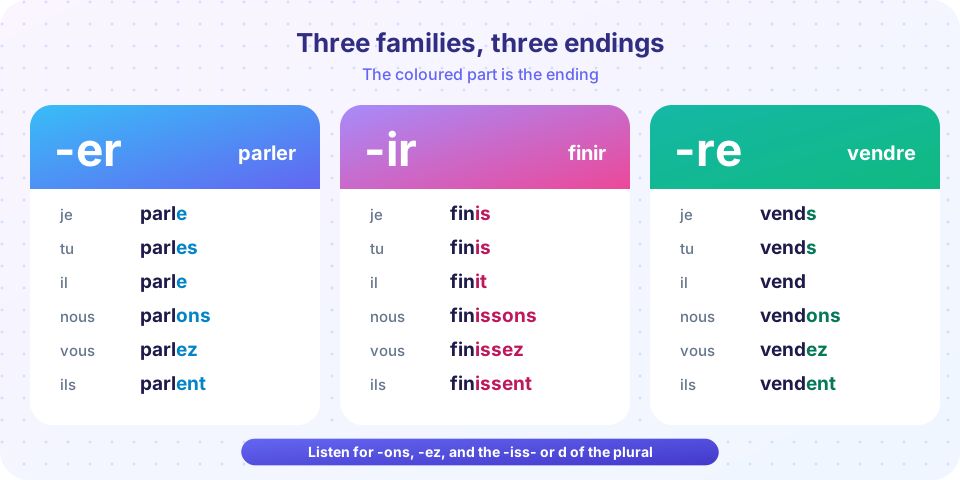
What you will learn
- The endings of regular -ir verbs (-is, -is, -it, -issons, -issez, -issent).
- The endings of the partir type and why it is different.
- The endings of regular -re verbs (-s, -s, -, -ons, -ez, -ent).
- A short list of common irregular -re and -ir verbs to watch.
Key terms
Second-group verbs (-ir verbs with -iss-): finir, choisir. First-group verbs: -er. Third-group verbs: all the others, including irregular ones.
Infix is a piece inserted between stem and ending, here -iss- in nous finissons.
Direct object is the noun receiving the verb's action without a preposition: J'attends le bus.
Regular -ir verbs: finir
Remove -ir and add -is, -is, -it, -issons, -issez, -issent:
| Pronoun | Form | Pronunciation |
|---|---|---|
| je | finis | /ʒə fini/ |
| tu | finis | /ty fini/ |
| il / elle / on | finit | /il fini/ |
| nous | finissons | /nu finisɔ̃/ |
| vous | finissez | /vu finise/ |
| ils / elles | finissent | /il finis/ |
The plural forms insert -iss- before the endings, and this infix is pronounced. That means every form of finir has its own sound, except that je finis, tu finis and il finit sound the same. Note that in ils finissent, the s is pronounced, so unlike -er verbs, you can hear the plural: il finit /il fini/ versus ils finissent /il finis/.
Common regular -ir verbs:
| Verb | Meaning | Verb | Meaning |
|---|---|---|---|
| finir | to finish | grandir | to grow (up) |
| choisir | to choose | grossir | to gain weight |
| réussir | to succeed, to pass | maigrir | to lose weight |
| remplir | to fill | rougir | to blush, to turn red |
| réfléchir | to think, to reflect | obéir (à) | to obey |
| agir | to act | applaudir | to applaud |
Many of these verbs are built from adjectives: grand → grandir, rouge → rougir, maigre → maigrir. Examples: Je finis mon travail. Tu choisis un film ? Nous réussissons l'examen. Ils remplissent les verres.
The partir type: irregular -ir verbs
Many -ir verbs are not like finir. They have no -iss- and use the endings -s, -s, -t, -ons, -ez, -ent, with the last consonant of the stem dropped in the singular:
| Pronoun | partir | sortir | dormir |
|---|---|---|---|
| je | pars | sors | dors |
| tu | pars | sors | dors |
| il / elle / on | part | sort | dort |
| nous | partons | sortons | dormons |
| vous | partez | sortez | dormez |
| ils / elles | partent | sortent | dorment |
So partir (to leave), sortir (to go out), dormir (to sleep), sentir (to feel, to smell), servir (to serve) and mentir (to lie) all follow the same shape: je pars, nous partons. The singular loses a consonant (par-) and the plural keeps the whole stem (part-). This is one pattern that deserves its own memory slot, since these verbs are among the most common in daily life.
Another group, the -ir verbs that behave like -er verbs in the present, includes ouvrir (to open), offrir (to offer), couvrir (to cover) and souffrir (to suffer): j'ouvre, tu ouvres, il ouvre, nous ouvrons, vous ouvrez, ils ouvrent. Watch for them by their endings in -vrir and -frir.
Regular -re verbs: vendre
Remove -re and add -s, -s, (nothing), -ons, -ez, -ent:
| Pronoun | Form | Pronunciation |
|---|---|---|
| je | vends | /ʒə vɑ̃/ |
| tu | vends | /ty vɑ̃/ |
| il / elle / on | vend | /il vɑ̃/ |
| nous | vendons | /nu vɑ̃dɔ̃/ |
| vous | vendez | /vu vɑ̃de/ |
| ils / elles | vendent | /il vɑ̃d/ |
The third person singular has no ending: il vend (not il vendt). The final d is silent in the singular and sounds in the plural vendent /vɑ̃d/. Common regular -re verbs:
| Verb | Meaning |
|---|---|
| vendre | to sell |
| attendre | to wait (for) |
| entendre | to hear |
| répondre (à) | to answer |
| perdre | to lose |
| descendre | to go down, to get off |
| rendre | to give back |
| défendre | to defend, to forbid |
Examples: Je vends ma voiture. Tu attends le bus ? Elle répond à la question. Nous perdons du temps. Ils descendent de l'avion. Notice that attendre needs no preposition for "wait for": J'attends le train, and répondre takes à: Je réponds à Paul.
A first look at irregular verbs ending in -re and -ir
Some very common verbs follow no regular pattern, and you should learn them as separate items. Here are the forms for je, nous and ils:
| Verb | Meaning | je | nous | ils |
|---|---|---|---|---|
| lire | to read | lis | lisons | lisent |
| écrire | to write | écris | écrivons | écrivent |
| dire | to say | dis | disons | disent (vous dites) |
| mettre | to put | mets | mettons | mettent |
| voir | to see | vois | voyons | voient |
| boire | to drink | bois | buvons | boivent |
| savoir | to know (a fact) | sais | savons | savent |
| connaître | to know (a person, place) | connais | connaissons | connaissent |
| vivre | to live | vis | vivons | vivent |
You do not need to memorize these now. Use them as a reference and revisit them in chapters 5 and 6. The next lesson also covers aller, faire, prendre, venir, pouvoir and vouloir in detail.
A short dialogue
| Français | English |
|---|---|
| Tu pars demain ? | Are you leaving tomorrow? |
| Oui, je pars à huit heures. Tu finis ton travail ce soir ? | Yes, I leave at eight. Do you finish your work tonight? |
| Oui, je finis à six heures. Tu attends le bus avec moi ? | Yes, I finish at six. Will you wait for the bus with me? |
| D'accord. Mes amis choisissent un restaurant. | OK. My friends are choosing a restaurant. |
| Super. Nous sortons ensemble ce soir ! | Great. We're going out together tonight! |
Spotting the family from the infinitive
When you meet an unknown verb ending in -ir, ask which of the two groups it belongs to. If the verb comes from an adjective or describes a change of state (grandir, rougir, maigrir, vieillir), it is almost certainly a regular finir-type verb. If it describes movement or the body (partir, sortir, dormir, sentir, servir), it probably follows the partir pattern. A dictionary or conjugation table will confirm, and you will quickly develop a feel. For -re verbs the situation is simpler: most of them are regular and follow vendre, but several very common ones, such as prendre, mettre, dire, lire, écrire, boire, être, faire and vivre, are irregular.
Common traps
Beware of the difference between partir and sortir, which both translate as "to leave" or "to go out". Partir means to leave a place and usually mentions the destination or origin (Je pars de Paris, je pars pour Rome). Sortir means to go out of an enclosed space, or to go out socially (Je sors de la maison, Nous sortons ce soir). Another trap is attendre, which looks like "to attend" but means "to wait for". And répondre needs à before a person or question: Je réponds à Marie, Il répond à la question.
Hearing the plural
One of the pleasant surprises of these families is that the plural becomes audible. In -er verbs, il parle and ils parlent sound identical. In finir the plural ils finissent /il finis/ differs from il finit /il fini/, and in vendre the plural ils vendent /il vɑ̃d/ differs from il vend /il vɑ̃/. Listen for that final consonant, and you will know at once whether a speaker is talking about one person or several.
Common misconceptions
"All -ir verbs take -iss-." Only the regular finir type does. Partir, sortir and dormir do not.
"Il vend is spelled il vendt." The third person singular of -re verbs has no ending at all: il vend, il attend.
"Attendre means to attend." It means "to wait (for)". "To attend" is assister à.
Try it
This Python helper conjugates all three families from the infinitive, and recognizes the partir type from a short list. Edit the verb list to try your own.
Press Run (or Ctrl + Enter) to see the result here.
Program input · what you'd type while the program runs
Type the answers before you press Run, one per line. Each time the program reads a line (with input()), it gets the next line from this box.
Now conjugate the verbs yourself.
Finally, learn the key verbs as cards.
Check your understanding
Quick check · 5 questions
of 5 answered You scored / 5 · perfect!
-
1. What is 'we choose' in French?
Regular -ir verbs insert -iss- in the plural: nous choisissons. -
2. What is the third person singular of vendre?
-re verbs have no ending in the third person singular: il vend. -
3. Which verb does NOT take -iss-?
Partir belongs to the irregular partir type: je pars, nous partons. -
4. How do you say 'I wait for the bus'?
Attendre takes a direct object, without a preposition. -
5. What is the form of dormir for 'je'?
Partir-type verbs drop the last stem consonant in the singular: dors.
Summary
- Regular -ir verbs: -is, -is, -it, -issons, -issez, -issent (finir, choisir, réussir).
- Partir-type verbs: -s, -s, -t, -ons, -ez, -ent with a shorter stem in the singular (je pars, nous partons).
- Regular -re verbs: -s, -s, -, -ons, -ez, -ent (vendre, attendre, répondre).
- Many common verbs (lire, écrire, dire, voir, boire, savoir) are irregular and learned individually.
Next: Key irregular verbs
Track your progress
Create a free account to tick off lessons and pick up where you left off on any device.
of French for Beginners lessons completed