


















Lesson 21 of 48 · Present Tense Verbs
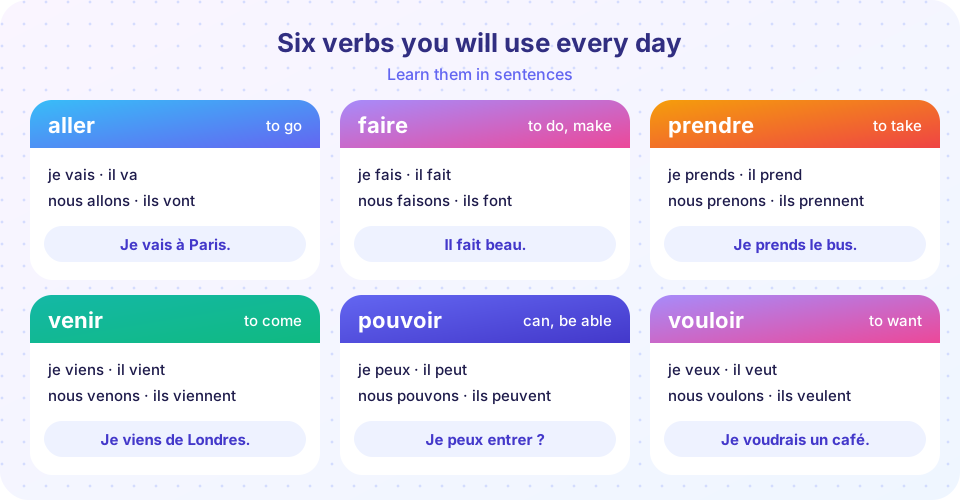
Key irregular verbs: aller, faire, prendre, venir, pouvoir, vouloir
Learn the present tense of the key irregular French verbs aller, faire, prendre, venir, pouvoir, vouloir and devoir, with their uses, weather phrases, modals and the near future.
Irregular verbs are the verbs that do not follow the neat patterns of the previous lessons. The good news is that they are also the most frequent verbs in the language, so you will meet them over and over, and they stick through repetition. In this lesson you will learn seven of the most useful: aller (to go), faire (to do, to make), prendre (to take), venir (to come), pouvoir (can, to be able), vouloir (to want) and devoir (must, to have to).
With these verbs you can talk about going places, doing things, taking transport, coming from somewhere, and asking for what you want or need. Several of them also help build other tenses: aller makes the near future (je vais manger), and venir de the recent past (je viens de manger).
What you will learn
- The present tense of seven key irregular verbs.
- How to use aller for places and the near future.
- How faire appears in weather and activities.
- How the modal verbs pouvoir, vouloir and devoir combine with an infinitive.
Key terms
Modal verb expresses ability, desire or necessity and is followed by an infinitive: je peux partir.
Near future (futur proche) is aller + infinitive: Je vais partir.
Recent past (passé récent) is venir de + infinitive: Je viens d'arriver.
Polite form is a softer way to ask: je voudrais instead of je veux.
Aller: to go
| Pronoun | Form | Pronunciation |
|---|---|---|
| je | vais | /ʒə vɛ/ |
| tu | vas | /ty va/ |
| il / elle / on | va | /il va/ |
| nous | allons | /nuz alɔ̃/ |
| vous | allez | /vuz ale/ |
| ils / elles | vont | /il vɔ̃/ |
Aller takes à (or the contractions au, aux, à la, à l') with a place: Je vais à Paris, Tu vas au marché, Nous allons à la plage, Ils vont à l'école. For countries, French uses en with feminine ones and au with masculine ones (Je vais en France, Il va au Canada); chapter 5 returns to this.
Aller also works for health and is the key to the greeting you learned: Comment allez-vous ? Je vais bien. And it is the helper of the near future: aller + infinitive. Je vais manger (I am going to eat), Nous allons visiter Rome, Il va pleuvoir (It is going to rain). This is the everyday way to talk about the future.
Faire: to do, to make
| Pronoun | Form | Pronunciation |
|---|---|---|
| je | fais | /ʒə fɛ/ |
| tu | fais | /ty fɛ/ |
| il / elle / on | fait | /il fɛ/ |
| nous | faisons | /nu fəzɔ̃/ |
| vous | faites | /vu fɛt/ |
| ils / elles | font | /il fɔ̃/ |
Notice the odd spelling of faisons, which is pronounced /fəzɔ̃/, with a schwa. Faire covers a huge range of English verbs:
- Activities: faire du sport, faire de la musique, faire du vélo, faire la cuisine, faire les courses (to shop), faire la vaisselle (to do the dishes), faire une promenade (to take a walk).
- Weather: Il fait beau (the weather is nice), Il fait chaud, Il fait froid, Il fait du vent, Il fait nuit.
- Prices: Ça fait dix euros.
- Expressions: faire attention (to be careful), faire la queue (to queue), faire la connaissance de (to meet).
For sports and hobbies, faire takes the partitive: Je fais du tennis, Elle fait de la danse, Nous faisons de la natation.
Prendre: to take
| Pronoun | Form | Pronunciation |
|---|---|---|
| je | prends | /ʒə pʁɑ̃/ |
| tu | prends | /ty pʁɑ̃/ |
| il / elle / on | prend | /il pʁɑ̃/ |
| nous | prenons | /nu pʁənɔ̃/ |
| vous | prenez | /vu pʁəne/ |
| ils / elles | prennent | /il pʁɛn/ |
Prendre means "to take", but also "to have" food and drink: Je prends un café, Elle prend le petit déjeuner. It is used with transport: Nous prenons le train, le bus, le métro. Verbs built on it follow the same pattern: apprendre (to learn), comprendre (to understand), surprendre (to surprise): Je comprends, Nous apprenons le français, Ils comprennent.
Venir: to come
| Pronoun | Form | Pronunciation |
|---|---|---|
| je | viens | /ʒə vjɛ̃/ |
| tu | viens | /ty vjɛ̃/ |
| il / elle / on | vient | /il vjɛ̃/ |
| nous | venons | /nu vənɔ̃/ |
| vous | venez | /vu vəne/ |
| ils / elles | viennent | /il vjɛn/ |
Venir is used with de to say where you come from: Je viens de Londres, Il vient du Canada, Elles viennent des États-Unis. With de and an infinitive, it means "to have just": Je viens de manger (I have just eaten), Elle vient d'arriver. Verbs built on venir: devenir (to become), revenir (to come back), tenir (to hold; je tiens, nous tenons).
The modal verbs: pouvoir, vouloir, devoir
These three verbs are used with an infinitive:
| pouvoir (can) | vouloir (to want) | devoir (must) | |
|---|---|---|---|
| je | peux | veux | dois |
| tu | peux | veux | dois |
| il / elle / on | peut | veut | doit |
| nous | pouvons | voulons | devons |
| vous | pouvez | voulez | devez |
| ils / elles | peuvent | veulent | doivent |
Examples: Je peux partir ? (Can I leave?), Tu veux manger ? (Do you want to eat?), Nous devons travailler (We must work), Vous pouvez répéter, s'il vous plaît ? Only the first verb is conjugated; the second stays in the infinitive. Note the vowel change in the boot forms: peux/peut, veux/veut, and peuvent/veulent with a different sound in the plural.
Politeness. Je veux un café sounds blunt, almost like a demand. Learners and natives alike say Je voudrais un café, s'il vous plaît ("I would like a coffee, please"). Je voudrais is a softer form of vouloir (technically the conditional, which you can simply memorize as a polite chunk).
A short dialogue
| Français | English |
|---|---|
| Salut Marc ! Tu viens au cinéma ce soir ? | Hi Marc! Are you coming to the cinema tonight? |
| Je voudrais bien, mais je dois travailler. | I'd like to, but I have to work. |
| Dommage ! Nous allons voir un film à huit heures. | Too bad! We're going to see a film at eight. |
| Je peux venir demain ? | Can I come tomorrow? |
| Oui, demain je suis libre. On prend le métro ensemble ? | Yes, tomorrow I'm free. Shall we take the metro together? |
| D'accord, à demain ! | OK, see you tomorrow! |
Verbs that look like these
Learning one irregular verb often unlocks several others. Prendre gives you apprendre (to learn), comprendre (to understand) and surprendre (to surprise), all with the same forms: je comprends, nous comprenons, ils comprennent. Venir gives you devenir (to become), revenir (to come back) and tenir (to hold): il devient, nous revenons, ils tiennent. Faire gives you refaire (to do again) and défaire (to undo). Pouvoir and vouloir have similar patterns: peux/veux, peut/veut, peuvent/veulent. This family resemblance means the real number of forms to memorize is smaller than it looks.
Using modal verbs politely
In real conversation, requests are softened. Instead of Je veux un café, say Je voudrais un café, s'il vous plaît. Instead of Tu peux m'aider ?, to a stranger say Pourriez-vous m'aider, s'il vous plaît ? (Could you help me?). Those forms (voudrais, pourriez) belong to the conditional mood, which you do not need to study yet; for now, memorize je voudrais as a polite chunk and use Vous pouvez...? with strangers. The idea of politeness through verb form is typical of French, and a beginner who uses je voudrais instead of je veux sounds noticeably more courteous.
Common misconceptions
"I go to Paris is Je vais pour Paris." Use à with cities: Je vais à Paris.
"Faire is only 'to do'." It covers "to make", weather expressions, sports and many idioms.
"Je veux is the polite way to ask." It is blunt. Use Je voudrais in shops, restaurants and requests.
"After pouvoir I conjugate both verbs." Only the first is conjugated: Je peux partir, not je peux pars.
Try it
First, the Python helper conjugates these irregular verbs and builds phrases, including the near future with aller and the recent past with venir de.
Press Run (or Ctrl + Enter) to see the result here.
Program input · what you'd type while the program runs
Type the answers before you press Run, one per line. Each time the program reads a line (with input()), it gets the next line from this box.
Now fill in the correct form of the irregular verb.
Finally, learn the weather phrases with faire as cards.
Check your understanding
Quick check · 5 questions
of 5 answered You scored / 5 · perfect!
-
1. How do you say 'We are going to eat'?
Near future: aller + infinitive. -
2. Which is the polite way to order a coffee?
Je voudrais is the polite chunk for requests. -
3. What does 'Il fait froid' describe?
Faire is used for weather: il fait froid, il fait chaud. -
4. What is 'I come from Canada' (masc.)?
Venir de + le contracts to du. -
5. Which is correct?
After a modal verb, the second verb stays in the infinitive.
Summary
- Aller: vais, vas, va, allons, allez, vont; used for places (à) and the near future (aller + infinitive).
- Faire: fais, fais, fait, faisons, faites, font; used for activities, weather and many idioms.
- Prendre: prends, prend, prenons, prennent; also comprendre and apprendre.
- Venir: viens, vient, venons, viennent; venir de + place or infinitive.
- Pouvoir, vouloir, devoir take an infinitive; use je voudrais to be polite.
Next: Saying no: negation
Track your progress
Create a free account to tick off lessons and pick up where you left off on any device.
of French for Beginners lessons completed