


















Lesson 6 of 48 · Sounds, Greetings and Basics
Vowels and nasal sounds
Learn French vowel sounds step by step: pure vowels, the rounded u and eu, spelling patterns like ou, oi and eau, and the four nasal vowels with examples and a vowel chart.
Vowels are where English speakers hear the biggest difference between their own language and French. English has long, gliding vowels; French has short, steady ones. English has no vowel like the u in tu and no nasal vowels at all. The good news is that French vowels are very consistent: once you know the spelling patterns, you can pronounce almost any word you read.
In this lesson you will learn the main oral vowels, the rounded vowels, the four nasal vowels, and the spelling patterns that produce them. Say every example aloud. If you can, compare yourself to a native recording; if not, use the mouth positions described below.
What you will learn
- How to say the pure vowels /a/, /i/, /e/, /ɛ/, /o/, /ɔ/, /u/ and the French-only rounded vowels /y/, /ø/, /œ/.
- The spelling patterns ou, oi, eau, au, ai, ei, eu, œu, ui.
- How the four nasal vowels sound and when a vowel is nasal.
- How to avoid common English-speaker errors.
Key terms
Rounded vowel is a vowel pronounced with rounded lips, like /y/ and /u/.
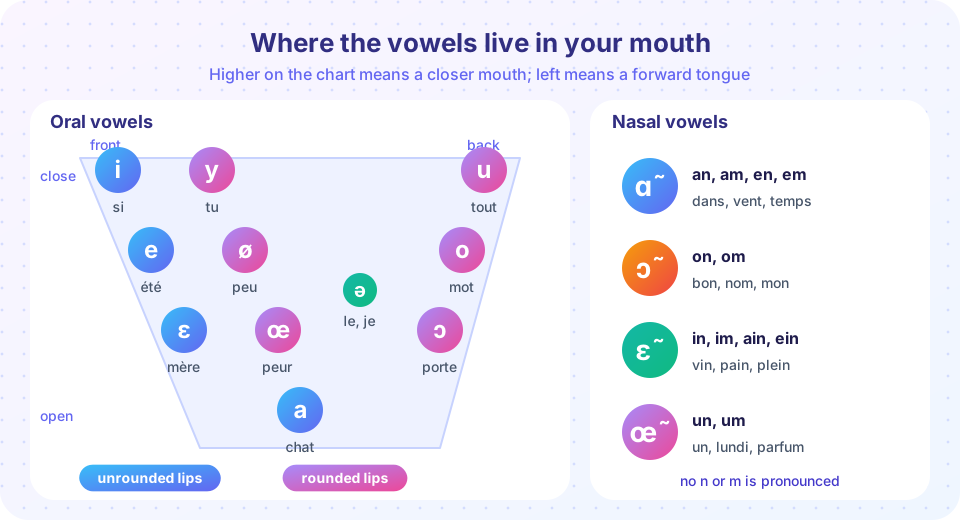
Front vowel is made with the tongue forward; back vowel with the tongue pulled back.
Close/open describes how high the tongue is: /i/ is close, /a/ is open.
Schwa is the weak vowel /ə/ in le, je, de.
The pure oral vowels
/a/ is the vowel of chat (cat), la, ça. It is a short, open "ah", never the "a" of English "cat".
/i/ is "ee" in si (if), ici (here), midi (noon), but short and without the glide of English "see".
/e/ is the closed sound of é, er, ez and most ai in verb endings: été /ete/, parler /paʁle/, vous parlez /vu paʁle/, j'ai /ʒe/. It is a pure "ay" with no "ee" tail, like the middle of English "bait" cut short.
/ɛ/ is the open sound of è, ê, and e before a pronounced consonant: mère /mɛʁ/, elle /ɛl/, merci /mɛʁsi/, mais /mɛ/. It is similar to the "e" in English "bed". Pairs like é and è differ only in how open the mouth is.
/o/ is a closed, pure "oh" in mot (word), rose, beau, eau (water), chaud (hot). /ɔ/ is open, like the vowel in British "pot": porte (door), pomme (apple), école. Often, a word that ends in the vowel sound is closed /o/ and a vowel before a pronounced consonant is open /ɔ/ (mot vs porte), with exceptions like rose /ʁoz/.
/u/ is the "oo" in vous (you), tout (all), rouge (red). It is always written ou. Round your lips and keep them tense. English "boot" often glides; French bout does not.
/ə/ (schwa) is the weak vowel in le, je, de, ce, ne and inside words like petit /pəti/. It sounds like a short, rounded "uh". Often it disappears in fast speech: je ne sais pas becomes something like "chais pas".
The rounded vowels: the heart of French
These three sounds have no English equivalent, and they are the reason French sounds French.
/y/ is written u. Say "ee" as in "see", hold your tongue exactly where it is, and round your lips as if you were going to whistle or say "oo". That is /y/. Words: tu (you), rue (street), une (a), du (of the), salut (hi). The difference between tu /ty/ and tout /tu/, or rue /ʁy/ (street) and roue /ʁu/ (wheel), is real and changes the meaning.
/ø/ is written eu or œu (at the end of a word or before z). Say "ay" as in "say", keep your tongue there, and round your lips. That is /ø/. Words: peu (little), deux (two), bleu (blue), feu (fire), il pleut (it is raining).
/œ/ is written eu or œu before a pronounced consonant. It is the open version, like "uh" with rounded lips, as in peur (fear), sœur (sister), cœur (heart), fleur (flower), heure (hour). Think of the pair: peu /pø/ with a closed vowel, peur /pœʁ/ with an open one.
A trick for the rounded vowels: say the unrounded partner and then round your lips without moving your tongue. /i/ becomes /y/, /e/ becomes /ø/, /ɛ/ becomes /œ/.
Spelling patterns that make one sound
Learn these digraphs (two-letter spellings) and trigraphs, and a large share of French spelling becomes predictable.
| Spelling | Sound | Examples |
|---|---|---|
| ou, où, oû | /u/ | vous, tout, où |
| oi, oy | /wa/ | moi, toi, trois, voilà, voyage |
| eau, au | /o/ | eau, beau, chaud, au revoir |
| ai, ei | /ɛ/ or /e/ | mais, lait, j'ai, neige |
| eu, œu | /ø/ or /œ/ | peu, peur, cœur |
| ui | /ɥi/ | nuit, huit, je suis |
| ou before a vowel | /w/ | oui, jouer |
Notice oi is not "oy" like English "boy". It is /wa/, "wah", as in moi /mwa/. And ui in huit is a quick /ɥ/ (a very short "ü") followed by /i/: huit /ɥit/.
Nasal vowels
French has four nasal vowels. In each, the vowel is pronounced with air passing through both mouth and nose, and no separate n or m is pronounced. The nose does the work of the consonant.
| IPA | Spelling | Mouth shape | Examples |
|---|---|---|---|
| /ɑ̃/ | an, am, en, em | open, back, like "ah" through the nose | dans, enfant, temps, vent |
| /ɔ̃/ | on, om | rounded, like "oh" through the nose | bon, nom, mon, vont |
| /ɛ̃/ | in, im, ain, ein, ien | like the "e" of "bed" through the nose | vin, pain, plein, bien |
| /œ̃/ | un, um | rounded; many speakers use /ɛ̃/ instead | un, lundi, parfum |
The classic practice sentence is un bon vin blanc /œ̃ bɔ̃ vɛ̃ blɑ̃/ ("a good white wine"), which uses all four. The words vent (wind), vin (wine) and vont (they go) differ only by the nasal vowel: /vɑ̃/, /vɛ̃/, /vɔ̃/.
When is a vowel nasal? A vowel + n or m is nasal when the n or m comes at the end of a word or before another consonant: bon /bɔ̃/, champ /ʃɑ̃/, inconnu /ɛ̃kɔny/. If the n or m is doubled or followed by a vowel, it is a normal consonant and the vowel is oral: bonne /bɔn/, une /yn/, année /ane/, femme /fam/ (an exception to the usual "em" pattern), ennemi /ɛnmi/. That is why the masculine bon and the feminine bonne sound so different, a fact that will matter when you learn adjectives in chapter 3.
Common English-speaker problems
First, English speakers add a glide: they say /eɪ/ for é and /oʊ/ for o. Practice holding the vowel steady for a full count. Second, they pronounce the nasal as vowel plus n or ng, saying "bong" for bon. The nasal vowel has no n or g at the end; stop the sound while the air is still in your nose. Third, they replace /y/ with /u/. Record yourself saying tu and tout; they must sound clearly different.
Common misconceptions
"The u in French is like the u in English 'tube'." No. English "tube" is /tuːb/ or /tjuːb/. The French u is a front rounded vowel that English does not use.
"Nasal vowels end with an n sound." They do not. No consonant is pronounced; the vowel itself is nasal.
"é and è are interchangeable." They are different vowels. Mixing them can change a word, as in les /le/ (the) vs lait /lɛ/ (milk).
Try it
The first drill is the sound-pair deck. Say both words in each card and hear the difference. If your browser can speak French, the "Say it" button reads the first word.
Now a small Python experiment: a heuristic that tells you whether a spelling pattern is nasal. It is a simplified model of the rule above: a nasal vowel pattern followed by the end of the word or a consonant (not n or m, and not a vowel) is nasal. Real French has exceptions (such as femme), so treat it as an aid, not an authority.
Press Run (or Ctrl + Enter) to see the result here.
Program input · what you'd type while the program runs
Type the answers before you press Run, one per line. Each time the program reads a line (with input()), it gets the next line from this box.
Finally, match the words with their pronunciation. Use the chart above if you get stuck.
Check your understanding
Quick check · 5 questions
of 5 answered You scored / 5 · perfect!
-
1. How do you make the French /y/ (as in tu)?
Start from /i/, keep the tongue still, and round the lips: that is /y/. -
2. Which word has a nasal vowel?
Bon /bɔ̃/ ends in a vowel + n at the end of the word. In bonne, une and année the n is followed by a vowel or doubled, so the vowel is oral. -
3. How is oi pronounced in moi?
The oi digraph is /wa/: moi /mwa/. -
4. Which pair differs by open versus closed vowel?
Peu /pø/ has a closed vowel, peur /pœʁ/ an open one. -
5. What is the correct description of the nasal vowel in bon?
No consonant is pronounced; the air passes through the nose during the vowel.
Summary
- French vowels are pure: hold them steady.
- The rounded vowels /y/, /ø/ and /œ/ are the signature sounds; make them from /i/, /e/, /ɛ/ by rounding the lips.
- Learn the digraphs: ou /u/, oi /wa/, eau/au /o/, ai /ɛ/ or /e/, eu /ø/ or /œ/, ui /ɥi/.
- Four nasal vowels (/ɑ̃/, /ɔ̃/, /ɛ̃/, /œ̃/) carry no pronounced n or m; doubling or a following vowel removes the nasal.
Track your progress
Create a free account to tick off lessons and pick up where you left off on any device.
of French for Beginners lessons completed