


















Lesson 44 of 48 · Projects and Practice
Projects: Profile, Café Role Play and Word Counter
Three hands-on French projects: write your own profile, play a branching café dialogue, and analyze a French text with a Python word counter.
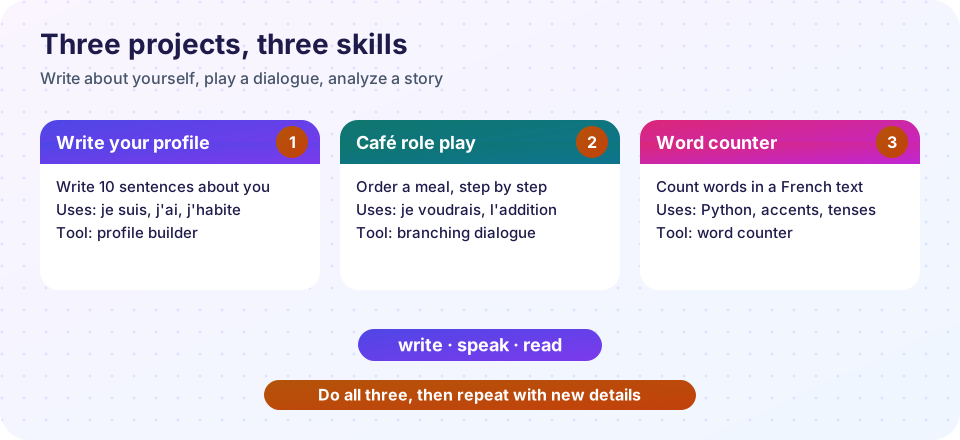
You now know enough French to build things. In this chapter you stop studying pieces and start producing. This lesson has three small projects that each use a different skill: writing (a profile about yourself), speaking (a café role play with choices) and reading (a short story with a word-frequency tool). All three run inside the page, so you can try them now and repeat them whenever you like.
A course cannot replace talking with real people, but these projects are the next best step. They make you commit to full sentences and give you something real to say the first time you meet a French speaker.
What you will learn
- Write a ten-sentence self-introduction in correct French
- Handle a complete café scenario, from greeting to the bill
- Read a short story with several tenses and analyze its vocabulary
- Measure your own progress by comparing your first and second attempts
Key terms
le profil: a short description of yourself. le jeu de rôle: role play. la fréquence: how often a word appears. le corpus: a collection of texts to analyze. la compréhension écrite: reading comprehension.
Project 1: write your profile
Write ten sentences about yourself. Use this skeleton, and replace the underlined parts with your own information.
| Sentence | Pattern | Example |
|---|---|---|
| 1 | name | Je m'appelle Anna. |
| 2 | age (use avoir) | J'ai vingt-deux ans. |
| 3 | city (habiter à) | J'habite à Montréal. |
| 4 | job or study | Je suis étudiante. |
| 5 | languages | Je parle anglais et un peu français. |
| 6 | likes (aimer) | J'aime la musique et le football. |
| 7 | dislikes (negation) | Je n'aime pas le froid. |
| 8 | yesterday (passé composé) | Hier, j'ai regardé un film. |
| 9 | childhood (imparfait) | Quand j'étais petite, je jouais du piano. |
| 10 | tomorrow (futur proche) | Demain, je vais visiter le musée. |
This single paragraph uses numbers, avoir and être, negation, both past tenses and the near future, which is almost every skill you have learned. The builder below turns your answers into a French paragraph, with the age spelled out. It does not check your grammar, so use it as a template and then personalize each sentence.
The builder adds a feminine -e only to simple job words (for example étudiant becomes étudiante). Many jobs change in other ways (acteur becomes actrice), so always check the final sentence yourself.
Project 2: the café role play
You are in a French café. The server speaks, and you choose your reply. Some choices are polite and natural; others are blunt or wrong, and the game tells you why. Play it twice and aim for a perfect run.
Project 3: read a story and count its words
Here is a short story that uses several tenses, a pronoun and a subjunctive. Read it first.
Hier, je me suis levé à sept heures. Il faisait beau, alors je suis allé au marché. J'ai acheté du pain, des pommes et un peu de fromage. Au café, j'ai rencontré Camille. Elle m'a dit : « Demain, nous allons visiter le musée. Tu veux venir ? » J'ai répondu : « Oui, avec plaisir ! Il faut que je finisse mon travail avant midi. » Je ne l'ai pas oublié : ce soir, je vais préparer mon sac.
English: "Yesterday I got up at seven. The weather was nice, so I went to the market. I bought bread, apples and a little cheese. At the café I met Camille. She said to me: 'Tomorrow we are going to visit the museum. Do you want to come?' I answered: 'Yes, with pleasure! I have to finish my work before noon.' I haven't forgotten it: tonight I'm going to pack my bag."
Find the grammar in the text:
| Feature | Examples from the story |
|---|---|
| passé composé with être (and reflexive) | je me suis levé, je suis allé |
| passé composé with avoir | j'ai acheté, j'ai rencontré, j'ai répondu |
| imparfait | il faisait beau |
| futur proche | nous allons visiter, je vais préparer |
| subjunctive | il faut que je finisse |
| negation | je ne l'ai pas oublié |
| object pronoun | m' (to me), l' (it) |
| partitive and quantity | du pain, des pommes, un peu de fromage |
The Python tool below counts the words. It lowercases the text, splits elisions (j'ai becomes j and ai) and prints the ten most frequent words as a bar chart. Replace the text with something you write.
Press Run (or Ctrl + Enter) to see the result here.
Program input · what you'd type while the program runs
Type the answers before you press Run, one per line. Each time the program reads a line (with input()), it gets the next line from this box.
What to notice: the most frequent words are small grammar words (je, ai, j, suis, il), exactly like in English. A little vocabulary (the top few hundred words) covers most of every text, which is why learning high-frequency words first is such an efficient strategy.
Make it yours
- Rewrite Project 1 with a friend or family member in mind (use il/elle instead of je).
- Change the café to a train station using the vocabulary of Chapter 8, and write the dialogue.
- Paste your own writing into the word counter and see which words you overuse.
Checking your own writing
When you finish a project text, check it in five passes, one question at a time. First, does every verb agree with its subject (j'ai, tu as, il a)? Second, are accents correct on every word you were unsure of (é, è, ê, à, ç)? Third, wherever you wrote pas or jamais, is there a ne or n' in front of the verb, and did the article change to de? Fourth, are the past tenses chosen well: an event in the passé composé, a description in the imparfait? Fifth, did you use the right auxiliary, especially for aller, venir, arriver and reflexive verbs? Reading your text aloud once also helps, because your ear catches missing words that your eye skips. If you work with a teacher or a language partner, send them the corrected version and ask for only three corrections, so the feedback stays focused.
Common misconceptions
"A project means I need perfect grammar." The aim is to produce language, find mistakes and fix them. Errors are information.
"The profile builder is a translator." It is a template: you supply the words, and it handles the number spelling and elision. Check everything.
"Frequent words are boring." They are the engine of the language: je, de, le, à, il, avoir, être appear in almost every sentence.
Check your understanding
Quick check · 4 questions
of 4 answered You scored / 4 · perfect!
-
1. Which sentence correctly gives the age of a 22-year-old?
French uses avoir for age, and 22 is vingt-deux (et un appears only in 21, 31...). -
2. In the café game, why is 'Je voudrais ... s'il vous plaît' better than 'Je veux ...'?
Je voudrais with s'il vous plaît is the polite way to order; je veux sounds demanding. -
3. In 'il faut que je finisse', which mood is 'finisse'?
Il faut que triggers the subjunctive: que je finisse. -
4. What does the word counter tell you about the most frequent words?
In any text the most common words are short function words.
Summary
- Project 1: ten sentences about yourself, using numbers, avoir/être, negation, past and near future.
- Project 2: a six-step café dialogue; polite phrases beat blunt ones.
- Project 3: a story with several tenses and a word-frequency tool.
- Repeat the projects with new details every week to keep your French active.
Next: Mixed practice set
Track your progress
Create a free account to tick off lessons and pick up where you left off on any device.
of French for Beginners lessons completed