Lesson 35 of 48 · Future, Pronouns and Subjunctive Basics
The Futur Proche and the Futur Simple
Learn the two French future tenses: aller plus infinitive and the futur simple with its endings, irregular stems, and the rule for quand and si.
French has two everyday ways to talk about the future, and learners usually find both easier than the past. The futur proche ("near future") is built from aller plus an infinitive: Je vais manger. The futur simple ("simple future") adds endings to a stem: Je mangerai. Both exist in speech, but the near future is more common in casual conversation, and the simple future is more common in writing, promises, predictions and formal plans.
In this lesson you will learn both, the irregular stems you must memorize, and a rule that surprises English speakers: after quand ("when") French uses the future where English uses the present.
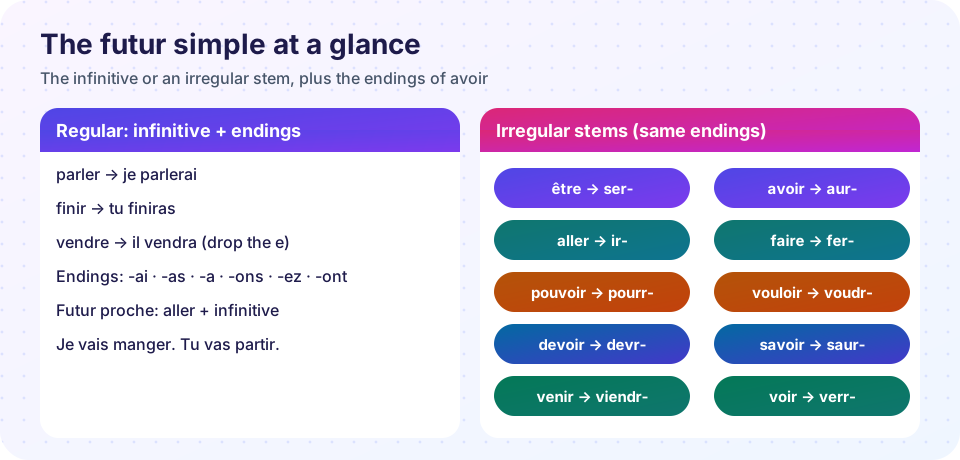
Futur simple at a glance: the infinitive (or an irregular stem) plus the endings -ai, -as, -a, -ons, -ez, -ont.
le futur proche: aller + infinitive. le futur simple: infinitive/stem + -ai, -as, -a, -ons, -ez, -ont. un radical irrégulier: an irregular future stem (ser-, aur-, ir-, fer-). demain: tomorrow. la semaine prochaine: next week.
Conjugate aller in the present and add the infinitive of the action.
Subject
aller
Example
je
vais
Je vais manger.
tu
vas
Tu vas partir.
il / elle / on
va
Il va pleuvoir.
nous
allons
Nous allons voyager.
vous
allez
Vous allez gagner.
ils / elles
vont
Ils vont arriver.
It means "I am going to ...", and it is used for plans and for things that are about to happen: Je vais appeler ma mère ce soir. (I'm going to call my mother tonight.) Regarde ces nuages : il va pleuvoir ! (Look at those clouds: it's going to rain!)
Negation wraps aller: Je ne vais pas partir. An object pronoun goes before the infinitive: Je vais le faire. (I'm going to do it.)
Bonus: venir de. The mirror image, the very recent past, is venir de + infinitive: Je viens de manger. (I have just eaten.) Elle vient d'arriver. (She has just arrived.)
For regular verbs, take the infinitive as the stem. Add the endings, which are the present tense of avoir without its first letters (-ai, -as, -a, -ons, -ez, -ont).
Subject
parler
finir
vendre
je
parlerai
finirai
vendrai
tu
parleras
finiras
vendras
il / elle / on
parlera
finira
vendra
nous
parlerons
finirons
vendrons
vous
parlerez
finirez
vendrez
ils / elles
parleront
finiront
vendront
Verbs ending in -re drop the final e before the endings: vendre → je vendrai, prendre → je prendrai, écrire → j'écrirai.
Pronunciation note: the r is the key. Je parlerai (future) has the r before the ending, so it sounds different from je parlais (imparfait) in careful speech. The ending -ai of the future is pronounced like é.
Acheter → j'achèterai (the stem takes a grave accent). Appeler → j'appellerai (doubled l). Payer → je paierai (also je payerai is accepted). Se lever → je me lèverai. Verbs in -eler/-eter and -e + consonant + er often change this way, as in the present for je / tu / il / ils.
Futur proche for plans, intentions and what is about to happen: Ce soir, je vais regarder un film.
Futur simple for predictions, promises, formal plans and things further away: L'année prochaine, j'aurai vingt ans. Je vous appellerai demain. (I will call you tomorrow, a polite promise.)
Often both work. In everyday speech French people say je vais far more than je ferai.
The present can also express the near future with a time word: Demain, je pars à huit heures.
Quand, dès que, lorsque, aussitôt que + future (when the action has not happened yet): Quand tu arriveras, appelle-moi. (When you arrive, call me.) Dès que j'aurai le temps, je viendrai. (As soon as I have time, I'll come.) English uses the present in these clauses; French uses the future.
Si + present → future: Si tu viens, je serai content. (If you come, I'll be happy.) Si demain il pleut, nous resterons à la maison. Never use the future right after si in this meaning.
<style>:root{--ink:#1e1b4b;--mut:#475569;--a:#4f46e5;--b:#db2777}*{box-sizing:border-box}body{margin:0;padding:14px;font-family:system-ui,-apple-system,'Segoe UI',sans-serif;background:linear-gradient(135deg,#faf5ff,#eff6ff);color:var(--ink)}.wrap{max-width:640px;margin:0 auto}button{font:inherit;cursor:pointer;border:0;border-radius:999px;padding:8px 16px;color:#fff;background:linear-gradient(135deg,#4f46e5,#7c3aed);box-shadow:0 4px 10px rgba(79,70,229,.25)}button.alt{background:#fff;color:var(--a);border:1px solid #c7d2fe;box-shadow:none}button:disabled{opacity:.45;cursor:default}.row{display:flex;gap:8px;flex-wrap:wrap;justify-content:center;margin:12px 0}.card{background:#fff;border-radius:18px;box-shadow:0 10px 24px rgba(67,56,202,.16);padding:26px 18px;text-align:center;min-height:130px;display:flex;flex-direction:column;justify-content:center;align-items:center;width:100%;color:var(--ink);cursor:pointer;border:0}.card .big{font-size:28px;font-weight:700}.card .sm{font-size:14px;color:var(--mut);margin-top:6px}.cnt{text-align:center;color:var(--mut);font-size:14px;margin-bottom:8px}.msg{text-align:center;min-height:22px;color:var(--mut);font-size:14px}.ok{color:#047857;font-weight:600}.bad{color:#be123c;font-weight:600}input[type=text]{font:inherit;border:2px solid #c7d2fe;border-radius:10px;padding:5px 8px;width:150px;background:#fff;color:var(--ink)}input.good{border-color:#10b981;background:#ecfdf5}input.wrong{border-color:#ef4444;background:#fef2f2}.item{background:#fff;border-radius:14px;padding:10px 14px;margin:8px 0;box-shadow:0 4px 12px rgba(67,56,202,.10);line-height:2}.item small{display:block;color:var(--mut);line-height:1.3}.keys{display:flex;flex-wrap:wrap;gap:6px;justify-content:center;margin:8px 0}.keys button{padding:4px 11px;background:#fff;color:var(--a);border:1px solid #c7d2fe;box-shadow:none;border-radius:8px}.cols{display:grid;grid-template-columns:1fr 1fr;gap:10px}.cols button{display:block;width:100%;border-radius:12px;background:#fff;color:var(--ink);border:2px solid #c7d2fe;box-shadow:none;padding:10px 8px;margin-bottom:8px;text-align:center}.cols button.sel{border-color:#4f46e5;background:#eef2ff}.cols button.done{border-color:#10b981;background:#ecfdf5;color:#047857;cursor:default}.cols button.no{border-color:#ef4444;background:#fef2f2}</style><divclass="wrap"><divclass="cnt"id="cnt"></div><buttonclass="card"id="card"aria-live="polite"><spanclass="big"id="big"></span><spanclass="sm"id="sm"></span></button><divclass="row"><buttonclass="alt"id="prev">Back</button><buttonid="flip">Flip</button><buttonclass="alt"id="next">Next</button></div><divclass="row"><buttonclass="alt"id="dir">French first</button><buttonclass="alt"id="shuf">Shuffle</button><buttonclass="alt"id="say">Listen</button></div><divclass="msg"id="msg"></div></div><script>constD=[["être","ser- (je serai)"],["avoir","aur- (j'aurai)"],["aller","ir- (j'irai)"],["faire","fer- (je ferai)"],["pouvoir","pourr- (je pourrai)"],["vouloir","voudr- (je voudrai)"],["devoir","devr- (je devrai)"],["savoir","saur- (je saurai)"],["venir","viendr- (je viendrai)"],["voir","verr- (je verrai)"]];let i=0,showFr=true,fr=true;const$=id=>document.getElementById(id);functiondraw(){const c=D[i];$('cnt').textContent='Card '+(i+1)+' of '+D.length;const q=fr?c[0]:c[1],a=fr?c[1]:c[0];$('big').textContent=showFr?q:a;$('sm').textContent=showFr?'Tap to flip':(fr?'English':'French');}functionflip(){showFr=!showFr;draw();}$('card').onclick=flip;$('flip').onclick=flip;$('next').onclick=()=>{i=(i+1)%D.length;showFr=true;draw();};$('prev').onclick=()=>{i=(i-1+D.length)%D.length;showFr=true;draw();};$('dir').onclick=()=>{fr=!fr;$('dir').textContent=fr?'French first':'English first';showFr=true;draw();};$('shuf').onclick=()=>{for(let k=D.length-1;k>0;k--){const j=Math.floor(Math.random()*(k+1));[D[k],D[j]]=[D[j],D[k]];}i=0;showFr=true;draw();};$('say').onclick=()=>{try{if(!('speechSynthesis'in window))throw0;const u=newSpeechSynthesisUtterance(D[i][0]);u.lang='fr-FR';speechSynthesis.cancel();speechSynthesis.speak(u);$('msg').textContent='';}catch(e){$('msg').textContent='Speech is not available in this preview. Say it aloud yourself.';}};draw();</script>
This Python helper conjugates the futur simple and builds the futur proche. Try your own verbs, including -re verbs and irregulars.
Python
Future tense conjugator
IRREGULAR ={"être":"ser","avoir":"aur","aller":"ir","faire":"fer","pouvoir":"pourr","vouloir":"voudr","devoir":"devr","savoir":"saur","venir":"viendr","voir":"verr","envoyer":"enverr","acheter":"achèter","appeler":"appeller"}
ENDINGS =[("je","ai"),("tu","as"),("il","a"),("nous","ons"),("vous","ez"),("ils","ont")]
ALLER ={"je":"vais","tu":"vas","il":"va","nous":"allons","vous":"allez","ils":"vont"}deffutur_simple(verb):
stem = IRREGULAR.get(verb)if stem isNone:
stem = verb[:-1]if verb.endswith("re")else verb
forms =[]for pron, end in ENDINGS:
form = stem + end
if pron =="je"and form[0]in"aeiouéèh":
forms.append("j'"+ form)else:
forms.append(pron +" "+ form)return forms
deffutur_proche(verb):return[(p +" "+ ALLER[p]+" "+ verb)for p in ALLER]for v in["parler","finir","vendre","être","avoir","aller","faire","acheter"]:print(v.ljust(8)," | ".join(futur_simple(v)))print()print(" | ".join(futur_proche("manger")))
Press Run (or Ctrl + Enter) to see the result here.
Program input · what you'd type while the program runs
Type the answers before you press Run, one per line. Each time the program reads a line (with input()), it gets the next line from this box.
Futur proche and futur simple
<style>:root{--ink:#1e1b4b;--mut:#475569;--a:#4f46e5;--b:#db2777}*{box-sizing:border-box}body{margin:0;padding:14px;font-family:system-ui,-apple-system,'Segoe UI',sans-serif;background:linear-gradient(135deg,#faf5ff,#eff6ff);color:var(--ink)}.wrap{max-width:640px;margin:0 auto}button{font:inherit;cursor:pointer;border:0;border-radius:999px;padding:8px 16px;color:#fff;background:linear-gradient(135deg,#4f46e5,#7c3aed);box-shadow:0 4px 10px rgba(79,70,229,.25)}button.alt{background:#fff;color:var(--a);border:1px solid #c7d2fe;box-shadow:none}button:disabled{opacity:.45;cursor:default}.row{display:flex;gap:8px;flex-wrap:wrap;justify-content:center;margin:12px 0}.card{background:#fff;border-radius:18px;box-shadow:0 10px 24px rgba(67,56,202,.16);padding:26px 18px;text-align:center;min-height:130px;display:flex;flex-direction:column;justify-content:center;align-items:center;width:100%;color:var(--ink);cursor:pointer;border:0}.card .big{font-size:28px;font-weight:700}.card .sm{font-size:14px;color:var(--mut);margin-top:6px}.cnt{text-align:center;color:var(--mut);font-size:14px;margin-bottom:8px}.msg{text-align:center;min-height:22px;color:var(--mut);font-size:14px}.ok{color:#047857;font-weight:600}.bad{color:#be123c;font-weight:600}input[type=text]{font:inherit;border:2px solid #c7d2fe;border-radius:10px;padding:5px 8px;width:150px;background:#fff;color:var(--ink)}input.good{border-color:#10b981;background:#ecfdf5}input.wrong{border-color:#ef4444;background:#fef2f2}.item{background:#fff;border-radius:14px;padding:10px 14px;margin:8px 0;box-shadow:0 4px 12px rgba(67,56,202,.10);line-height:2}.item small{display:block;color:var(--mut);line-height:1.3}.keys{display:flex;flex-wrap:wrap;gap:6px;justify-content:center;margin:8px 0}.keys button{padding:4px 11px;background:#fff;color:var(--a);border:1px solid #c7d2fe;box-shadow:none;border-radius:8px}.cols{display:grid;grid-template-columns:1fr 1fr;gap:10px}.cols button{display:block;width:100%;border-radius:12px;background:#fff;color:var(--ink);border:2px solid #c7d2fe;box-shadow:none;padding:10px 8px;margin-bottom:8px;text-align:center}.cols button.sel{border-color:#4f46e5;background:#eef2ff}.cols button.done{border-color:#10b981;background:#ecfdf5;color:#047857;cursor:default}.cols button.no{border-color:#ef4444;background:#fef2f2}</style><divclass="wrap"><divclass="keys"id="keys"></div><divid="list"></div><divclass="row"><buttonid="chk">Check answers</button><buttonclass="alt"id="show">Show answers</button></div><divclass="msg"id="msg">Type each answer. Use the accent buttons if your keyboard has no accents.</div></div><script>constD=[{"s":"Ce soir, nous ___ manger au restaurant. (aller)","a":["allons"],"h":"Futur proche: aller + infinitive."},{"s":"Demain, il ___ beau. (faire)","a":["fera"],"h":"Irregular stem fer-."},{"s":"Quand tu ___ à Paris, appelle-moi. (arriver)","a":["arriveras"],"h":"Future after quand."},{"s":"Si tu viens, je ___ content. (être)","a":["serai"],"h":"Irregular stem ser-."},{"s":"L’année prochaine, j’___ vingt ans. (avoir)","a":["aurai"],"h":"Irregular stem aur-."},{"s":"Nous ___ le train à huit heures. (prendre)","a":["prendrons"],"h":"Drop the e of -re."}];const$=id=>document.getElementById(id);let last=null;constnorm=s=>s.trim().toLowerCase().replace(/[\u2019\u2018]/g,"'").replace(/\s+/g,' ');D.forEach((d,k)=>{const p=d.s.split('___');const div=document.createElement('div');div.className='item';
div.append(p[0]);const inp=document.createElement('input');inp.type='text';inp.id='i'+k;inp.autocomplete='off';inp.spellcheck=false;inp.setAttribute('aria-label','Answer '+(k+1));inp.onfocus=()=>last=inp;div.append(inp);div.append(p[1]||'');if(d.h){const s=document.createElement('small');s.textContent=d.h;div.append(s);}$('list').append(div);});['é','è','ê','à','â','ç','î','ï','ô','ù','û','œ'].forEach(ch=>{const b=document.createElement('button');b.textContent=ch;b.setAttribute('aria-label','Insert '+ch);b.onmousedown=e=>e.preventDefault();b.onclick=()=>{const t=last||$('i0');t.focus();const s=t.selectionStart,e=t.selectionEnd;t.setRangeText(ch,s,e,'end');};$('keys').append(b);});$('chk').onclick=()=>{let n=0;D.forEach((d,k)=>{const t=$('i'+k);const ok=d.a.some(a=>norm(a)===norm(t.value));t.className=ok?'good':'wrong';if(ok)n++;});$('msg').innerHTML=n===D.length?'<span class="ok">All '+n+' correct. Bravo !</span>':'<span class="bad">'+n+' of '+D.length+' correct.</span> Check accents and endings.';};$('show').onclick=()=>{D.forEach((d,k)=>{$('i'+k).value=d.a[0];$('i'+k).className='good';});$('msg').textContent='Answers shown. Reload the preview to reset.';};</script>