


















Lesson 23 of 48 · Present Tense Verbs
Chapter 4 review: Present Tense Verbs
Review the French present tense: être and avoir, regular -er, -ir and -re verbs, key irregular verbs and negation, with a one-page summary, conjugation table, drill and ten-question quiz.
You have reached the end of the foundation block. After four chapters you can pronounce French, greet people, count, describe the world with nouns and adjectives, and talk about actions in the present: what you do, have and are, where you go, what you want and what you do not do. That is a real working base. Chapters 5 to 9 add everyday topics, questions, the past and the future, pronouns, conversation and culture, but every one of them uses what you have just learned.
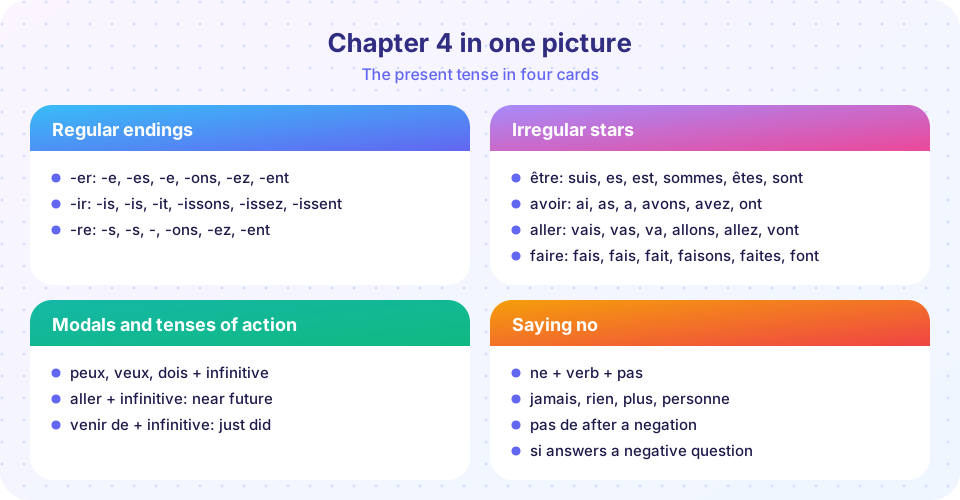
This review gathers the present tense into one picture, one table and one drill. Then comes a ten-question quiz.
What you will learn
- To recall the endings of the three regular verb families.
- To conjugate the irregular verbs être, avoir, aller, faire and others from memory.
- To combine verbs, nouns, adjectives and negation in one sentence.
- Where to review if a form slips.
Key terms
Stem + ending: how regular verbs are built. Boot verb: stem changes in je, tu, il, ils. Modal verb: pouvoir, vouloir, devoir + infinitive. Near future: aller + infinitive. Negation frame: ne + verb + pas.
The present tense on one page
Regular endings.
| -er (parler) | -ir (finir) | -re (vendre) | |
|---|---|---|---|
| je | parle | finis | vends |
| tu | parles | finis | vends |
| il / elle / on | parle | finit | vend |
| nous | parlons | finissons | vendons |
| vous | parlez | finissez | vendez |
| ils / elles | parlent | finissent | vendent |
The essential irregular verbs.
| être | avoir | aller | faire | |
|---|---|---|---|---|
| je | suis | ai | vais | fais |
| tu | es | as | vas | fais |
| il / elle / on | est | a | va | fait |
| nous | sommes | avons | allons | faisons |
| vous | êtes | avez | allez | faites |
| ils / elles | sont | ont | vont | font |
More verbs to recall. Prendre (prends, prenons, prennent), venir (viens, venons, viennent), pouvoir (peux, pouvons, peuvent), vouloir (veux, voulons, veulent), devoir (dois, devons, doivent); the partir type (je pars, nous partons).
Spelling changes in -er verbs. Nous mangeons, nous commençons, j'achète, j'appelle, je préfère, j'envoie.
Negation. Ne ... pas, with jamais, rien, plus, personne, pas encore; articles become de after a negation of quantity; answer a negative question with si.
Revisit the lessons if a section feels weak: Être and avoir, Regular -er verbs, Regular -ir and -re verbs, Key irregular verbs and Saying no.
Sentences that use everything
Here is a short text about a day, which combines verbs with noun groups, adjectives and negation. Read it aloud and underline each verb, then label its subject.
| Français | English |
|---|---|
| Je m'appelle Sofia et j'habite à Bordeaux avec mes deux petites sœurs. | My name is Sofia and I live in Bordeaux with my two little sisters. |
| Nous prenons le bus le matin, mais nous ne prenons jamais le métro. | We take the bus in the morning, but we never take the metro. |
| Mon père travaille dans une grande banque ; il finit à six heures. | My father works in a big bank; he finishes at six. |
| Ma mère ne cuisine pas beaucoup, alors nous mangeons souvent des pizzas. | My mother doesn't cook a lot, so we often eat pizzas. |
| Ce soir, nous allons regarder un film. Tu veux venir ? | Tonight, we are going to watch a film. Do you want to come? |
Check the details. Nous prenons uses prendre, with an irregular nous form. Ne ... jamais wraps prenons. Il finit is the -ir verb finir with -it. Ne cuisine pas beaucoup has pas after the verb and an adverb after it. Nous allons regarder is the near future: aller + infinitive. Tu veux venir ? combines the modal vouloir with the infinitive venir.
If you miss a question
For a missing -er form, write out the six forms of parler and manger from memory. For an irregular verb, say its six forms aloud while you do something else, such as walking. For negation, turn five sentences from your day into negatives. A reliable test is to describe your day in the present tense using ten different verbs and to correct yourself with the tables above.
Worked example: describing your day in the present tense
Let us build a short text that uses most verbs of the chapter, to show how the pieces fit. Start with the verbs se lever, prendre, aller, travailler, finir, manger, regarder and dormir, and add the people and places you know.
Le matin, je me lève à sept heures. Je prends le bus et je vais au bureau. Je travaille jusqu'à six heures, puis je finis mes e-mails. Le soir, nous mangeons ensemble. Ma sœur regarde un film, mais moi, je ne regarde jamais la télévision. À onze heures, nous dormons.
In English: "In the morning, I get up at seven. I take the bus and go to the office. I work until six, then I finish my emails. In the evening, we eat together. My sister watches a film, but I never watch television. At eleven, we sleep." Each verb is in the present. Je me lève is a reflexive form of lever (chapter 5 studies reflexives, but it is useful to meet it now). Je prends and je vais are irregular and are among the most useful forms you know. Nous mangeons shows the spelling change. Je finis is an -ir verb. Nous dormons is a partir-type verb in the nous form. And je ne regarde jamais is a negation using jamais.
Now write your own version with ten verbs about your day. Read it aloud, check each ending against the tables above, and correct it. Do this once a week for a month and the present tense will become comfortable.
A self-test plan
Use the following plan before moving on to chapter 5. First, conjugate être, avoir, aller and faire from memory, writing all six forms of each. Second, take five regular verbs, one of each family and two with spelling changes, and write their forms. Third, write five sentences with vouloir, pouvoir or devoir plus an infinitive. Fourth, turn six affirmative sentences into negatives with pas, jamais and plus. If you can do all four without looking, you are ready for chapter 5.
Common misconceptions
"I need to memorize all irregular verbs at once." Start with être, avoir, aller, faire; add the others slowly through sentences.
"The French present is hard because of all the endings." The spoken forms are far fewer than the written ones: in -er verbs four forms sound the same.
"If I make a mistake with a verb ending, people won't understand." They will almost always understand you; correct forms come with practice.
Try it
Here is a conjugation trainer. It picks a verb and a pronoun at random and asks for the present tense form. Use it daily for five minutes; it is the single best exercise of the chapter. Accents are required but the checker tells you if only an accent is missing.
Now a mixed gap-fill on the whole chapter. Type the missing form.
Last, a Python sentence builder: it makes a near-future or a negative sentence for any verb in the list, using the verb tables from the chapter.
Press Run (or Ctrl + Enter) to see the result here.
Program input · what you'd type while the program runs
Type the answers before you press Run, one per line. Each time the program reads a line (with input()), it gets the next line from this box.
Check your understanding
Quick check · 10 questions
of 10 answered You scored / 10 · perfect!
-
1. What is 'we finish'?
Regular -ir verbs insert -iss- in the plural. -
2. Which form is irregular?
Vont, from aller, is irregular. -
3. How do you say 'I am not going to eat'?
The negative frame goes around the conjugated verb vais. -
4. What does 'J'ai faim' mean?
Avoir faim means to be hungry. -
5. Which is correct?
After a negation, des becomes d' before a vowel. -
6. Which ending is pronounced in the present tense of parler?
Only -ons and -ez are heard; -e, -es and -ent are silent. -
7. What is the correct form of the verb in 'Il ___ de Londres'?
The il form of venir is vient. -
8. How do you answer yes to 'Tu ne viens pas ?'
Si contradicts a negative question. -
9. How do you say 'I want a coffee' politely?
Je voudrais is the polite chunk. -
10. What is the il form of the verb dormir?
Partir-type verbs: je dors, il dort, nous dormons.
Summary
- The French present tense has three regular families (-er, -ir, -re) and a handful of key irregular verbs.
- Être, avoir, aller, faire come first; then prendre, venir, pouvoir, vouloir, devoir.
- In -er verbs only -ons and -ez are heard; spelling changes (mangeons, commençons, achète) keep the sound steady.
- Negation is the sandwich ne ... pas; use si to contradict a negative question.
- You now have the foundation for chapters 5 to 9: daily life, questions, the past, the future and conversation.
Next: continue with the second half of the course on the French for Beginners course page
Track your progress
Create a free account to tick off lessons and pick up where you left off on any device.
of French for Beginners lessons completed