


















Lesson 34 of 48 · Future, Pronouns and Subjunctive Basics
Chapter 7 Overview: Future, Pronouns and Subjunctive
Chapter 7 of French for Beginners: talk about plans with the futur proche and futur simple, use object pronouns, and meet the subjunctive. Overview and dialogue.
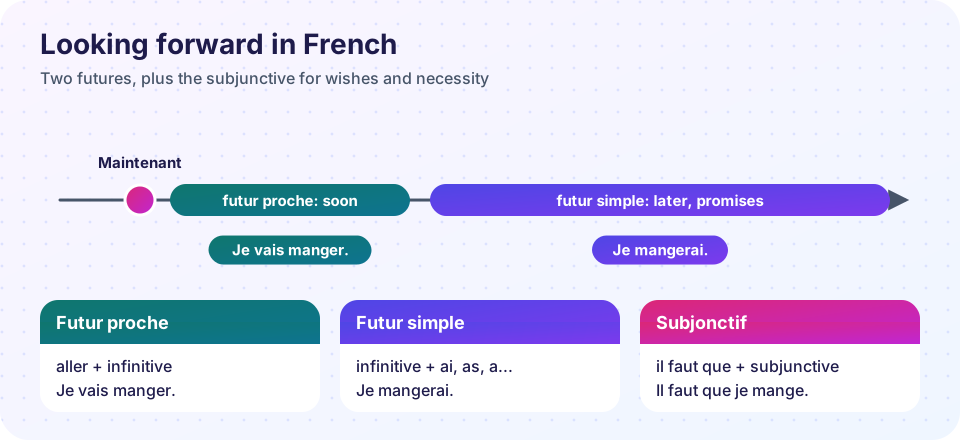
You can tell stories about the past. Now you will look forward and make your French sound less repetitive. This chapter has three connected goals: talking about plans and predictions (the future), replacing repeated nouns with pronouns (je la vois instead of je vois Marie), and a first, gentle look at the subjunctive, the mood French uses for wishes, necessity and feelings (il faut que tu viennes).
The three topics belong together because real conversation uses them together. You say what you are going to do, you refer to people and things without naming them again, and you say what others should or want to do. The dialogue below shows all three in six short lines.
What you will learn
- The overall shape of the chapter and why pronouns and the subjunctive appear next to the future
- How to read a dialogue that mixes all three topics
- What each lesson in the chapter covers
- How to study verb stems and endings efficiently
Key terms
le futur proche: the near future (aller + infinitive). le futur simple: the simple future (je parlerai). un pronom complément: an object pronoun that replaces a noun. le subjonctif: the subjunctive mood. un déclencheur: a trigger (the phrase that requires the subjunctive).
The chapter in five slides
Talking about the future
One stem, six endings
Pronouns save words
A first look at the subjunctive
Recognize it first; master it later.
A first look: weekend plans
| French | English |
|---|---|
| Julie : Qu'est-ce que tu vas faire ce week-end ? | What are you going to do this weekend? |
| Hugo : Je vais voir mes parents. Je les verrai samedi soir. | I'm going to see my parents. I'll see them Saturday evening. |
| Julie : Tu leur as téléphoné ? | Did you call them? |
| Hugo : Oui, je leur ai parlé hier. Ils veulent que je reste dormir. | Yes, I spoke to them yesterday. They want me to stay over. |
| Julie : Et ensuite ? Tu seras à Lyon dimanche ? | And then? Will you be in Lyon on Sunday? |
| Hugo : Oui, j'y serai vers midi. | Yes, I'll be there around noon. |
Look at what you can already identify. Je vais voir is the near future. Je verrai and tu seras are the simple future. Les and leur replace "my parents" (the first as direct object, the second as indirect). Y replaces "in Lyon". And Ils veulent que je reste is the subjunctive: the verb reste looks like an ordinary present form, but the structure vouloir que triggers the mood.
What each lesson covers
- Futur proche and futur simple: the two future tenses, the endings, irregular stems, and when to use each.
- Object pronouns: le, la, les, lui, leur, y, en, where they go in the sentence, and how they combine with the past tenses you already know.
- Subjunctive basics: the most useful triggers, the endings, and the irregular verbs être, avoir, aller, faire.
- Chapter review: a summary picture, a recap and a ten-question quiz.
How to study. For the future, learn stems first and endings second: the endings never change (they are the present of avoir). For pronouns, practice by rewriting your own sentences, one noun at a time. For the subjunctive, only memorize five or six triggers at first, and listen for them.
Check your understanding
Quick check · 3 questions
of 3 answered You scored / 3 · perfect!
-
1. Which sentence uses the futur proche?
The futur proche is aller + infinitive: je vais voir. -
2. In 'Je les verrai samedi', what does 'les' replace?
Les is a direct object pronoun standing in for the people already mentioned: mes parents. -
3. What triggers the subjunctive in 'Ils veulent que je reste'?
Vouloir que is one of the common triggers; the verb after que goes into the subjunctive.
Summary
- The chapter covers the future, object pronouns and a first look at the subjunctive.
- The futur proche (aller + infinitive) is for near plans; the futur simple adds endings to a stem.
- Pronouns replace nouns and stand before the conjugated verb.
- The subjunctive follows triggers such as il faut que and vouloir que.
Track your progress
Create a free account to tick off lessons and pick up where you left off on any device.
of French for Beginners lessons completed