


















Lesson 13 of 48 · Nouns, Articles and Adjectives
Articles: le, la, un, des, du
Master French articles: le, la, l', les, un, une, des and the partitive du, de la, de l'. Learn contractions au, aux, du, des, with rules for when articles are needed.
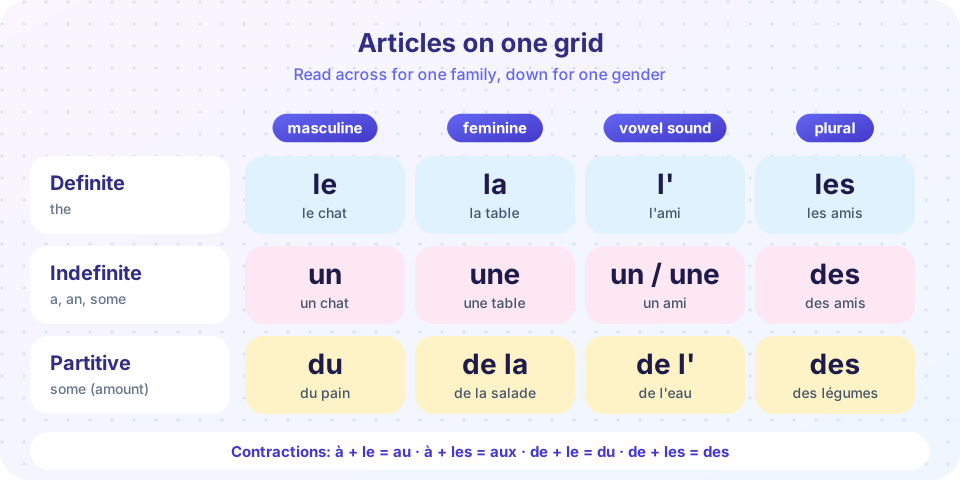
French uses articles much more than English does. In English you can say "I like cats", "I drink water" or "I have friends" without any small word in front of the noun. In French, nearly every noun needs one: J'aime les chats, Je bois de l'eau, J'ai des amis. There are three families of articles, definite ("the"), indefinite ("a", "some") and partitive ("some" for amounts you cannot count). Each has masculine, feminine and plural forms. It sounds like many forms, but the grid is small, and once you see it you will only need practice.
This lesson gives you the grid, the logic for choosing between the three families, the contractions with à and de, and the situations in which the article disappears.
What you will learn
- The definite, indefinite and partitive articles and when to use each.
- The contractions au, aux, du, des with à and de.
- Why des and du have no equivalent in English.
- When no article, or only de, is used.
Key terms
Definite article points to something specific or general: le, la, l', les ("the").
Indefinite article introduces something countable: un, une, des ("a", "an", "some").
Partitive article names an unspecified amount of something uncountable: du, de la, de l' ("some").
Contraction means two words merge: à + le = au.
Countable / uncountable means whether you can count it (two apples) or not (water, bread as a substance).
The grid
| Family | Masculine | Feminine | Before a vowel | Plural |
|---|---|---|---|---|
| Definite (the) | le | la | l' | les |
| Indefinite (a, some) | un | une | un / une | des |
| Partitive (some) | du | de la | de l' | des |
The partitive plural is des, the same word as the indefinite plural. Notice that l' is used for both genders before a vowel or a mute h: l'ami, l'amie, l'hôtel. That is one more reason why the gender must be learned with the noun.
The definite article: le, la, l', les
Use it, like English "the", for something specific that both speaker and listener know: le livre de Marie (Marie's book), la table près de la fenêtre. French also uses it where English uses no article: for general ideas and categories. "Cats are independent" is Les chats sont indépendants. "I love music" is J'aime la musique. "Time is money" is Le temps, c'est de l'argent. After verbs of liking and disliking (aimer, adorer, détester, préférer) the definite article is the rule: J'aime le café, Je déteste les épinards.
Languages are used with the article when they are the subject or object: Le français est beau, J'apprends le français. After parler it is often dropped: Je parle français.
Elision and liaison apply: le + ami = l'ami, les amis /lezami/.
The indefinite article: un, une, des
Use it for one thing (or several things) not yet identified: J'ai un chat, Elle a une voiture, Nous avons des amis. The plural des corresponds to "some", but English often leaves it out, while French never does. "I have friends" is J'ai des amis. A question such as Tu as des frères ? ("Do you have any brothers?") needs des.
You also use un/une when you introduce or define something with c'est: C'est un chat (It's a cat), C'est une bonne idée (It's a good idea).
The partitive: du, de la, de l'
Use it for uncountable things when you mean "some" or "an amount of": Je mange du pain, Elle boit de la limonade, Nous achetons de l'eau, Il y a du soleil. Compare:
| Countable | Uncountable (partitive) |
|---|---|
| Je mange une pomme. | Je mange de la salade. |
| Elle a un gâteau. | Elle mange du gâteau. |
| Tu bois un café ? | Tu bois du café ? |
The partitive is a very French idea: when you eat bread, you eat "of the bread" (an amount of it). If you can count units (two coffees), use un/une/des: Deux cafés, s'il vous plaît. If it is an amount of a substance, use du/de la/de l'.
Contractions: au, aux, du, des
The prepositions à ("to, at, in") and de ("of, from") merge with le and les:
| Without contraction | Contracted | Example |
|---|---|---|
| à + le | au | Je vais au marché. (I am going to the market.) |
| à + les | aux | Elle parle aux enfants. (She speaks to the children.) |
| à + la | à la (no change) | Nous allons à la plage. |
| à + l' | à l' (no change) | Il est à l'école. |
| de + le | du | Il revient du marché. (He is coming back from the market.) |
| de + les | des | La voiture des voisins. (The neighbors' car.) |
| de + la | de la (no change) | Le prix de la baguette. |
| de + l' | de l' (no change) | La porte de l'hôtel. |
Be careful: du and des have two jobs. They can be partitive or indefinite articles (Je mange du pain, J'ai des amis), or the contraction of de + le/les (Le livre du professeur, la voiture des voisins). The meaning of the sentence tells you which.
No article, or just de
After a negation, un, une, des, du, de la usually become de (d' before a vowel): J'ai un chat but Je n'ai pas de chat; Il mange du pain but Il ne mange pas de pain. Chapter 4 teaches negation in full; for now, remember that "no cat" is pas de chat. This does not apply to c'est: Ce n'est pas un chat.
After expressions of quantity, use de with no article: beaucoup de livres (many books), un peu de lait (a little milk), trop de bruit (too much noise), assez d'argent (enough money), un kilo de pommes, une bouteille d'eau.
With professions, religions and nationalities after être, French usually uses no article: Je suis étudiant (I am a student), Elle est médecin, Il est français. If you add an adjective or use c'est, the article returns: C'est une bonne étudiante, C'est un médecin célèbre.
A short dialogue
| Français | English |
|---|---|
| Bonjour, je voudrais une baguette et deux croissants, s'il vous plaît. | Hello, I would like a baguette and two croissants, please. |
| Voilà. Vous prenez du café ? | Here you are. Will you have some coffee? |
| Oui, du café et de l'eau, merci. | Yes, some coffee and some water, thanks. |
| Avec du sucre ? | With sugar? |
| Non merci, je ne prends pas de sucre. | No thanks, I do not take sugar. |
| Très bien. Ça fait huit euros. | Very well. That's eight euros. |
Choosing among the three families: a checklist
When you are not sure which article to use, ask three quick questions. First, can you count it? If you can say "one, two, three" (un chat, deux chats), use un, une or des. Second, if it is an amount you cannot count, such as bread, water, patience or music, use du, de la or de l' when you mean "some". Third, if you are talking about the thing in general or about a specific, known item (the cat everyone knows, or cats as a category), use le, la, l' or les. These three questions settle most cases. For the rest, remember the special situations: a negative of quantity makes it de, expressions of quantity take de, and a bare profession after être takes none.
Common misconceptions
"French drops articles like English does." It almost never does. J'aime les chats, Je bois de l'eau and J'ai des amis all need one.
"Du is only used with masculine nouns because it looks like le." Du is masculine partitive. Feminine partitive is de la, and before a vowel de l'.
"After pas, I keep the article." Je n'ai pas un chat is wrong in this sense; say Je n'ai pas de chat.
Try it
This helper chooses the right article for a noun, given its gender, whether it is countable and whether it starts with a vowel sound. It is a model of the logic above.
Press Run (or Ctrl + Enter) to see the result here.
Program input · what you'd type while the program runs
Type the answers before you press Run, one per line. Each time the program reads a line (with input()), it gets the next line from this box.
Now try the contractions and partitives yourself. Type the missing article. Use a straight apostrophe, as in de l'
Finally, a flashcard deck of article patterns.
Check your understanding
Quick check · 5 questions
of 5 answered You scored / 5 · perfect!
-
1. Which is correct for 'I drink water'?
Water is uncountable, so use the partitive de l'. -
2. What is à + les?
À + les contracts to aux. -
3. Which sentence is correct?
After a negation, des becomes de/d'. -
4. Which article is used after expressions of quantity like beaucoup?
Beaucoup de livres, un peu de lait. -
5. Which sentence expresses a general preference?
Verbs of liking take the definite article for general statements.
Summary
- Definite: le, la, l', les; indefinite: un, une, des; partitive: du, de la, de l' (plural des).
- Use the definite article for specific things and for general statements, especially after aimer, adorer, détester.
- Use the partitive for uncountable amounts and un/une/des for countable things.
- à + le = au, à + les = aux, de + le = du, de + les = des.
- After negation and quantity words, the article becomes de; professions after être take none.
Track your progress
Create a free account to tick off lessons and pick up where you left off on any device.
of French for Beginners lessons completed