


















Lesson 22 of 48 · Present Tense Verbs
Saying no: negation with ne ... pas and friends
Learn how French negation works: the ne ... pas frame around the verb, n' before a vowel, jamais, rien, plus, personne, de after negation, si versus oui, and casual spoken French.
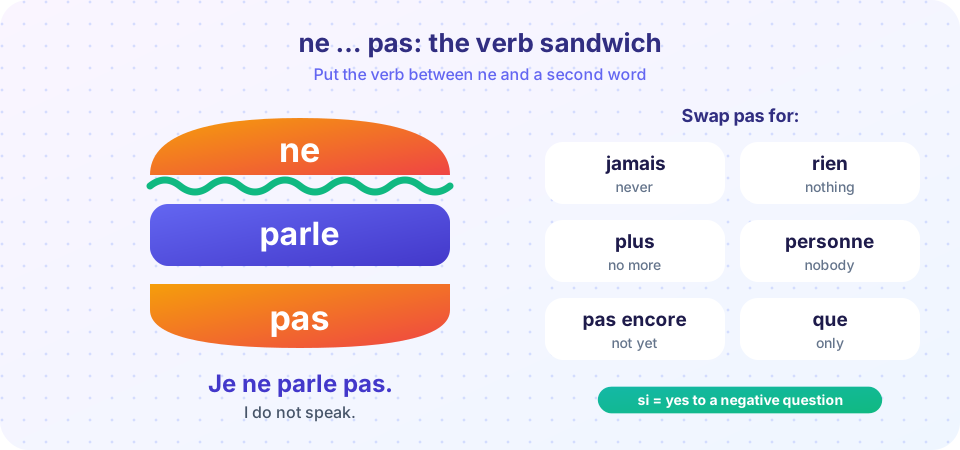
You can now say what you do, have and are, but you also need to say what you do not do. English builds negatives with "do not", "don't", "never", "nothing". French wraps the verb in two words, like a sandwich: ne before it and pas after it. Je parle becomes je ne parle pas. The little word ne shortens to n' before a vowel, and pas can be swapped for words like jamais (never), rien (nothing), plus (no more) and personne (nobody).
This lesson gives you the sandwich and all its fillings, shows how articles change after a negation, explains why French has a special word si for contradicting a negative question, and tells you how casual speech drops the ne altogether.
What you will learn
- The basic frame ne + verb + pas and the elision to n'.
- The negative words jamais, rien, plus, personne, pas encore, ne ... que.
- Why un/une/des/du/de la become de after a negation.
- How to answer a negative question with si, and how casual speech drops ne.
Key terms
Negation turns a statement into its opposite meaning.
Negative adverb is the second word of the negative frame: pas, jamais, plus.
Frame (encadrement) means the verb is placed between ne and the second word.
Si is the French "yes" used to contradict a negative question or statement.
The basic frame: ne ... pas
Put ne before the conjugated verb and pas after it:
| Affirmative | Negative | Meaning |
|---|---|---|
| Je parle français. | Je ne parle pas français. | I do not speak French. |
| Tu aimes le café. | Tu **n'**aimes pas le café. | You do not like coffee. |
| Il habite ici. | Il **n'**habite pas ici. | He does not live here. |
| Nous sommes prêts. | Nous ne sommes pas prêts. | We are not ready. |
| Elles ont une voiture. | Elles **n'**ont pas de voiture. | They do not have a car. |
Ne becomes n' before a verb that starts with a vowel or a mute h: je n'aime pas, il n'y a pas, nous n'habitons pas. The pronunciation of je n'aime pas is /ʒə nɛm pa/; ne itself is /nə/, often barely audible.
With two verbs, the negative frame goes around the first (conjugated) verb, and the infinitive follows: Je ne veux pas partir. (I don't want to leave.) Il ne peut pas venir. Nous ne devons pas manger ici. The same is true of the near future: Je ne vais pas manger (I am not going to eat).
Other negative words
Replace pas with another word and you get a different meaning. Ne stays in place.
| Frame | Meaning | Example |
|---|---|---|
| ne ... pas | not | Je ne mange pas. |
| ne ... jamais | never | Je ne mange jamais de viande. (I never eat meat.) |
| ne ... plus | no more, no longer | Il ne travaille plus ici. (He no longer works here.) |
| ne ... rien | nothing | Je ne comprends rien. (I understand nothing.) |
| ne ... personne | nobody, no one | Elle ne voit personne. (She sees nobody.) |
| ne ... pas encore | not yet | Nous ne sommes pas encore prêts. |
| ne ... que | only | Il ne mange que du pain. (He eats only bread.) |
| ne ... ni ... ni | neither ... nor | Je ne mange ni viande ni poisson. |
Keep two things in mind. First, personne and rien can also be the subject, in which case they come first and ne comes before the verb: Personne ne vient (Nobody is coming), Rien ne marche (Nothing works). Second, ne ... que is not truly negative in meaning; it restricts: "only".
Articles after a negation
When a verb is negative, the indefinite and partitive articles (un, une, des, du, de la, de l') become de (or d' before a vowel):
| Affirmative | Negative |
|---|---|
| J'ai un frère. | Je n'ai pas de frère. |
| Elle a des amis. | Elle n'a pas **d'**amis. |
| Je mange du pain. | Je ne mange pas de pain. |
| Il y a de l'eau. | Il n'y a pas **d'**eau. |
| Nous avons une voiture. | Nous n'avons plus de voiture. |
This change applies after pas, plus, jamais and similar words, but not in three cases: after être (Ce n'est pas un chat, Ce ne sont pas des amis); with the definite article, which stays (Je n'aime pas le café, Elle n'aime pas les chats); and when you are contrasting (Je ne mange pas un pain, j'en mange deux). The rule of thumb: if the article means "a/some", it becomes de after a negative of quantity; if it means "the", it stays.
Answering negative questions: si
If someone asks a negative question and you want to say "yes, I do", English uses "yes" and French uses si. Compare:
| Question | Yes (contradicting) | No (agreeing) |
|---|---|---|
| Tu aimes le café ? | Oui, j'aime le café. | Non, je n'aime pas le café. |
| Tu n'aimes pas le café ? | Si, j'aime le café. | Non, je n'aime pas le café. |
Si means "yes, I do" when the question or statement was negative. Without it, oui would sound as though you are agreeing with the negative: for a French speaker, Tu ne viens pas ? Oui is confusing.
Also useful: Moi non plus (neither do I), Pas moi (not me), Pas de problème (no problem), Non, merci (no, thank you).
Spoken French drops ne
In everyday conversation, many French speakers drop the ne completely: Je sais pas instead of Je ne sais pas, C'est pas grave instead of Ce n'est pas grave, Il y a pas de problème. This is normal in casual speech, in text messages and with friends, but not in formal writing, exams, business emails or speeches. For your own French, learn the complete form first and notice the shorter form when you listen to natives; do not drop ne in school writing.
A short dialogue
| Français | English |
|---|---|
| Tu ne manges pas de viande ? | You don't eat meat? |
| Non, je suis végétarien. Je ne mange ni viande ni poisson. | No, I'm a vegetarian. I eat neither meat nor fish. |
| Alors il n'y a pas de problème. Il y a des légumes et du riz. | Then no problem. There are vegetables and rice. |
| Tu n'aimes pas le café ? | You don't like coffee? |
| Si, j'aime le café, mais je ne bois jamais de café le soir. | Yes, I like coffee, but I never drink coffee in the evening. |
Worked examples: building a negative step by step
Let us build a complex negative sentence together. Start with the affirmative Elle veut manger de la viande ("She wants to eat meat"). Step one: find the conjugated verb. It is veut, since manger is an infinitive. Step two: put ne before it and pas after it: Elle ne veut pas manger de la viande. Step three: change the article. De la viande is a partitive, and after a negation of quantity it becomes de: Elle ne veut pas manger de viande. The sentence is complete: "She does not want to eat meat."
Try another: Nous avons des amis en France. The verb is avons, so: Nous n'avons pas des amis en France; des becomes d': Nous n'avons pas d'amis en France. Now one with jamais: Je mange du poisson becomes Je ne mange jamais de poisson, "I never eat fish". Finally, a sentence with être: C'est une bonne idée becomes Ce n'est pas une bonne idée, where the article stays because the verb is être. Working through four or five sentences this way, with the same three steps, makes negation automatic.
Common misconceptions
"I can put pas anywhere, as in English 'not'." Pas goes right after the conjugated verb: Je ne parle pas, not Je ne pas parle.
"Pas un chat is the negative of un chat after être." After être, the article stays: Ce n'est pas un chat.
"Si and oui are interchangeable." Use si to contradict a negative question or statement; use oui otherwise.
"Ne is optional everywhere." It is optional only in casual speech. Write it in full in any formal context.
Try it
The helper below negates simple sentences with the frame, handling n' before a vowel and the de rule for articles. Change the sentences to explore.
Press Run (or Ctrl + Enter) to see the result here.
Program input · what you'd type while the program runs
Type the answers before you press Run, one per line. Each time the program reads a line (with input()), it gets the next line from this box.
Now build the negative yourself. Type the verb with ne or n', but without the second word, which the sentence already gives.
Finally, learn the negative words as cards.
Check your understanding
Quick check · 5 questions
of 5 answered You scored / 5 · perfect!
-
1. How do you say 'I do not like fish'?
The frame goes around aime; the definite article le stays after a verb of liking. -
2. How do you say 'I have no brothers'?
After a negation, des becomes de. -
3. How do you answer yes to 'Tu ne viens pas ?'
Si contradicts a negative question. -
4. What does 'Je ne mange que du pain' mean?
Ne ... que means only. -
5. Where does ne go in 'Je ne veux pas partir'?
The frame ne ... pas surrounds the conjugated verb veux.
Summary
- Negation is a sandwich: ne before the verb, pas after it; ne becomes n' before a vowel.
- Replace pas with jamais, rien, plus, personne, pas encore or use ne ... que for "only".
- After a negation, un/une/des/du/de la become de/d'; le/la/les and the article after être stay.
- Answer a negative question with si to say "yes".
- In casual speech ne is often dropped, but keep it in writing.
Track your progress
Create a free account to tick off lessons and pick up where you left off on any device.
of French for Beginners lessons completed