


















Lesson 16 of 48 · Nouns, Articles and Adjectives
Chapter 3 review: Nouns, Articles and Adjectives
Review French noun gender and plurals, articles, adjective agreement and position, possessives and demonstratives with a one-picture summary, a recap table and a ten-question quiz.
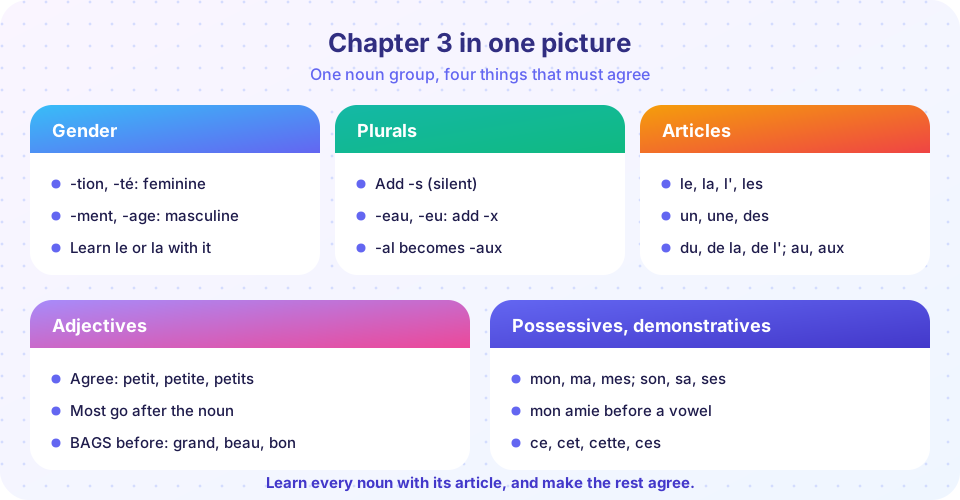
Chapter 3 introduced the central machinery of French grammar: the noun group, in which an article, a noun and an adjective all agree. That agreement is the biggest difference between French and English at beginner level, and it takes time to become automatic. This review collects the rules in one picture and one table, shows them at work in a paragraph that describes a room, and asks you ten questions mixing all five lessons.
What you will learn
- How to recall the main rules of gender, plurals, articles, adjectives and possessives.
- How to describe a place using a complete noun group.
- Where to look back when a rule feels uncertain.
Key terms
Noun group: determiner + noun + adjective. Agreement: matching gender and number. BAGS: adjectives of Beauty, Age, Goodness and Size go before the noun. Partitive: du, de la, de l' for an amount. Contraction: au, aux, du, des.
Chapter 3 in five rules
1. Gender. Learn each noun with its article. Endings help: -ment, -age, -eau masculine; -tion, -té, -ure, -ie, -ée feminine; know the exceptions (la page, le musée). People and jobs: add -e or use -euse, -trice, -ère, -ienne. See Nouns: gender and plurals.
2. Plurals. Add -s (silent). -s, -x, -z stay. -eau, -eu take -x. -al becomes -aux. Irregular: un œil, des yeux.
3. Articles. le/la/l'/les, un/une/des, du/de la/de l'/des. Use the definite article for general statements (J'aime les chats) and the partitive for amounts (Je mange du pain). After a negation or a quantity word, use de (pas de pain, beaucoup de gens). Contractions: au, aux, du, des. See Articles: le, la, un, des, du.
4. Adjectives. They agree in gender and number. Add -e for the feminine and -s for the plural, with patterns (heureuse, active, bonne, blanche, belle). Most adjectives follow the noun; BAGS adjectives precede it. A few change meaning with position (un grand homme versus un homme grand). See Adjectives: agreement and position.
5. Possessives and demonstratives. mon/ma/mes, ton/ta/tes, son/sa/ses, notre/nos, votre/vos, leur/leurs, agreeing with the thing owned; mon/ton/son before a vowel sound. ce, cet, cette, ces, with -ci and -là. See Possessives and demonstratives.
Recap table
| Topic | Rule | Example |
|---|---|---|
| -tion | feminine | la solution |
| -ment | masculine | le gouvernement |
| Plural -eau | add x | des bateaux |
| Plural -al | -aux | des journaux |
| Indefinite | un / une / des | un chat, une table, des amis |
| Partitive | du / de la / de l' | du pain, de la salade, de l'eau |
| Contraction | à + le = au, de + le = du | au marché, du marché |
| After negation | de | pas de chat |
| Adjective feminine | -e, -euse, -ive, -ère, -onne | petite, heureuse, active |
| Position | after, except BAGS | une voiture rouge, une belle maison |
| Possessive | agrees with noun | ma mère, mon père, mes parents |
| Vowel exception | mon amie | not ma amie |
| Demonstrative | ce / cet / cette / ces | ce livre, cet ami |
One paragraph, all the rules
Here is a short description of a living room. Read it aloud and underline every article, adjective and possessive.
| Français | English |
|---|---|
| Dans mon salon, il y a un grand canapé rouge et deux petites chaises blanches. | In my living room, there is a big red sofa and two small white chairs. |
| Sur la table, il y a des livres, de la musique et un vieil ordinateur. | On the table, there are books, some music and an old computer. |
| Cette lampe est très belle, mais ces fenêtres sont trop petites. | This lamp is very beautiful, but these windows are too small. |
| Mes parents aiment les plantes vertes, donc leur maison est pleine de fleurs. | My parents like green plants, so their house is full of flowers. |
Look at what happens in the first sentence. Canapé is masculine, so un grand canapé rouge, with grand before (BAGS) and rouge after, invariable. Chaises is feminine plural, so petites chaises blanches: petites before the noun, agreeing, and blanches after, feminine plural of blanc. In the second sentence, un vieil ordinateur uses vieil because ordinateur begins with a vowel. In the last, leur maison uses leur for a singular noun, and plantes vertes is feminine plural with vertes after the noun.
Il y a ("there is, there are") is a handy chunk you will study in chapter 4.
If the quiz shows a weak spot
If you miss a question on gender or plurals, redo the helper in the gender lesson with your own nouns. If article questions trouble you, rewrite five sentences about your day with le/la, un/une, du/de la and check with the grid. If adjectives slip, practice a colour-and-size description of five objects around you. Everything in this chapter improves with a daily "describe what you see" habit: Je vois une grande table ronde...
Worked analysis: three sentences
Take the sentence Nous achetons de beaux fruits au marché. Beyond the grammar you know already, notice how many ideas are packed into it. Fruits is masculine plural, and beaux is the masculine plural of beau; it goes before the noun (Beauty in BAGS). The article would be des, but in careful writing des becomes de before a plural adjective, hence de beaux fruits. Au marché is the contraction of à + le. Each of the five lessons in this chapter shows up in one short sentence.
Next, Ma sœur n'a pas de voiture rouge. Ma agrees with the feminine sœur; the negation turns une into de; and rouge follows the noun and does not change. Finally, Cette vieille maison appartient à ses parents. Cette is the feminine demonstrative; vieille is the feminine of vieux and goes before the noun (Age); ses is plural because parents is plural, even though the owner is singular. Practicing this kind of line-by-line analysis is the fastest way to see how the chapter fits together.
How the five lessons connect
Gender decides which article you need. The article decides whether you can use de after a negation. Gender and number decide the form of the adjective, and the same gender decides which possessive or demonstrative appears. So gender is the root of the whole chapter. If you learn each noun with its article, the other rules follow almost automatically. That is why the first advice of this chapter, learn le chat and not chat, is also the most important.
Common misconceptions
"I have to get the gender perfect before I speak." You will be understood even if you make gender mistakes; keep going, and fix them over time.
"The partitive and plural indefinite are the same thing." They share the form des in the plural, but du/de la/de l' refer to uncountable amounts and un/une/des to countable things.
"BAGS is a rule that never breaks." It is a strong tendency. When in doubt, think of the adjective in a short, common phrase and copy its position.
Try it
The Python helper below builds a complete noun group with article, noun and adjective, checking gender, number, the vowel exception for bel, and elision. Read the output aloud and notice how every word agrees.
Press Run (or Ctrl + Enter) to see the result here.
Program input · what you'd type while the program runs
Type the answers before you press Run, one per line. Each time the program reads a line (with input()), it gets the next line from this box.
Now a mixed gap-fill covering the whole chapter. Type the missing word.
Finally, a deck to review all the noun-group words.
Check your understanding
Quick check · 10 questions
of 10 answered You scored / 10 · perfect!
-
1. Which sentence is correct?
À + le contracts to au. -
2. What is the plural of un cheval?
Nouns in -al change to -aux. -
3. Which noun is feminine?
-tion nouns are feminine. -
4. How do you say 'I have no brothers'?
After a negation, des becomes de. -
5. Which is correct?
Feminine nouns beginning with a vowel sound take mon, ton, son. -
6. Which adjective goes before the noun?
Grand is a Size adjective (BAGS). -
7. What is the feminine of heureux?
-eux becomes -euse. -
8. Which article is used for 'some water' in 'Je bois ___ eau'?
Before a vowel, the partitive is de l'. -
9. What does 'un homme grand' mean?
After the noun, grand means tall. -
10. 'Sa sœur' can mean:
Sa agrees with sœur (feminine), not with the owner.
Summary
- A French noun group is determiner + noun + adjective, with agreement throughout.
- Learn gender with the article; use endings as clues and remember the exceptions.
- Plurals: -s (silent), -x for -eau/-eu, -aux for -al; articles show plural in speech.
- Articles: definite, indefinite, partitive; contractions au, aux, du, des; de after negation and quantities.
- Adjectives follow the noun, except BAGS; possessives agree with the thing owned; ce, cet, cette, ces point.
Track your progress
Create a free account to tick off lessons and pick up where you left off on any device.
of French for Beginners lessons completed