Learn French for travel: ask for directions, understand commands like tournez à gauche, buy train tickets, and book a hotel, with dialogues and an interactive map.
The first time you are lost in a French-speaking town, you will be glad you can say five things: where something is, whether it is far, how to get there, how much a ticket costs and when the train leaves. This lesson gives you exactly that, with real dialogues and a small interactive map where you steer with French commands.
You will meet two kinds of language here. Some phrases you say (Où est la gare ?), and some you understand when someone answers you in a rush (Prenez la deuxième rue à droite). Learn the second kind as chunks: you do not need to produce them, only to recognize them quickly.
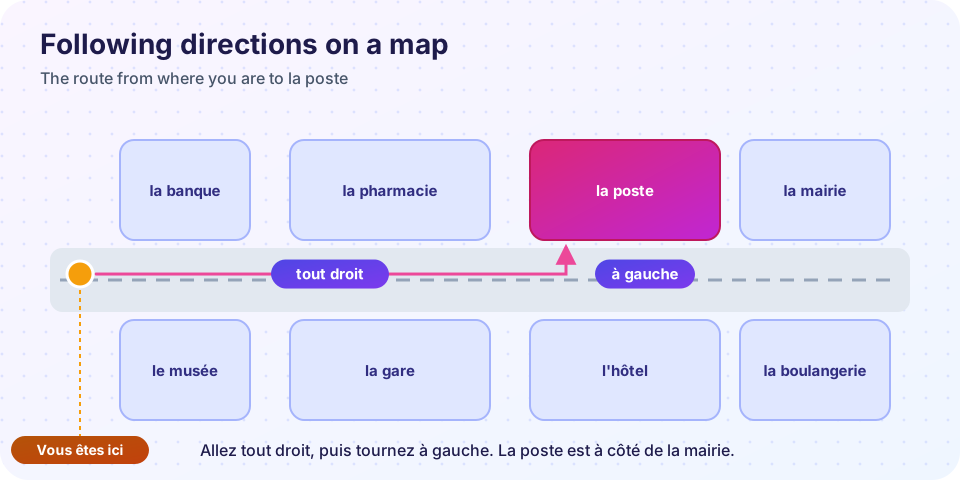
Following the route: allez tout droit, puis tournez à gauche. La poste est à côté de la mairie.
le plan: the map. la rue: the street. le carrefour: the intersection. un aller simple / un aller-retour: a one-way / return ticket. le quai / la voie: the platform / the track. à pied: on foot.
Voyageur : Bonjour, un aller simple pour Lyon, s'il vous plaît.
Hello, a one-way ticket to Lyon, please.
Guichetier : Pour quel jour ?
For which day?
Voyageur : Pour demain matin.
For tomorrow morning.
Guichetier : Il y a un train à huit heures dix.
There's a train at 8:10.
Voyageur : Parfait. Ça coûte combien ?
Perfect. How much is it?
Guichetier : Trente-quatre euros. Le train part de la voie 5.
Thirty-four euros. The train leaves from track 5.
Voyageur : Merci.
Thank you.
Guichetier : Bon voyage !
Have a good trip!
Useful rail words:un billet (ticket), un aller-retour (return), le quai (platform), la voie (track), le prochain train (the next train), le retard (delay: Le train a du retard), direct (non-stop), une correspondance (connection), composter (validate a paper ticket, still seen in some stations).
At a hotel:J'ai réservé une chambre au nom de Martin. (I booked a room in the name of Martin.) Avez-vous une chambre libre ? (Do you have a free room?) C'est pour deux nuits. (It's for two nights.) Le petit déjeuner est compris ? (Is breakfast included?) À quelle heure est le petit déjeuner ?
Native speakers give directions quickly, and the first few times you will understand only a few words. That is normal, and there are three strategies that help. First, listen for the keywords and ignore the rest: the verbs (allez, tournez, prenez, traversez), the direction words (tout droit, à gauche, à droite), numbers (la deuxième rue) and landmarks (le feu, la pharmacie, le pont). Second, repeat back what you understood: Donc, tout droit, puis à gauche au feu ? (So, straight on, then left at the light?) The other person will confirm or correct you, and you hear the answer a second time more slowly. Third, write it down or use a map if the route has more than three steps, and say Je peux le noter ? (May I write it down?). Asking for repetition is a normal part of conversation and never a sign of failure.
"À le musée." It is always au musée; the same goes for du and aux.
"I need to understand every word." You only need the keywords: the street, gauche/droite, tout droit and the landmark. Ask Pouvez-vous répéter, s'il vous plaît ? if you miss it.
"Où est la gare ? is rude." It is fine, but adding Excusez-moi or Bonjour first is the polite habit.
"Droit means right."À droite is right (direction); tout droit is straight on.
Drive the arrow with French commands. Your goal is la gare. Buildings block the way. Press the buttons, and watch the French instructions pile up.
Interactive map: follow the route
<style>*{box-sizing:border-box}body{margin:0;padding:14px;font-family:system-ui,-apple-system,'Segoe UI',sans-serif;background:linear-gradient(135deg,#faf5ff,#eff6ff);color:#1e1b4b}.wrap{max-width:560px;margin:0 auto}.grid{display:grid;grid-template-columns:repeat(6,1fr);gap:5px}.cell{aspect-ratio:1;border-radius:10px;background:#fff;display:flex;align-items:center;justify-content:center;text-align:center;font-size:11px;font-weight:600;line-height:1.15;color:#475569;box-shadow:0 2px 6px rgba(67,56,202,.10);padding:2px}.cell.b{background:#e0e7ff;color:#3730a3}.cell.t{background:linear-gradient(135deg,#db2777,#c026d3);color:#fff}.cell.me{background:#fef3c7;color:#92400e;font-size:26px;border:2px solid #f59e0b}.row{display:flex;gap:8px;flex-wrap:wrap;justify-content:center;margin:12px 0}button{font:inherit;cursor:pointer;border:0;border-radius:999px;padding:8px 14px;color:#fff;background:linear-gradient(135deg,#4f46e5,#7c3aed)}button.alt{background:#fff;color:#4f46e5;border:1px solid #c7d2fe}.msg{min-height:44px;text-align:center;font-size:15px}.log{background:#fff;border-radius:12px;padding:8px 12px;font-size:14px;min-height:40px;box-shadow:0 2px 6px rgba(67,56,202,.10)}.ok{color:#047857;font-weight:700}</style><divclass="wrap"><divclass="grid"id="g"></div><divclass="row"><buttonid="s">Allez tout droit</button><buttonid="l">Tournez à gauche</button><buttonid="r">Tournez à droite</button><buttonclass="alt"id="x">Recommencer</button></div><divclass="msg"id="m">Vous êtes au départ, face à l'est (▶). Trouvez la gare.</div><divclass="log"id="log"></div></div><script>constW=6,H=4,blocks={'2,2':'la pharmacie','1,1':'la banque','3,2':'le musée','5,3':'le café','2,0':'la mairie'};constT={x:4,y:1},D=[[0,-1],[1,0],[0,1],[-1,0]],AR=['▲','▶','▼','◀'];let p,d,log;const$=id=>document.getElementById(id);functionreset(){p={x:0,y:3};d=1;log=[];$('m').textContent="Vous êtes au départ, face à l'est (▶). Trouvez la gare.";draw();}functiondraw(){const g=$('g');g.innerHTML='';for(let y=0;y<H;y++)for(let x=0;x<W;x++){const c=document.createElement('div');c.className='cell';const k=x+','+y;if(blocks[k]){c.classList.add('b');c.textContent=blocks[k];}if(x===T.x&&y===T.y){c.classList.add('t');c.textContent='la gare';}if(x===p.x&&y===p.y){c.classList.add('me');c.textContent=AR[d];}
g.append(c);}$('log').textContent=log.length?log.join(' ; '):'Vos commandes apparaîtront ici.';}functiondone(){return p.x===T.x&&p.y===T.y;}functiongo(){const nx=p.x+D[d][0],ny=p.y+D[d][1];
log.push('Allez tout droit');if(nx<0||ny<0||nx>=W||ny>=H){$('m').textContent='Attention, c\'est la fin du plan !';draw();return;}if(blocks[nx+','+ny]){$('m').textContent='Il y a '+blocks[nx+','+ny]+' devant vous. Tournez !';draw();return;}
p={x:nx,y:ny};if(done()){$('m').innerHTML='<span class="ok">Bravo ! Vous êtes arrivé(e) à la gare.</span>';}else$('m').textContent='Vous avancez.';draw();}$('s').onclick=()=>{if(!done())go();};$('l').onclick=()=>{if(done())return;d=(d+3)%4;log.push('Tournez à gauche');$('m').textContent='Vous tournez à gauche.';draw();};$('r').onclick=()=>{if(done())return;d=(d+1)%4;log.push('Tournez à droite');$('m').textContent='Vous tournez à droite.';draw();};$('x').onclick=reset;reset();</script>
This Python helper turns a list of steps into a French sentence, and builds location sentences with the correct au/du/aux/des contractions. Add your own places.
Python
Directions and contractions
PLACES ={"gare":"la","poste":"la","musée":"le","hôtel":"l'","banque":"la","supermarché":"le","toilettes":"les"}
STEP ={"straight":"allez tout droit","left":"tournez à gauche","right":"tournez à droite","cross":"traversez la place","second":"prenez la deuxième rue à gauche"}defwith_article(noun):
art = PLACES[noun]return art + noun if art.endswith("'")else art +" "+ noun
defto_place(noun):
art = PLACES[noun]return{"le":"au "+ noun,"les":"aux "+ noun,"la":"à la "+ noun}.get(art,"à l'"+ noun)defof_place(noun):
art = PLACES[noun]return{"le":"du "+ noun,"les":"des "+ noun,"la":"de la "+ noun}.get(art,"de l'"+ noun)defroute(dest, steps):
text =", puis ".join(STEP[s]for s in steps)returnf"Pour aller {to_place(dest)} : {text}."defwhere(place, relation, ref):
verb ="sont"if PLACES[place]=="les"else"est"
s =f"{with_article(place)}{verb}{relation}{of_place(ref)}."return s[0].upper()+ s[1:]print(route("poste",["straight","left"]))print(route("musée",["cross","second"]))print(where("poste","à côté","musée"))print(where("hôtel","en face","gare"))print(where("toilettes","près","hôtel"))print(where("banque","loin","supermarché"))
Press Run (or Ctrl + Enter) to see the result here.
Program input · what you'd type while the program runs
Type the answers before you press Run, one per line. Each time the program reads a line (with input()), it gets the next line from this box.
Direction words
<style>:root{--ink:#1e1b4b;--mut:#475569;--a:#4f46e5;--b:#db2777}*{box-sizing:border-box}body{margin:0;padding:14px;font-family:system-ui,-apple-system,'Segoe UI',sans-serif;background:linear-gradient(135deg,#faf5ff,#eff6ff);color:var(--ink)}.wrap{max-width:640px;margin:0 auto}button{font:inherit;cursor:pointer;border:0;border-radius:999px;padding:8px 16px;color:#fff;background:linear-gradient(135deg,#4f46e5,#7c3aed);box-shadow:0 4px 10px rgba(79,70,229,.25)}button.alt{background:#fff;color:var(--a);border:1px solid #c7d2fe;box-shadow:none}button:disabled{opacity:.45;cursor:default}.row{display:flex;gap:8px;flex-wrap:wrap;justify-content:center;margin:12px 0}.card{background:#fff;border-radius:18px;box-shadow:0 10px 24px rgba(67,56,202,.16);padding:26px 18px;text-align:center;min-height:130px;display:flex;flex-direction:column;justify-content:center;align-items:center;width:100%;color:var(--ink);cursor:pointer;border:0}.card .big{font-size:28px;font-weight:700}.card .sm{font-size:14px;color:var(--mut);margin-top:6px}.cnt{text-align:center;color:var(--mut);font-size:14px;margin-bottom:8px}.msg{text-align:center;min-height:22px;color:var(--mut);font-size:14px}.ok{color:#047857;font-weight:600}.bad{color:#be123c;font-weight:600}input[type=text]{font:inherit;border:2px solid #c7d2fe;border-radius:10px;padding:5px 8px;width:150px;background:#fff;color:var(--ink)}input.good{border-color:#10b981;background:#ecfdf5}input.wrong{border-color:#ef4444;background:#fef2f2}.item{background:#fff;border-radius:14px;padding:10px 14px;margin:8px 0;box-shadow:0 4px 12px rgba(67,56,202,.10);line-height:2}.item small{display:block;color:var(--mut);line-height:1.3}.keys{display:flex;flex-wrap:wrap;gap:6px;justify-content:center;margin:8px 0}.keys button{padding:4px 11px;background:#fff;color:var(--a);border:1px solid #c7d2fe;box-shadow:none;border-radius:8px}.cols{display:grid;grid-template-columns:1fr 1fr;gap:10px}.cols button{display:block;width:100%;border-radius:12px;background:#fff;color:var(--ink);border:2px solid #c7d2fe;box-shadow:none;padding:10px 8px;margin-bottom:8px;text-align:center}.cols button.sel{border-color:#4f46e5;background:#eef2ff}.cols button.done{border-color:#10b981;background:#ecfdf5;color:#047857;cursor:default}.cols button.no{border-color:#ef4444;background:#fef2f2}</style><divclass="wrap"><divclass="cnt"id="cnt"></div><buttonclass="card"id="card"aria-live="polite"><spanclass="big"id="big"></span><spanclass="sm"id="sm"></span></button><divclass="row"><buttonclass="alt"id="prev">Back</button><buttonid="flip">Flip</button><buttonclass="alt"id="next">Next</button></div><divclass="row"><buttonclass="alt"id="dir">French first</button><buttonclass="alt"id="shuf">Shuffle</button><buttonclass="alt"id="say">Listen</button></div><divclass="msg"id="msg"></div></div><script>constD=[["à gauche","to the left"],["à droite","to the right"],["tout droit","straight ahead"],["à côté de","next to"],["en face de","opposite"],["près de","near"],["loin de","far from"],["au coin de","at the corner of"],["un aller simple","a one-way ticket"],["le quai","the platform"]];let i=0,showFr=true,fr=true;const$=id=>document.getElementById(id);functiondraw(){const c=D[i];$('cnt').textContent='Card '+(i+1)+' of '+D.length;const q=fr?c[0]:c[1],a=fr?c[1]:c[0];$('big').textContent=showFr?q:a;$('sm').textContent=showFr?'Tap to flip':(fr?'English':'French');}functionflip(){showFr=!showFr;draw();}$('card').onclick=flip;$('flip').onclick=flip;$('next').onclick=()=>{i=(i+1)%D.length;showFr=true;draw();};$('prev').onclick=()=>{i=(i-1+D.length)%D.length;showFr=true;draw();};$('dir').onclick=()=>{fr=!fr;$('dir').textContent=fr?'French first':'English first';showFr=true;draw();};$('shuf').onclick=()=>{for(let k=D.length-1;k>0;k--){const j=Math.floor(Math.random()*(k+1));[D[k],D[j]]=[D[j],D[k]];}i=0;showFr=true;draw();};$('say').onclick=()=>{try{if(!('speechSynthesis'in window))throw0;const u=newSpeechSynthesisUtterance(D[i][0]);u.lang='fr-FR';speechSynthesis.cancel();speechSynthesis.speak(u);$('msg').textContent='';}catch(e){$('msg').textContent='Speech is not available in this preview. Say it aloud yourself.';}};draw();</script>
Directions and tickets
<style>:root{--ink:#1e1b4b;--mut:#475569;--a:#4f46e5;--b:#db2777}*{box-sizing:border-box}body{margin:0;padding:14px;font-family:system-ui,-apple-system,'Segoe UI',sans-serif;background:linear-gradient(135deg,#faf5ff,#eff6ff);color:var(--ink)}.wrap{max-width:640px;margin:0 auto}button{font:inherit;cursor:pointer;border:0;border-radius:999px;padding:8px 16px;color:#fff;background:linear-gradient(135deg,#4f46e5,#7c3aed);box-shadow:0 4px 10px rgba(79,70,229,.25)}button.alt{background:#fff;color:var(--a);border:1px solid #c7d2fe;box-shadow:none}button:disabled{opacity:.45;cursor:default}.row{display:flex;gap:8px;flex-wrap:wrap;justify-content:center;margin:12px 0}.card{background:#fff;border-radius:18px;box-shadow:0 10px 24px rgba(67,56,202,.16);padding:26px 18px;text-align:center;min-height:130px;display:flex;flex-direction:column;justify-content:center;align-items:center;width:100%;color:var(--ink);cursor:pointer;border:0}.card .big{font-size:28px;font-weight:700}.card .sm{font-size:14px;color:var(--mut);margin-top:6px}.cnt{text-align:center;color:var(--mut);font-size:14px;margin-bottom:8px}.msg{text-align:center;min-height:22px;color:var(--mut);font-size:14px}.ok{color:#047857;font-weight:600}.bad{color:#be123c;font-weight:600}input[type=text]{font:inherit;border:2px solid #c7d2fe;border-radius:10px;padding:5px 8px;width:150px;background:#fff;color:var(--ink)}input.good{border-color:#10b981;background:#ecfdf5}input.wrong{border-color:#ef4444;background:#fef2f2}.item{background:#fff;border-radius:14px;padding:10px 14px;margin:8px 0;box-shadow:0 4px 12px rgba(67,56,202,.10);line-height:2}.item small{display:block;color:var(--mut);line-height:1.3}.keys{display:flex;flex-wrap:wrap;gap:6px;justify-content:center;margin:8px 0}.keys button{padding:4px 11px;background:#fff;color:var(--a);border:1px solid #c7d2fe;box-shadow:none;border-radius:8px}.cols{display:grid;grid-template-columns:1fr 1fr;gap:10px}.cols button{display:block;width:100%;border-radius:12px;background:#fff;color:var(--ink);border:2px solid #c7d2fe;box-shadow:none;padding:10px 8px;margin-bottom:8px;text-align:center}.cols button.sel{border-color:#4f46e5;background:#eef2ff}.cols button.done{border-color:#10b981;background:#ecfdf5;color:#047857;cursor:default}.cols button.no{border-color:#ef4444;background:#fef2f2}</style><divclass="wrap"><divclass="keys"id="keys"></div><divid="list"></div><divclass="row"><buttonid="chk">Check answers</button><buttonclass="alt"id="show">Show answers</button></div><divclass="msg"id="msg">Type each answer. Use the accent buttons if your keyboard has no accents.</div></div><script>constD=[{"s":"Pour aller ___ musée ? (to the)","a":["au"],"h":"à + le."},{"s":"Il est près ___ pont. (of the)","a":["du"],"h":"de + le."},{"s":"___ à gauche, puis allez tout droit. (Turn left)","a":["Tournez"],"h":"Command, vous form."},{"s":"Un aller ___ pour Lyon. (one-way)","a":["simple"],"h":""},{"s":"La poste est ___ côté de la mairie.","a":["à"],"h":""},{"s":"Pouvez-vous ___ , s’il vous plaît ? (repeat)","a":["répéter"],"h":""}];const$=id=>document.getElementById(id);let last=null;constnorm=s=>s.trim().toLowerCase().replace(/[\u2019\u2018]/g,"'").replace(/\s+/g,' ');D.forEach((d,k)=>{const p=d.s.split('___');const div=document.createElement('div');div.className='item';
div.append(p[0]);const inp=document.createElement('input');inp.type='text';inp.id='i'+k;inp.autocomplete='off';inp.spellcheck=false;inp.setAttribute('aria-label','Answer '+(k+1));inp.onfocus=()=>last=inp;div.append(inp);div.append(p[1]||'');if(d.h){const s=document.createElement('small');s.textContent=d.h;div.append(s);}$('list').append(div);});['é','è','ê','à','â','ç','î','ï','ô','ù','û','œ'].forEach(ch=>{const b=document.createElement('button');b.textContent=ch;b.setAttribute('aria-label','Insert '+ch);b.onmousedown=e=>e.preventDefault();b.onclick=()=>{const t=last||$('i0');t.focus();const s=t.selectionStart,e=t.selectionEnd;t.setRangeText(ch,s,e,'end');};$('keys').append(b);});$('chk').onclick=()=>{let n=0;D.forEach((d,k)=>{const t=$('i'+k);const ok=d.a.some(a=>norm(a)===norm(t.value));t.className=ok?'good':'wrong';if(ok)n++;});$('msg').innerHTML=n===D.length?'<span class="ok">All '+n+' correct. Bravo !</span>':'<span class="bad">'+n+' of '+D.length+' correct.</span> Check accents and endings.';};$('show').onclick=()=>{D.forEach((d,k)=>{$('i'+k).value=d.a[0];$('i'+k).className='good';});$('msg').textContent='Answers shown. Reload the preview to reset.';};</script>