


















Lesson 5 of 48 · Sounds, Greetings and Basics
Chapter 2 overview: Sounds, Greetings and Basics
Preview chapter 2 of French for Beginners: five key facts about French pronunciation, the greetings you will learn, introductions and numbers, with a first short dialogue.
Chapter 2 is where French starts to sound like French. You will learn how the vowels and consonants are pronounced, why many written letters are silent, how words link together in speech, and then use those sounds for the most useful things a beginner can say: greetings, politeness, your name, where you are from, and numbers up to one hundred.
The order matters. Many learners rush to grammar and then discover that they cannot pronounce what they have memorized. Spending a short time on sound first means every word you learn from now on arrives with a good pronunciation, instead of an English one that is hard to unlearn.
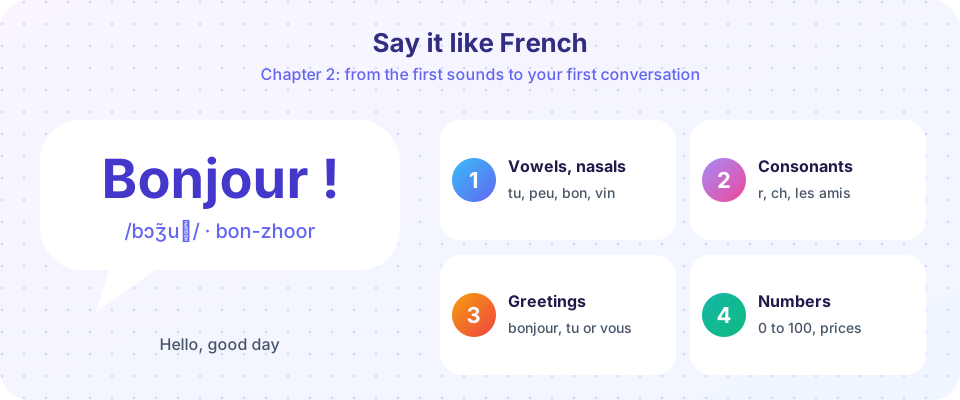
What you will learn
- The big picture of French pronunciation and why spelling looks so far from sound.
- What each lesson of the chapter covers and why it comes in this order.
- A first dialogue you can read aloud and learn by heart.
Key terms
Phoneme is one distinct sound in a language, shown in IPA between slashes.
Nasal vowel is a vowel pronounced with air passing through the nose, such as the /ɑ̃/ in dans.
Liaison is the linking of a normally silent final consonant to a following vowel, as in les amis /lez‿ami/.
Elision is dropping a vowel before another vowel: le + ami becomes l'ami.
Syllable-timed means each syllable takes roughly the same time, unlike English, where stressed syllables are longer.
Five facts about French pronunciation
1. French is syllable-timed. In English, we squeeze unstressed syllables and lengthen stressed ones: "PHOtograph", "phoTOgrapher". French syllables come out evenly, like beads on a string. The only gentle stress falls on the last syllable of a phrase or word group. So photographe is pho-to-graphe with roughly equal beats and a small lift at the end.
2. Vowels are pure. English vowels often glide: "say" slides toward "ee", "go" toward "oo". French vowels hold steady. The é in été does not glide, and the o in mot stays an o. Keep your tongue and lips still while the vowel lasts.
3. French has vowels that English lacks. The rounded front vowels (u as in tu, eu as in peu), and four nasal vowels (an, in, on, un) take practice. The next lesson trains them one at a time.
4. Many final consonants are silent. Petit is /pəti/, grand is /ɡʁɑ̃/, vous is /vu/. The letters are there, but the sound is not. A useful memory trick is the word CaReFuL: the final letters c, r, f and l are often pronounced (sac, bar, chef, hôtel) while most other final consonants are silent. It is a tendency, not a law: parler ends in a silent r, and clef has a silent f in the usual pronunciation.
5. Words link together. French speakers glide words into each other. Un ami sounds like "u-na-mi", and vous avez sounds like "vou-za-vé". This linking is why French sounds so smooth, and why a written sentence can seem to disappear when a native speaker says it quickly. You will practice it in lesson 3.
What each lesson covers
- Vowels and nasals (Vowels and nasal sounds): the oral vowels, the rounded vowels, nasal vowels, and the common spelling patterns ou, eau, ai, oi, eu.
- Consonants, silent letters and liaison (Consonants and liaison): the French r, the soft and hard c and g, the silent h, elision and liaison.
- Greetings and introductions (Greetings and introductions): bonjour, salut, thank you, please, tu and vous, and how to say who you are and where you are from.
- Numbers (Numbers 0 to 100): counting, the odd system of seventy, eighty and ninety, and prices and phone numbers.
- Review (Chapter 2 review): a one-picture summary, a mixed quiz, and a longer dialogue.
Sounds first
Spelling versus sound
Social words
Numbers
A first dialogue
Here is a short exchange in a café. You will understand every word by the end of the chapter. Read it aloud, then try to cover the English.
| Français | English |
|---|---|
| Bonjour, monsieur. | Hello, sir. |
| Bonjour, madame. Un café, s'il vous plaît. | Hello, madam. A coffee, please. |
| Voilà. Deux euros cinquante. | Here you are. Two euros fifty. |
| Merci. Voici trois euros. | Thank you. Here are three euros. |
| Merci. Au revoir ! | Thank you. Goodbye! |
| Au revoir, bonne journée ! | Goodbye, have a good day! |
Pronunciation preview: Bonjour /bɔ̃ʒuʁ/ (bon-zhoor, with a nasal on), merci /mɛʁsi/ (mair-see), s'il vous plaît /sil vu plɛ/ (seel voo pleh), au revoir /o ʁəvwaʁ/ (oh ruh-vwahr), voilà /vwala/ (vwah-lah). You will practice each sound before the chapter ends.
How to use the chapter
For this chapter, spend about half of each session speaking. Record yourself on your phone saying a short list of words, and compare with a native recording from a website, app or video. Listen for three things: are the vowels pure, are the final consonants silent, and do the words link? Do not worry about getting the French r perfect on day one; it is the last sound most learners master, and listeners understand a rough version perfectly well.
Why sound comes first
Research on infant speech perception, such as the work of Patricia Kuhl, shows that babies begin life able to hear the differences between sounds of all languages, and that during the first year this ability narrows toward the sounds of the language they hear most. Adults therefore tend to hear a new language through the filter of their first one. An English speaker may genuinely fail to hear the difference between tu and tout at first. The good news is that listening can be trained: with focused practice on contrasts such as /y/ versus /u/ and /ɛ/ versus /e/, adult learners improve both perception and production. That is why this chapter asks you to listen, say and record, not just read.
Common misconceptions
"French is pronounced the way it is spelled, like Spanish." French spelling follows rules, but they are different from English rules and keep many historical silent letters. Learn the patterns and the exceptions will shrink.
"I should say each letter I see." Often the last letter of a word is silent. When in doubt, check a pronunciation guide.
"Stress goes on the first syllable, as in English." Do not stress the first syllable. Give each syllable about the same length, with a light lift at the end of the group.
Try it
Learn the six café phrases as cards. Say each aloud, then flip.
Now match the sound clues with the words. This game does not test your ears; it only checks that you connect words to respellings.
Check your understanding
Quick check · 4 questions
of 4 answered You scored / 4 · perfect!
-
1. What does syllable-timed mean?
French syllables come out at an even pace, with a light stress at the end of a group. -
2. What is liaison?
In les amis, the s links to the a: /lez‿ami/. -
3. In the CaReFuL trick, which final letters are often pronounced?
Final c, r, f and l are often pronounced: sac, bar, chef, hôtel. -
4. Which is a pure vowel behaviour?
French vowels hold steady, unlike English 'say' and 'go'.
Summary
- French is syllable-timed, with pure vowels, nasal vowels, silent final consonants and linking between words.
- Chapter 2 covers vowels and nasals, consonants and liaison, greetings and introductions, and numbers up to 100.
- Learn each word with its sound; record yourself and compare.
- Spelling follows patterns; learn them rather than saying each letter.
Next: Vowels and nasal sounds
Track your progress
Create a free account to tick off lessons and pick up where you left off on any device.
of French for Beginners lessons completed