Learn the three ways to ask French questions, from casual intonation to formal inversion, plus question words, quel, and survival phrases.
A language you can only answer in is half a language. Questions let you start conversations, get directions, order food and keep talking when you are lost. French has one great advantage here: you can ask a perfectly good yes/no question just by raising your voice. It also has a more formal toolkit, and you will meet all of it on signs, in textbooks and in polite speech.
In this lesson you will learn the three standard ways to form a question, the question words (où, quand, comment and friends), the word quel, which changes its form, and a handful of phrases that keep you afloat when you do not understand.
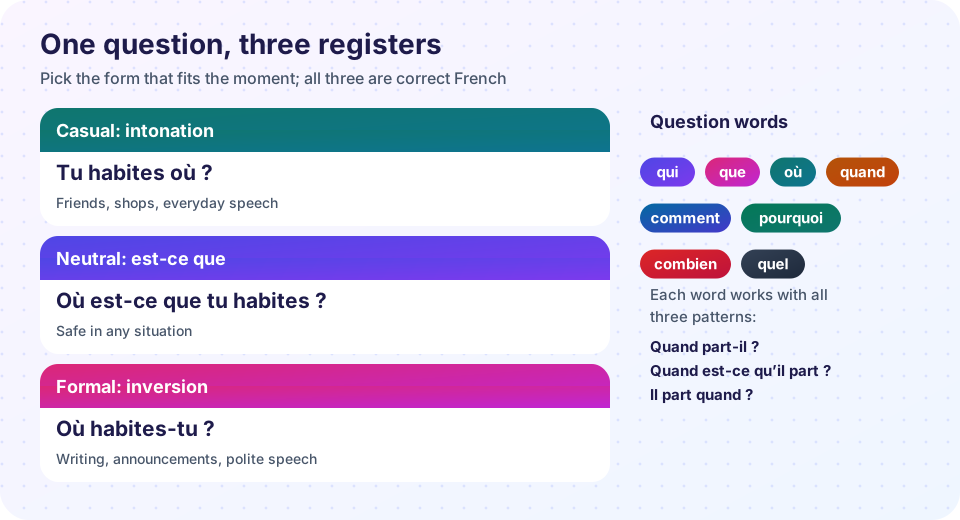
One question, three registers: the higher the card, the more formal the French.
l'intonation (f.): your voice rising at the end of a sentence. est-ce que: a fixed phrase that turns a statement into a question. l'inversion (f.): putting the verb before the subject pronoun and joining them with a hyphen. un mot interrogatif: a question word. le registre: the level of formality (casual, neutral, formal).
Put est-ce que in front of a statement. It literally means "is it that". It becomes est-ce qu' before a vowel.
Est-ce que tu parles français ? Do you speak French?
Est-ce qu'il habite ici ? Does he live here?
Est-ce que vous voulez un café ? Do you want a coffee?
Say it as one blob: esk(e). It works at any level of formality, and it is the safest choice while you are learning because the word order stays the same as in a statement.
Swap the subject pronoun and the verb, and join them with a hyphen.
Tu parles français. → Parles-tu français ?
Vous avez une réservation. → Avez-vous une réservation ?
Ils aiment le fromage. → Aiment-ils le fromage ?
Three rules matter:
When the verb ends in a vowel and the pronoun is il, elle or on, you add -t- to separate the two vowels: Parle-t-il ?, A-t-elle faim ?, Va-t-on au cinéma ?
With a noun subject, keep the noun first and add the pronoun: Marie habite-t-elle ici ? (Does Marie live here?), Tes parents travaillent-ils ?
Avoid inversion with je. Say Est-ce que je peux entrer ? instead of "Puis-je" in normal speech, though Puis-je ...? (May I ...?) exists in formal service language, and so do Suis-je ...? and Ai-je ...? in writing.
You will see inversion in newspapers, on exams, in announcements and in formal conversation. You will hear it much less in daily chatter, and you should be able to recognize it even if you prefer est-ce que when you speak.
For questions that need information (not just yes or no), start with a question word.
French
English
Example
qui
who
Qui est-ce ? Who is it?
que / qu'
what
Que fais-tu ? What are you doing?
où
where
Où habites-tu ? Where do you live?
quand
when
Quand pars-tu ? When are you leaving?
comment
how
Comment vas-tu ? How are you?
pourquoi
why
Pourquoi pleures-tu ? Why are you crying?
combien (de)
how much / many
Combien de frères as-tu ? How many brothers do you have?
quel, quelle, quels, quelles
which / what
Quelle heure est-il ? What time is it?
Each question word works with all three patterns. Here is où with the verb habiter:
Register
Question
Casual
Tu habites où ?
Neutral
Où est-ce que tu habites ?
Formal
Où habites-tu ?
For what, notice that que alone needs inversion (Que veux-tu ?), while the neutral version is qu'est-ce que (Qu'est-ce que tu veux ?) and the casual one puts quoi at the end (Tu veux quoi ?). Use Qu'est-ce que c'est ? ("What is it?") as your all-purpose way of asking about an unknown object.
A preposition goes in front of the question word: Avec qui parles-tu ? (With whom are you talking?), De quoi parles-tu ? (What are you talking about?), Pour quoi faire ? (What for?). Careful French does not leave it at the end the way English does, although casual speech often does (Tu parles avec qui ?).
Quel means "which" or "what" before a noun, and it agrees with that noun:
Masculine
Feminine
Singular
quel
quelle
Plural
quels
quelles
All four are pronounced the same, like "kell". Examples: Quel âge as-tu ? (How old are you?), Quelle est ta couleur préférée ? (What is your favorite color?), Quels sont vos plats favoris ? (What are your favorite dishes?), Quelles langues parlez-vous ? (Which languages do you speak?). In English you say "what time"; in French the noun heure is feminine, so it is quelle heure.
Oui means yes, and non means no. To say yes to a negative question, French has the special word si:
Tu n'as pas faim ? — Si, j'ai faim. You're not hungry? — Yes, I am.
Tu ne viens pas ? — Non, je ne viens pas. You're not coming? — No, I'm not.
You can also use short tags: add n'est-ce pas ? (isn't it?) or non ? to a statement to ask for agreement: Il fait beau, n'est-ce pas ? (The weather is nice, isn't it?). In casual speech people add hein ? or non ?.
Review the question words with a matching game. Tap a French word, then its meaning.
Question words
<style>:root{--ink:#1e1b4b;--mut:#475569;--a:#4f46e5;--b:#db2777}*{box-sizing:border-box}body{margin:0;padding:14px;font-family:system-ui,-apple-system,'Segoe UI',sans-serif;background:linear-gradient(135deg,#faf5ff,#eff6ff);color:var(--ink)}.wrap{max-width:640px;margin:0 auto}button{font:inherit;cursor:pointer;border:0;border-radius:999px;padding:8px 16px;color:#fff;background:linear-gradient(135deg,#4f46e5,#7c3aed);box-shadow:0 4px 10px rgba(79,70,229,.25)}button.alt{background:#fff;color:var(--a);border:1px solid #c7d2fe;box-shadow:none}button:disabled{opacity:.45;cursor:default}.row{display:flex;gap:8px;flex-wrap:wrap;justify-content:center;margin:12px 0}.card{background:#fff;border-radius:18px;box-shadow:0 10px 24px rgba(67,56,202,.16);padding:26px 18px;text-align:center;min-height:130px;display:flex;flex-direction:column;justify-content:center;align-items:center;width:100%;color:var(--ink);cursor:pointer;border:0}.card .big{font-size:28px;font-weight:700}.card .sm{font-size:14px;color:var(--mut);margin-top:6px}.cnt{text-align:center;color:var(--mut);font-size:14px;margin-bottom:8px}.msg{text-align:center;min-height:22px;color:var(--mut);font-size:14px}.ok{color:#047857;font-weight:600}.bad{color:#be123c;font-weight:600}input[type=text]{font:inherit;border:2px solid #c7d2fe;border-radius:10px;padding:5px 8px;width:150px;background:#fff;color:var(--ink)}input.good{border-color:#10b981;background:#ecfdf5}input.wrong{border-color:#ef4444;background:#fef2f2}.item{background:#fff;border-radius:14px;padding:10px 14px;margin:8px 0;box-shadow:0 4px 12px rgba(67,56,202,.10);line-height:2}.item small{display:block;color:var(--mut);line-height:1.3}.keys{display:flex;flex-wrap:wrap;gap:6px;justify-content:center;margin:8px 0}.keys button{padding:4px 11px;background:#fff;color:var(--a);border:1px solid #c7d2fe;box-shadow:none;border-radius:8px}.cols{display:grid;grid-template-columns:1fr 1fr;gap:10px}.cols button{display:block;width:100%;border-radius:12px;background:#fff;color:var(--ink);border:2px solid #c7d2fe;box-shadow:none;padding:10px 8px;margin-bottom:8px;text-align:center}.cols button.sel{border-color:#4f46e5;background:#eef2ff}.cols button.done{border-color:#10b981;background:#ecfdf5;color:#047857;cursor:default}.cols button.no{border-color:#ef4444;background:#fef2f2}</style><divclass="wrap"><divclass="cols"><divid="L"></div><divid="R"></div></div><divclass="row"><buttonclass="alt"id="again">Shuffle again</button></div><divclass="msg"id="msg">Tap a French item, then its English match.</div></div><script>constD=[["où","where"],["quand","when"],["comment","how"],["pourquoi","why"],["qui","who"],["combien","how much, how many"],["quel","which, what"],["est-ce que","turns a statement into a question"]];const$=id=>document.getElementById(id);let selL=null,done=0,tries=0;constsh=a=>{a=a.slice();for(let k=a.length-1;k>0;k--){const j=Math.floor(Math.random()*(k+1));[a[k],a[j]]=[a[j],a[k]];}return a;};functionbuild(){selL=null;done=0;tries=0;$('L').innerHTML='';$('R').innerHTML='';$('msg').textContent='Tap a French item, then its English match.';sh(D.map((d,k)=>k)).forEach(k=>{const b=document.createElement('button');b.textContent=D[k][0];b.dataset.k=k;b.onclick=()=>{if(b.classList.contains('done'))return;document.querySelectorAll('#L .sel').forEach(x=>x.classList.remove('sel'));b.classList.add('sel');selL=b;};$('L').append(b);});sh(D.map((d,k)=>k)).forEach(k=>{const b=document.createElement('button');b.textContent=D[k][1];b.dataset.k=k;b.onclick=()=>{if(!selL||b.classList.contains('done'))return;tries++;if(selL.dataset.k===b.dataset.k){selL.className='done';b.className='done';selL=null;done++;if(done===D.length)$('msg').innerHTML='<span class="ok">Complete in '+tries+' tries. Bravo !</span>';}else{b.classList.add('no');setTimeout(()=>b.classList.remove('no'),500);}};$('R').append(b);});}$('again').onclick=build;build();</script>
This Python helper builds the three versions of a question from a subject and a verb form that you give it. It adds the -t- in inversion and the elision in est-ce qu'. Try your own verbs.
Python
Question builder
defask(qword, subject, verb, rest=""):"""Return (casual, neutral, formal) versions of a question."""
s = subject.capitalize()
tail =(" "+ rest)if rest else""
third = subject in("il","elle","on")
t ="-t-"if third and verb[-1]in"ae"else"-"if qword:
casual =f"{s}{verb}{qword} ?"
que ="qu'"if subject in("il","elle","on","ils","elles")else"que "
neutral =f"{qword.capitalize()} est-ce {que}{subject}{verb} ?"
formal =f"{qword.capitalize()}{verb}{t}{subject} ?"else:
casual =f"{s}{verb}{tail} ?"
que ="qu'"if subject in("il","elle","on","ils","elles")else"que "
neutral =f"Est-ce {que}{subject}{verb}{tail} ?"
formal =f"{verb.capitalize()}{t}{subject}{tail} ?"return casual, neutral, formal
examples =[("où","tu","habites",""),("quand","il","arrive",""),("pourquoi","vous","partez",""),("comment","elle","va",""),("","tu","parles","français"),("","elle","a","faim"),]for q, subj, verb, rest in examples:
c, n, f = ask(q, subj, verb, rest)print("casual :", c)print("neutral:", n)print("formal :", f)print()
Press Run (or Ctrl + Enter) to see the result here.
Program input · what you'd type while the program runs
Type the answers before you press Run, one per line. Each time the program reads a line (with input()), it gets the next line from this box.
Finish with a gap-fill on question words and quel.
Fill in the question word
<style>:root{--ink:#1e1b4b;--mut:#475569;--a:#4f46e5;--b:#db2777}*{box-sizing:border-box}body{margin:0;padding:14px;font-family:system-ui,-apple-system,'Segoe UI',sans-serif;background:linear-gradient(135deg,#faf5ff,#eff6ff);color:var(--ink)}.wrap{max-width:640px;margin:0 auto}button{font:inherit;cursor:pointer;border:0;border-radius:999px;padding:8px 16px;color:#fff;background:linear-gradient(135deg,#4f46e5,#7c3aed);box-shadow:0 4px 10px rgba(79,70,229,.25)}button.alt{background:#fff;color:var(--a);border:1px solid #c7d2fe;box-shadow:none}button:disabled{opacity:.45;cursor:default}.row{display:flex;gap:8px;flex-wrap:wrap;justify-content:center;margin:12px 0}.card{background:#fff;border-radius:18px;box-shadow:0 10px 24px rgba(67,56,202,.16);padding:26px 18px;text-align:center;min-height:130px;display:flex;flex-direction:column;justify-content:center;align-items:center;width:100%;color:var(--ink);cursor:pointer;border:0}.card .big{font-size:28px;font-weight:700}.card .sm{font-size:14px;color:var(--mut);margin-top:6px}.cnt{text-align:center;color:var(--mut);font-size:14px;margin-bottom:8px}.msg{text-align:center;min-height:22px;color:var(--mut);font-size:14px}.ok{color:#047857;font-weight:600}.bad{color:#be123c;font-weight:600}input[type=text]{font:inherit;border:2px solid #c7d2fe;border-radius:10px;padding:5px 8px;width:150px;background:#fff;color:var(--ink)}input.good{border-color:#10b981;background:#ecfdf5}input.wrong{border-color:#ef4444;background:#fef2f2}.item{background:#fff;border-radius:14px;padding:10px 14px;margin:8px 0;box-shadow:0 4px 12px rgba(67,56,202,.10);line-height:2}.item small{display:block;color:var(--mut);line-height:1.3}.keys{display:flex;flex-wrap:wrap;gap:6px;justify-content:center;margin:8px 0}.keys button{padding:4px 11px;background:#fff;color:var(--a);border:1px solid #c7d2fe;box-shadow:none;border-radius:8px}.cols{display:grid;grid-template-columns:1fr 1fr;gap:10px}.cols button{display:block;width:100%;border-radius:12px;background:#fff;color:var(--ink);border:2px solid #c7d2fe;box-shadow:none;padding:10px 8px;margin-bottom:8px;text-align:center}.cols button.sel{border-color:#4f46e5;background:#eef2ff}.cols button.done{border-color:#10b981;background:#ecfdf5;color:#047857;cursor:default}.cols button.no{border-color:#ef4444;background:#fef2f2}</style><divclass="wrap"><divclass="keys"id="keys"></div><divid="list"></div><divclass="row"><buttonid="chk">Check answers</button><buttonclass="alt"id="show">Show answers</button></div><divclass="msg"id="msg">Type each answer. Use the accent buttons if your keyboard has no accents.</div></div><script>constD=[{"s":"___ habites-tu ? (Where do you live?)","a":["Où"],"h":"Question word for place."},{"s":"___ heure est-il ? (What time is it?)","a":["Quelle"],"h":"Agrees with the feminine noun heure."},{"s":"___ de frères as-tu ? (How many brothers?)","a":["Combien"],"h":"Followed by de."},{"s":"Tu veux ___ ? (casual: What do you want?)","a":["quoi"],"h":"Casual question word at the end."},{"s":"Tu ne viens pas ? — ___, je viens. (Yes, I am.)","a":["Si"],"h":"Answer to a negative question."},{"s":"___-t-il un chat ? (Does he have a cat?)","a":["A"],"h":"Verb avoir, inverted."}];const$=id=>document.getElementById(id);let last=null;constnorm=s=>s.trim().toLowerCase().replace(/[\u2019\u2018]/g,"'").replace(/\s+/g,' ');D.forEach((d,k)=>{const p=d.s.split('___');const div=document.createElement('div');div.className='item';
div.append(p[0]);const inp=document.createElement('input');inp.type='text';inp.id='i'+k;inp.autocomplete='off';inp.spellcheck=false;inp.setAttribute('aria-label','Answer '+(k+1));inp.onfocus=()=>last=inp;div.append(inp);div.append(p[1]||'');if(d.h){const s=document.createElement('small');s.textContent=d.h;div.append(s);}$('list').append(div);});['é','è','ê','à','â','ç','î','ï','ô','ù','û','œ'].forEach(ch=>{const b=document.createElement('button');b.textContent=ch;b.setAttribute('aria-label','Insert '+ch);b.onmousedown=e=>e.preventDefault();b.onclick=()=>{const t=last||$('i0');t.focus();const s=t.selectionStart,e=t.selectionEnd;t.setRangeText(ch,s,e,'end');};$('keys').append(b);});$('chk').onclick=()=>{let n=0;D.forEach((d,k)=>{const t=$('i'+k);const ok=d.a.some(a=>norm(a)===norm(t.value));t.className=ok?'good':'wrong';if(ok)n++;});$('msg').innerHTML=n===D.length?'<span class="ok">All '+n+' correct. Bravo !</span>':'<span class="bad">'+n+' of '+D.length+' correct.</span> Check accents and endings.';};$('show').onclick=()=>{D.forEach((d,k)=>{$('i'+k).value=d.a[0];$('i'+k).className='good';});$('msg').textContent='Answers shown. Reload the preview to reset.';};</script>