


















Lesson 33 of 48 · Past Tenses
Chapter 6 Review: Past Tenses
Review the French passé composé with avoir and être, the imparfait and how to choose between them, with a summary picture, recap and ten-question quiz.
You can now talk about yesterday, your childhood and the weather last weekend. This review gathers the two past tenses into one page, shows the most common errors, and tests whether you can tell the right form from the wrong one. As in every review, try the quiz first, then use the recap to fix gaps.
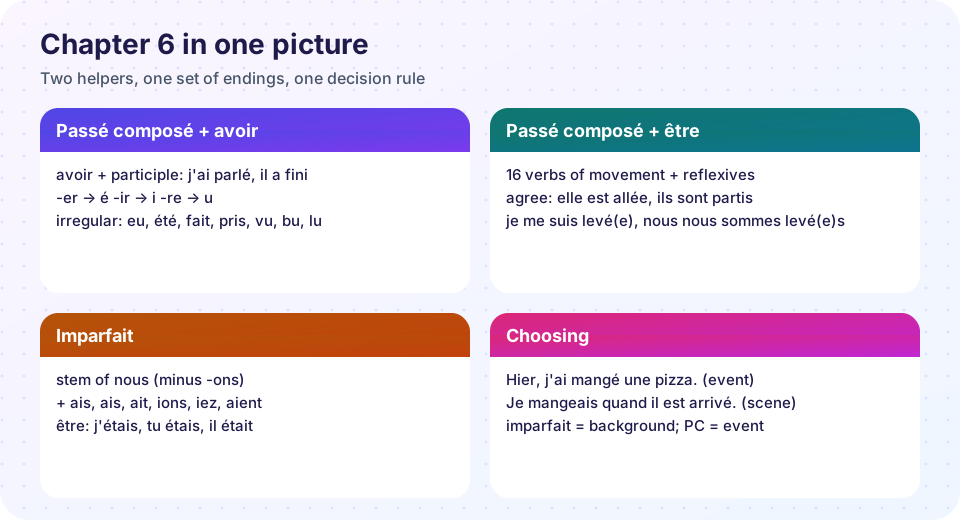
What you will learn
- Which pieces of the past tenses you remember, and which need another pass
- How to build and choose a past tense step by step
- The mistakes that cost points most often
Recap table
| Topic | Rule | Example |
|---|---|---|
| Passé composé (avoir) | present of avoir + participle | Nous avons mangé. |
| Regular participles | -er → é, -ir → i, -re → u | parlé, fini, vendu |
| Irregular participles | learn by heart | eu, été, fait, pris, vu, bu, lu, dit |
| Passé composé (être) | 16 verbs + reflexives; participle agrees | Elle est allée. Ils se sont levés. |
| Negation | wraps the auxiliary | Je n'ai pas mangé. |
| Imparfait | nous stem − -ons + -ais -ais -ait -ions -iez -aient | je parlais, nous finissions |
| Être in the imparfait | stem ét- | j'étais, il était |
| Choosing | event → passé composé; scene/habit → imparfait | Il pleuvait quand je suis sorti. |
Decision flow
Use this mini-flow whenever you hesitate.
- Is it a single, finished event that moves the story? → passé composé.
- Is it a description, age, weather or feeling? → imparfait.
- Is it a habit or repeated action ("used to")? → imparfait.
- Is it going on when something interrupts it? → imparfait for the long action, passé composé for the interruption.
- If you chose the passé composé, ask: does the verb take être (movement, change, reflexive)? If not, use avoir.
Quick check for -é vs -er. If you can replace the verb with vendu / vendre, a participle (vendu) means -é, and an infinitive (vendre) means -er. Il a mangé (like il a vendu) is a participle; Il veut manger (like il veut vendre) is an infinitive.
Worked examples
Three sentences, each combining several ideas from the chapter.
- Hier soir, je suis rentré tard parce qu'il pleuvait. (Last night I came home late because it was raining.) Rentrer is one of the sixteen être verbs, so the auxiliary is suis and the participle rentré agrees with the subject (add -e if the speaker is a woman). The event (je suis rentré) is in the passé composé, while the reason, the weather, is background and takes the imparfait (il pleuvait).
- Elle s'est réveillée à sept heures, mais elle n'a pas pris de petit-déjeuner. (She woke up at seven, but she didn't have breakfast.) The first verb is reflexive, so it uses être and the participle agrees with the feminine subject (réveillée). The second verb is prendre, which uses avoir, and the negation wraps the auxiliary (n'a pas pris). After the negation, un petit-déjeuner becomes de petit-déjeuner.
- Quand j'étais enfant, nous allions chaque été chez ma grand-mère. (When I was a child, we went to my grandmother's every summer.) Both verbs are in the imparfait: j'étais describes a stage of life, and nous allions describes a repeated habit signalled by chaque été. The stem of allions is all-, from nous allons.
If you wrote any of these differently, compare the choice of auxiliary first, because that is the most common source of error.
Try it
Review the forms with a gap-fill that mixes both tenses.
And flashcards for the verbs that need memorizing.
Check your understanding
Quick check · 10 questions
of 10 answered You scored / 10 · perfect!
-
1. Which sentence is correct?
Aller uses être. The agreement -e is only for a feminine subject. -
2. What is the participle of 'prendre'?
Prendre is irregular: pris. -
3. 'Il ___ beau.' (past weather, background)
Weather as background takes the imparfait: il faisait beau. -
4. Which is the imparfait of 'nous finissons'?
Finiss- + ions = nous finissions. -
5. How do you say 'She didn't get up'?
Reflexive verbs use être, and the negation wraps the pronoun and auxiliary: elle ne s'est pas levée. -
6. In 'Je lisais quand tu as téléphoné', which action was in progress?
Je lisais (imparfait) was in progress; tu as téléphoné (passé composé) interrupted it. -
7. Which spelling is correct?
Before i, the -ger verbs do not need the extra e: nous mangions. The extra e appears before a (je mangeais). -
8. How do you say 'We ate'?
Manger takes avoir and the participle mangé. -
9. Which tense for 'Every summer we went to the sea'?
A repeated habit takes the imparfait: tous les étés, nous allions à la mer. -
10. What does 'il y a deux jours' mean?
Il y a + time period means ago.
Summary
- Passé composé = avoir or être + participle; être verbs agree with the subject.
- Imparfait = nous stem + -ais endings; étais for être.
- Event → passé composé; scene, habit, description → imparfait.
- Next you will look forward: the near future, the simple future, pronouns and a first taste of the subjunctive.
Next: Chapter 7 Overview: Future, Pronouns and Subjunctive Basics
Track your progress
Create a free account to tick off lessons and pick up where you left off on any device.
of French for Beginners lessons completed