


















Lesson 38 of 48 · Future, Pronouns and Subjunctive Basics
Chapter 7 Review: Future, Pronouns and Subjunctive
Review the French futur proche, futur simple, object pronouns, y, en and subjunctive basics with a summary picture, recap table and ten-question quiz.
This chapter packed in three big ideas: how to talk about the future, how to replace nouns with pronouns, and how to recognize the subjunctive. None of them needs to be perfect yet. What matters is that you can hear a pattern, name it and produce it in a simple sentence. Use this page to find which of the three feels shakiest, then go back to that lesson.
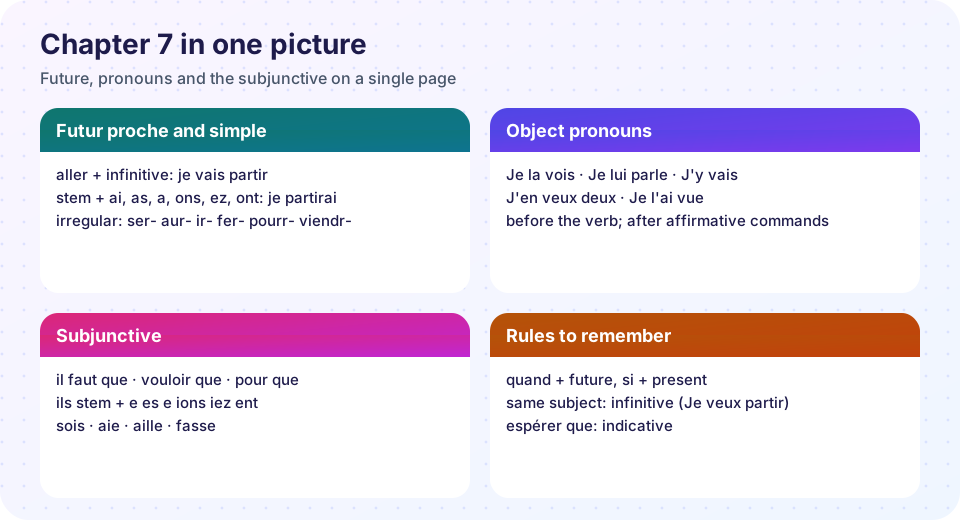
What you will learn
- Check which Chapter 7 skill is strongest and which needs another pass
- Build a sentence that combines a future, a pronoun and a trigger
- Avoid the classic mistakes of each topic
Recap table
| Topic | Rule | Example |
|---|---|---|
| Futur proche | aller + infinitive | Je vais partir. |
| Venir de | very recent past | Elle vient d'arriver. |
| Futur simple | infinitive/stem + -ai, -as, -a, -ons, -ez, -ont | Nous parlerons. |
| Irregular stems | ser-, aur-, ir-, fer-, pourr-, voudr-, devr-, saur-, viendr-, verr- | Je serai, j'irai, il viendra |
| After quand / si | quand + future; si + present | Quand tu arriveras, appelle-moi. |
| Direct pronouns | me, te, le/la/l', nous, vous, les | Je la vois. Je l'ai vue. |
| Indirect pronouns | me, te, lui, nous, vous, leur | Je lui parle. |
| Y and en | à + place, de + noun / quantity | J'y vais. J'en veux deux. |
| Position | before the conjugated verb or the infinitive; after affirmative commands | Je veux le voir. Regarde-le ! |
| Subjunctive | il faut que, vouloir que, pour que... + ils-stem forms | Il faut que tu partes. |
| Irregular subjunctive | sois, aie, aille, fasse | Il faut que tu sois à l'heure. |
Classic mistakes
- Using the future after si: Si tu viendras → Si tu viens.
- Forgetting that -re verbs drop the e in the future: vendrerai → vendrai.
- Putting the pronoun after the verb: Je vois la → Je la vois.
- Using le/la for an indirect object: Je le parle → Je lui parle.
- Using the subjunctive after espérer que, or the same-subject construction Je veux que je parte instead of Je veux partir.
Mix them. A great way to practice is to write a short plan for your weekend that includes one future, one pronoun and one trigger: Samedi, je vais voir Paul. Je lui téléphonerai demain. Il faut que je sois chez lui à huit heures. Check each piece against the table above.
Worked examples
Three sentences that combine the chapter's tools.
- Demain, si tu viens, je te montrerai la ville. (Tomorrow, if you come, I'll show you the city.) After si the verb is in the present (tu viens), and the result is in the futur simple (je montrerai: montrer is regular, so the infinitive is the stem). Te is placed before the conjugated verb, and it is an indirect object because you show the city to someone.
- Quand il arrivera, nous lui téléphonerons. (When he arrives, we'll call him.) Quand is followed by the future because the arrival has not happened yet, unlike in English. Téléphoner à takes an indirect object, so the pronoun is lui, and it stands before the verb.
- Il faut que tu les voies avant que je parte. (You must see them before I leave.) There are two triggers in this sentence, il faut que and avant que, so both verbs are in the subjunctive: que tu voies (from ils voient) and que je parte (partir). The pronoun les goes before voies.
Notice how each sentence has exactly one job per word. When a sentence feels confusing, find the verb first, then work out where each pronoun belongs.
Try it
A mixed gap-fill covering all three topics.
Flashcards for the key stems and triggers.
Check your understanding
Quick check · 10 questions
of 10 answered You scored / 10 · perfect!
-
1. Which sentence uses the futur proche?
Aller + infinitive: nous allons partir. -
2. What is the futur simple of 'prendre' with 'je'?
-re verbs drop the final e: prendr- + ai. -
3. Which stem does 'aller' use in the futur simple?
J'irai, tu iras, il ira. -
4. Which sentence is correct?
Si + present, then the future in the result clause. -
5. What does 'Je lui téléphone' mean?
Lui is the indirect pronoun for a single person (him or her). -
6. How do you say 'I saw her' (Marie)?
La becomes l' before ai, and the participle agrees with the feminine direct object: vue. -
7. Where does the pronoun go in 'Je veux ___ voir' (him)?
The pronoun belongs to the infinitive and goes right before it. -
8. Which trigger requires the subjunctive?
Il faut que triggers the subjunctive. Savoir que and espérer que take the indicative. -
9. What is the subjunctive of 'faire' with 'que tu'?
Faire is irregular: que je fasse, que tu fasses, qu'il fasse. -
10. How do you say 'I want to leave' (same subject)?
With one subject, use an infinitive.
Summary
- Futur proche (aller + infinitive) for plans; futur simple (stem + endings) for promises and predictions; quand + future, si + present.
- Direct le/la/les, indirect lui/leur, plus y and en, go before the verb.
- The subjunctive follows triggers of necessity, wish, feeling and doubt; use it with il faut que.
- Next, Chapter 8 puts everything to work in conversations and in culture.
Track your progress
Create a free account to tick off lessons and pick up where you left off on any device.
of French for Beginners lessons completed