


















Lesson 48 of 48 · Projects and Practice
Further Study: Where to Go After French for Beginners
A roadmap for learning French after the beginner level: CEFR levels, grammar to study next, listening, reading and speaking habits, and related language tracks.
You have reached the end of this beginner course. You can introduce yourself, count, tell the time, ask questions, say no, talk about the past and the future, replace nouns with pronouns, recognize the subjunctive, and handle travel, food and shopping. That is a real foundation, and the next stage is different in kind: less "learn the next rule", more "use French until it feels easy".
This final lesson gives you a roadmap. It explains the standard level system, lists the grammar topics that come next, and describes the habits (listening, reading, writing, speaking) that move a learner from beginner to confident. It also points to related language tracks on this site, since learning a second language makes a third easier.
What you will learn
- What the CEFR levels A1 to C2 mean
- Which grammar topics usually come after this course
- How to build listening, reading, writing and speaking habits
- How to plan eight weeks of review and a self-check
- Where to go on this site next
Key terms
le CECRL / CEFR: the Common European Framework of Reference for Languages, with six levels. DELF / DALF: official French diplomas for levels A1 to B2 (DELF) and C1 to C2 (DALF). la compréhension orale: listening comprehension. un échange linguistique: a language exchange.
The levels
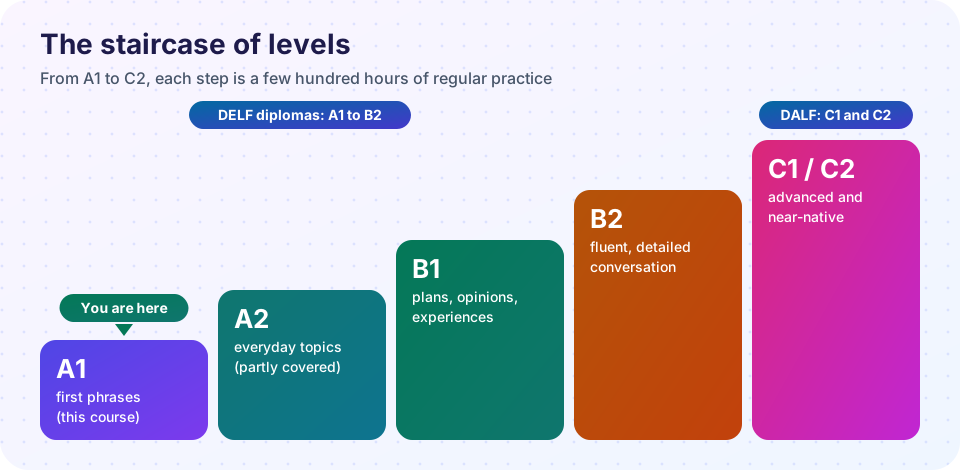
The CEFR divides language ability into six levels:
| Level | Name | Rough meaning |
|---|---|---|
| A1 | Beginner | simple phrases about yourself and immediate needs |
| A2 | Elementary | routine exchanges, simple descriptions, short messages |
| B1 | Intermediate | handle most travel situations, describe experiences and plans, give opinions |
| B2 | Upper intermediate | follow complex texts, converse fluently with native speakers |
| C1 | Advanced | express yourself spontaneously and precisely |
| C2 | Mastery | near-native ease in any context |
This course covers roughly the A1 level and a good part of A2. The DELF diploma exists at A1, A2, B1 and B2, and the DALF at C1 and C2. If an official certificate matters for work, study or immigration, the language-test centers of your country can tell you which exam is required. Remember that levels are guidelines: you can be stronger in reading than in speaking.
Grammar to study next
Roughly in this order:
- The conditional: you already use it in je voudrais (I would like). It also builds polite requests (pourriez-vous ...?) and "if" sentences (si j'avais le temps, je voyagerais).
- The plus-que-parfait (pluperfect): the past before the past, j'avais fini quand il est arrivé.
- Relative pronouns: qui, que, dont, où (le livre que j'ai lu, la ville où j'habite).
- Comparisons and superlatives: plus grand que, moins cher que, le plus beau.
- Reported speech: Il a dit qu'il viendrait.
- More of the subjunctive: after bien que, pour que, il faut que with a wider range of verbs.
- The gerund (en parlant) and the passive voice (La maison a été construite en 1950).
- The passé simple: a literary tense you meet when you read novels, rarely in speech.
Learn each topic the way you learned the ones in this course: one rule, many examples, then production.
Habits that build fluency
| Skill | Daily or weekly habit |
|---|---|
| Listening | 10 to 20 minutes of slow French: learner podcasts, news at slow speed, songs, videos with French subtitles |
| Reading | graded readers, comics (la bande dessinée, for instance the Astérix and Tintin series), short news items |
| Writing | a three-sentence diary in French; send messages to a language partner |
| Speaking | a weekly conversation: a tutor, a conversation club or a language exchange partner |
| Vocabulary | 5 to 10 new words per day with example sentences, reviewed at spaced intervals |
Three principles:
- Volume beats perfection. Read and listen to much more than you study.
- Speak early and badly. Mistakes are data. A real person gives feedback that no app can.
- Stay in the zone. Material at about 90 percent comprehension, with a few unknown words, is the sweet spot.
Related tracks on this site
French is a Romance language, so it shares many words and structures with Spanish, Italian and Portuguese. Learning one makes the others faster. You can continue with Spanish for Beginners, Italian for Beginners or Portuguese for Beginners, or contrast with the Germanic structure of German for Beginners. If you enjoy understanding why languages work the way they do, try Linguistics, and to strengthen your own grammar vocabulary, English Grammar. You can also return to the French for Beginners table of contents whenever you want to revisit a chapter.
Choosing resources
Good learning material is material you will actually use. When you choose a course, a book or a series, check three things. First, is the level right? You should understand most of it and meet a few new words in each paragraph. Second, does it match what you want to do with French (travel, study, work, family)? Third, does it include audio, so that you train your ears and your mouth as well as your eyes? Many learners combine a structured course for grammar with a weekly conversation and a daily dose of authentic material, such as short videos, radio or comics. Rotate the material every few weeks to avoid boredom, but keep one routine fixed (for example, ten minutes of listening each morning), because a fixed habit survives busy weeks better than a perfect plan.
Common misconceptions
"I must reach fluency before speaking." Fluency comes from speaking. Start with simple sentences.
"Apps alone make me fluent." Apps can help with vocabulary and habits, but conversation, reading and listening in context are essential.
"I'm too old / not talented." Adults learn languages steadily with regular practice. Consistency matters far more than talent.
"Native speakers will judge my errors." Most people are glad that you try. A clear effort in French, even with mistakes, is usually welcomed.
Try it
An eight-week review plan generator. Choose your minutes per day and days per week, and the script prints a plan with the topics of this course in order and the total study time.
Press Run (or Ctrl + Enter) to see the result here.
Program input · what you'd type while the program runs
Type the answers before you press Run, one per line. Each time the program reads a line (with input()), it gets the next line from this box.
A self-check you can answer honestly. This is a reflection tool, not an official level test.
Check your understanding
Quick check · 4 questions
of 4 answered You scored / 4 · perfect!
-
1. Which level is 'Intermediate' in the CEFR?
B1 is the intermediate level; A1 and A2 are beginner and elementary. -
2. Which grammar topic from the list uses a form you already know from 'je voudrais'?
Je voudrais is a conditional form of vouloir. -
3. What is the best way to improve speaking?
Speaking improves by speaking, with feedback. -
4. What are DELF and DALF?
DELF covers A1 to B2 and DALF covers C1 to C2.
Summary
- The CEFR levels run from A1 to C2; this course covers roughly A1 and a good part of A2.
- Next grammar: the conditional, the pluperfect, relative pronouns, comparisons, reported speech, more subjunctive, gerund and passive, and the passé simple for reading.
- Build daily listening, reading, writing, speaking and vocabulary habits; volume beats perfection.
- Related tracks: Spanish, Italian, Portuguese, German, Linguistics and English Grammar.
Track your progress
Create a free account to tick off lessons and pick up where you left off on any device.
of French for Beginners lessons completed