


















Lesson 45 of 48 · Projects and Practice
Mixed Practice Set: Chapters 5 to 8
A mixed French practice set covering numbers, questions, negation, past tenses, future, pronouns, the subjunctive and conversation, with random drills and answers.
Reviews inside a chapter test one topic at a time. Real French mixes everything: a sentence about yesterday may contain a number, a negation and an object pronoun. This practice set mixes all the topics from Chapters 5 to 8, so you must recognize which tool a sentence needs. That is a harder skill than filling gaps in a single-topic exercise, and it is exactly what you need in conversation.
Use the set in three passes. First, do the random drill several times until your scores are steady. Second, work through the translation list on paper. Third, check yourself with the answer table and note every miss in a small mistake log.
What you will learn
- Identify which grammar tool a mixed sentence needs
- Produce correct forms under mild time pressure
- Spot your personal weak spots with a mistake log
- Build a weekly routine that revisits every topic
Key terms
le journal d'erreurs: a mistake log. la révision espacée: spaced review (revisiting material at growing intervals). la production: producing language yourself. la reconnaissance: recognizing language when you read or hear it.
Pass 1: the random drill
Each press of New set picks six items from a bank of thirty questions across all four chapters. Type your answers, check them, and repeat until you can get a full set right twice in a row.
A second activity trains recognition. Match each French sentence with the English meaning.
Pass 2: translate (on paper)
Write each sentence in French before you look at the answers. Cover the table below.
- I am twenty-three years old.
- What time is it? It is half past four.
- We don't have a sister.
- Yesterday I got up at seven.
- When I was a child, I lived in Lyon.
- Tomorrow I am going to call him.
- I see them. I saw them.
- It is necessary that you be on time.
Pass 3: check your answers
| # | Answer |
|---|---|
| 1 | J'ai vingt-trois ans. |
| 2 | Quelle heure est-il ? Il est quatre heures et demie. |
| 3 | Nous n'avons pas de sœur. |
| 4 | Hier, je me suis levé(e) à sept heures. |
| 5 | Quand j'étais enfant, j'habitais à Lyon. |
| 6 | Demain, je vais lui téléphoner. |
| 7 | Je les vois. Je les ai vus (vues). |
| 8 | Il faut que tu sois à l'heure. |
Variations are possible. For example, Demain, je lui téléphonerai is also correct for sentence 6, and Quand j'étais petit(e) works for sentence 5. Mark an answer as correct if it is grammatical and keeps the meaning.
Your mistake log
For every error, write a line like this:
| Date | My sentence | Correct sentence | Rule |
|---|---|---|---|
| 12 May | J'ai allé au marché | Je suis allé au marché | aller takes être |
| 12 May | Je ne mange pas du pain | Je ne mange pas de pain | du → de after negation |
Review the log every Sunday. After a month you will see which two or three rules cause most of your errors, and you can target them.
How to learn from an error
An error is only useful if you can say why it happened. Ask three questions every time:
- What did I mean to say? Write the sentence in English first.
- Which tool does the sentence need? Name it: a tense, a pronoun, a negation, a question form, an article.
- Which exact rule did I break? Look it up in the cheat sheet or the lesson and write it in your mistake log.
Here are three typical errors, analyzed:
- Je suis allé au marché hier, il fait beau. The writer means "it was nice weather". The weather is background in the past, so the verb must be faisait: Il faisait beau. The error is a tense choice, not a spelling mistake, and the clue was the story setting.
- Elle ne veut pas des frites. After a negation, the partitive or indefinite article becomes de: Elle ne veut pas de frites. The rule is easy to apply once you notice the negation.
- Nous avons parlé à lui. A pronoun replaces à lui and goes before the auxiliary: Nous lui avons parlé. This is a word-order error, and English speakers make it constantly because English puts the pronoun after the verb.
After two weeks, sort your log by rule. Usually two or three rules account for most of the errors, and focusing your practice on those gives the fastest improvement.
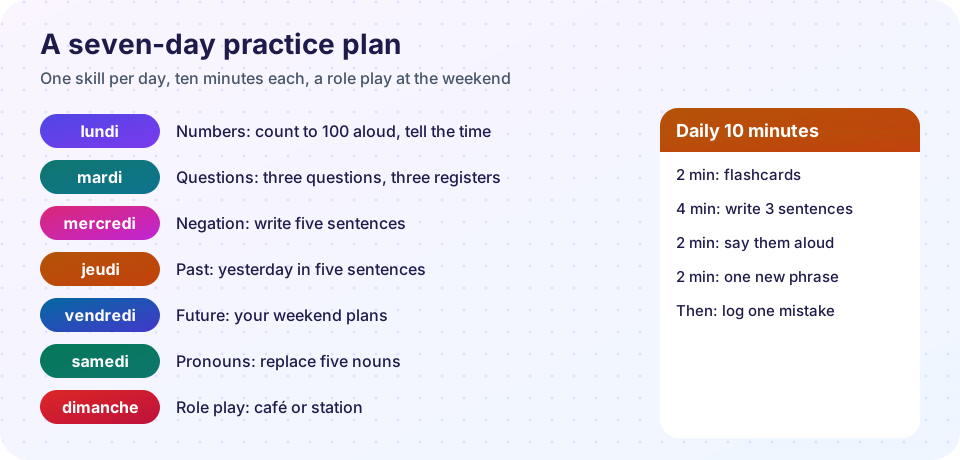
A weekly routine
| Day | Focus (10 minutes) |
|---|---|
| lundi | Numbers: count to 100 aloud, tell the time |
| mardi | Questions: ask three questions in three registers |
| mercredi | Negation: write five sentences |
| jeudi | Past: yesterday in five sentences |
| vendredi | Future: your weekend plans |
| samedi | Pronouns: replace five nouns |
| dimanche | Role play: café or station |
Common misconceptions
"I should only practice what I find hard." Mix easy and hard items, because recognizing which tool to use is part of the skill.
"If I got it right once, I know it." Spaced review matters: do the same drill again tomorrow and next week.
"I'll write the answers after peeking." Peeking trains recognition, not production. Always write first.
Check your understanding
Quick check · 5 questions
of 5 answered You scored / 5 · perfect!
-
1. 'Hier, je ___ levé à sept heures.' What completes it?
Se lever is reflexive, so the passé composé uses être with the reflexive pronoun: je me suis levé. -
2. How do you say 'We have no sister'?
After a negation, une becomes de. -
3. Which form completes 'Il faut que tu ___ à l'heure'?
Il faut que triggers the subjunctive, and the subjunctive of être is sois. -
4. 'Demain, je vais ___ téléphoner.' (to him)
Téléphoner à takes an indirect object, so lui goes before the infinitive. -
5. Which tense for 'It was raining'?
Weather as background takes the imparfait: il pleuvait.
Summary
- Mixed practice trains you to choose the right tool, not just to apply one rule.
- Do the random drill, translate on paper, check, and keep a mistake log.
- Follow a weekly routine so every topic returns regularly.
Next: Glossary
Track your progress
Create a free account to tick off lessons and pick up where you left off on any device.
of French for Beginners lessons completed