


















Lesson 19 of 48 · Present Tense Verbs
Regular -er verbs: parler, aimer, habiter
Learn the present tense of regular French -er verbs: the endings, pronunciation, common verbs, and spelling changes such as mangeons, commençons, achète and appelle.
The -er verbs are the largest family of French verbs, and the best news in French grammar: they all follow one pattern. Parler (to speak), aimer (to like, to love), habiter (to live), manger (to eat), travailler (to work), regarder (to watch), écouter (to listen) and several thousand others use the same six endings. Learn the pattern once, and you can conjugate almost any new -er verb you meet.
There are a few spelling adjustments to learn, mostly to keep the sound consistent, such as nous mangeons and nous commençons. This lesson covers the pattern, the pronunciation, the most useful verbs and the spelling changes.
What you will learn
- The present tense endings -e, -es, -e, -ons, -ez, -ent.
- How the spoken forms are simpler than the written forms.
- Twenty common -er verbs.
- Spelling changes in -ger, -cer, acheter, appeler, préférer and payer verbs.
Key terms
Stem is the verb without -er: parl-. Ending is what you add for each subject.
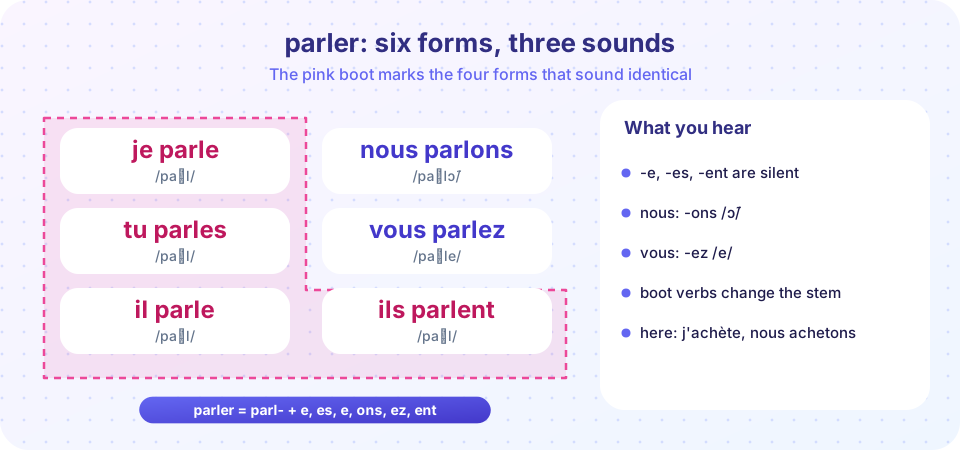
Boot verb is a verb whose stem changes in the je, tu, il and ils forms, a pattern shaped like a boot on a conjugation grid.
Spelling-change verb is a verb that changes a letter to keep its pronunciation.
Verb + infinitive: J'aime danser uses the conjugated verb followed by an infinitive.
The pattern
Remove -er and add the endings:
| Pronoun | Ending | parler | Pronunciation |
|---|---|---|---|
| je | -e | je parle | /ʒə paʁl/ |
| tu | -es | tu parles | /ty paʁl/ |
| il / elle / on | -e | il parle | /il paʁl/ |
| nous | -ons | nous parlons | /nu paʁlɔ̃/ |
| vous | -ez | vous parlez | /vu paʁle/ |
| ils / elles | -ent | ils parlent | /il paʁl/ |
Look at the pronunciation column: parle, parles, parle and parlent are all /paʁl/. The endings -e, -es and -ent are silent. Only nous parlons /paʁlɔ̃/ and vous parlez /paʁle/ sound different. This means that when you listen to French, you must pay attention to the subject pronoun to know whether the verb is singular or plural: il parle and ils parlent sound alike except for the liaison before a vowel, when ils aiment /ilz‿ɛm/ shows the plural.
For verbs that begin with a vowel or mute h, je becomes j': j'aime, j'habite, j'écoute, j'étudie. The other forms use liaison where needed: nous aimons /nuz‿ɛmɔ̃/, vous habitez /vuz‿abite/, ils habitent /ilz‿abit/.
Twenty common -er verbs
| Verb | Meaning | Verb | Meaning |
|---|---|---|---|
| parler | to speak | écouter | to listen |
| aimer | to like, to love | regarder | to watch, to look at |
| habiter | to live (reside) | chanter | to sing |
| travailler | to work | danser | to dance |
| manger | to eat | jouer | to play |
| étudier | to study | cuisiner | to cook |
| marcher | to walk | penser | to think |
| trouver | to find | donner | to give |
| demander | to ask | porter | to wear, to carry |
| arriver | to arrive | rester | to stay |
| visiter | to visit (a place) | acheter | to buy |
Examples: Je travaille à Paris. Tu aimes la musique ? Elle regarde un film. Nous écoutons la radio. Vous habitez à Lyon ? Ils jouent au football.
Using the verbs with infinitives and prepositions
Verbs of liking and wanting combine with another verb in the infinitive: J'aime danser. (I like dancing.) J'adore cuisiner. (I love cooking.) Je déteste marcher. (I hate walking.) Only the first verb is conjugated. Aimer with a person means "to love" (J'aime ma mère); for "like" in a milder sense, add bien: J'aime bien Paul.
Jouer takes à with sports and games, and de with musical instruments: Je joue au tennis (à + le = au), Elle joue de la guitare. Écouter, regarder and chercher ("to look for") need no preposition, unlike their English equivalents ("listen to", "look at", "look for"): J'écoute la radio, Je regarde la télé, Je cherche mes clés.
Spelling changes
A handful of -er verb groups change their spelling so the sound stays steady.
-ger verbs (manger, voyager, nager, ranger): add an e in the nous form, so the g stays soft before -ons: nous mangeons, nous voyageons. Without the e, mangons would give a hard g.
-cer verbs (commencer, lancer, annoncer): the c becomes ç in the nous form: nous commençons. Otherwise the c before o would sound /k/.
e + consonant + er verbs. Two patterns:
| Pattern | Verbs | Forms with a change |
|---|---|---|
| e becomes è | acheter, lever, promener | j'achète, tu achètes, il achète, ils achètent; nous achetons, vous achetez |
| consonant doubles | appeler, jeter, épeler | j'appelle, tu appelles, il appelle, ils appellent; nous appelons, vous appelez |
é + consonant + er verbs (préférer, espérer, répéter): the é becomes è in the boot forms: je préfère, tu préfères, il préfère, ils préfèrent, but nous préférons, vous préférez.
-yer verbs (payer, envoyer, nettoyer, essayer): y becomes i in the boot forms: j'envoie, tu envoies, il envoie, ils envoient; nous envoyons, vous envoyez. For payer and essayer, both je paie and je paye are accepted.
The reason these are called boot verbs is visual. On the conjugation grid, the changed forms (je, tu, il, ils) form a boot shape, and the unchanged forms (nous, vous) stay outside.
A reflexive example: s'appeler
You already know je m'appelle. It is the reflexive verb s'appeler (to be called): je m'appelle, tu t'appelles, il s'appelle, nous nous appelons, vous vous appelez, ils s'appellent. Notice that appeler doubles the l in the boot forms and has one l in nous appelons and vous appelez. Reflexive verbs have a pronoun before the verb; chapter 5 covers them more fully for daily routines.
A short dialogue
| Français | English |
|---|---|
| Tu aimes danser ? | Do you like dancing? |
| Oui, j'adore danser ! Et toi, tu chantes ? | Yes, I love dancing! And you, do you sing? |
| Un peu. Je joue de la guitare. | A little. I play the guitar. |
| Nous écoutons de la musique tous les soirs. | We listen to music every evening. |
| Mes amis cuisinent très bien. Nous mangeons ensemble le dimanche. | My friends cook very well. We eat together on Sundays. |
Why the spelling changes exist
Spelling changes may look arbitrary, but each has a reason. The e in nous mangeons keeps the g soft, because without it mangons would be read with a hard /ɡ/. The cedilla in nous commençons keeps the c soft before o. The accent in j'achète marks the vowel that becomes open when the next syllable is a silent e: ach-ète has a clear /ɛ/ where acheter has a weak /ə/. The doubled consonant in j'appelle has the same function, closing the syllable so the vowel is /ɛ/. The i in j'envoie replaces the y because a y followed by a silent e would be awkward to read. In every case, the spelling change protects the sound.
Memorizing the boot verbs
The boot shape helps. When you learn a spelling-change verb, write its six forms in two columns and draw a boot around je, tu, il and ils. Everything that changes lives inside the boot, and nous and vous keep the infinitive's spelling. After a few repetitions, you will notice that you are really only learning one new idea per group: "e becomes è", "the consonant doubles" or "y becomes i". That is all.
Common misconceptions
"The endings are pronounced, so I should say -es and -ent." In -er verbs, -e, -es and -ent are silent. Pronounce only -ons and -ez.
"Écouter means listen to, so I need à." No: J'écoute la radio. The same for regarder, chercher and attendre.
"Manger has no spelling change." Nous mangeons needs the e.
Try it
This Python conjugator applies the pattern and all the spelling changes from this lesson. Read the forms aloud and notice the pattern in each family.
Press Run (or Ctrl + Enter) to see the result here.
Program input · what you'd type while the program runs
Type the answers before you press Run, one per line. Each time the program reads a line (with input()), it gets the next line from this box.
Now practice the endings and spelling changes yourself.
Finally, learn the key verbs as cards.
Check your understanding
Quick check · 5 questions
of 5 answered You scored / 5 · perfect!
-
1. Which form of parler sounds different from the others?
Parle, parles and parlent are /paʁl/; nous parlons /paʁlɔ̃/ is different. -
2. How do you write 'we eat'?
-ger verbs add e before -ons to keep the soft g. -
3. What is 'I buy' in French?
Acheter changes e to è in the je, tu, il and ils forms. -
4. Which sentence uses a preposition wrongly?
Écouter takes a direct object; no preposition is needed. -
5. What is 'she plays the guitar'?
Jouer de + instrument; jouer à + sport.
Summary
- Regular -er verbs: stem + -e, -es, -e, -ons, -ez, -ent.
- Parle, parles, parle and parlent sound identical; only nous and vous differ.
- Spelling changes: nous mangeons, nous commençons, j'achète, j'appelle, je préfère, j'envoie.
- Verbs of liking take an infinitive: J'aime danser; écouter and regarder need no preposition.
- Jouer à for sports and jouer de for instruments.
Track your progress
Create a free account to tick off lessons and pick up where you left off on any device.
of French for Beginners lessons completed