


















Lesson 29 of 48 · Past Tenses
Chapter 6 Overview: Past Tenses
Chapter 6 of French for Beginners: tell stories about yesterday with the passé composé and the imparfait. Big picture, dialogue and lesson map.
So far you have talked about now: who you are, what you have, what you do. Real conversations constantly reach back in time: What did you do yesterday? Where were you born? What was your town like when you were a child? In this chapter you learn how French handles the past.
English has several past forms ("I ate", "I have eaten", "I was eating", "I used to eat"). French organizes the everyday past around just two tenses: the passé composé and the imparfait. Learn what each one is for, and you can tell almost any story.
What you will learn
- The difference between a snapshot (passé composé) and a film (imparfait)
- What the chapter's lessons teach and in which order
- How to read a short past-tense dialogue
- A study routine for verb forms
Key terms
le passé composé: the "compound past", an auxiliary verb plus a past participle (j'ai mangé). l'imparfait (m.): the "unfinished" past for scenes, habits and descriptions (je mangeais). l'auxiliaire (m.): the helper verb avoir or être. le participe passé: the past participle (mangé, fini, vendu).
Two tenses, two jobs
Imagine telling a story as a photographer and as a film director.
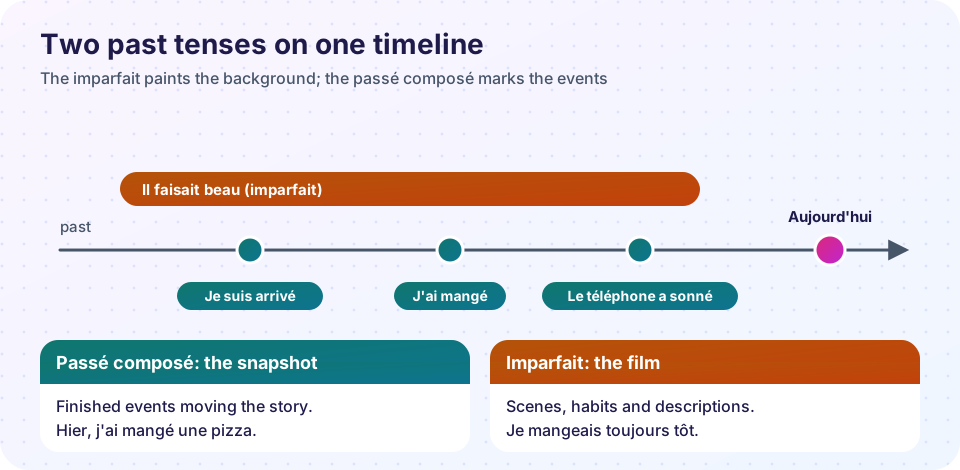
- The passé composé is the snapshot. It records a finished event at a point in time: Hier, j'ai mangé une pizza. Nous sommes arrivés à midi. Elle a ouvert la porte.
- The imparfait is the film. It describes what things were like, what used to happen, or what was going on: Il faisait beau. J'avais dix ans. Nous mangions souvent ensemble.
Most stories combine them. The imparfait sets the scene, and the passé composé moves the plot forward: Il pleuvait quand je suis sorti. ("It was raining" is the background; "I went out" is the event.) You will practice this contrast until it feels natural.
Two past tenses
Building the passé composé
Building the imparfait
Putting it together
Scene first, event second.
A first look: a story about yesterday
| French | English |
|---|---|
| Marc : Qu'est-ce que tu as fait hier ? | What did you do yesterday? |
| Sophie : Le matin, j'ai travaillé. | In the morning, I worked. |
| L'après-midi, je suis allée au parc. | In the afternoon, I went to the park. |
| Il faisait beau et il y avait beaucoup de monde. | The weather was nice and there were lots of people. |
| Marc : Tu as vu Paul ? | Did you see Paul? |
| Sophie : Non, je n'ai vu personne. Mais j'ai lu un livre. | No, I saw nobody. But I read a book. |
Notice what you can already read. J'ai travaillé, j'ai vu and j'ai lu use avoir. Je suis allée uses être, and allée has an extra e because Sophie is a woman. Il faisait beau and il y avait are imparfait: they describe the scene. The negation je n'ai vu personne comes straight from the last chapter.
What each lesson covers
- Passé composé with avoir: the formula, regular and irregular participles, negation, questions and time words.
- Passé composé with être: the 16-17 verbs of movement and change, agreement with the subject, and reflexive verbs.
- The imparfait and the contrast: how to form it, when to use it, and how to choose between the two tenses.
- Chapter review: a summary picture and a ten-question quiz.
Study routine. Verb forms stick best when you say them in sentences, not in lists. Each day, write three sentences about yesterday ("hier"), read them aloud, and check each participle. After a week you will have 21 sentences you can reuse.
Check your understanding
Quick check · 3 questions
of 3 answered You scored / 3 · perfect!
-
1. Which tense describes what the weather was like?
Descriptions and backgrounds use the imparfait: il faisait beau. -
2. In 'Je suis allée au parc', why does 'allée' end in -e?
With être, the participle agrees with the subject. A woman says je suis allée. -
3. Which sentence is a finished event?
J'ai ouvert la porte is a completed event in the passé composé. The other two are imparfait (scene and habit).
Summary
- French uses two everyday past tenses: the passé composé for events and the imparfait for scenes and habits.
- The passé composé is an auxiliary (avoir or être) plus a participle.
- The imparfait uses the nous stem plus -ais, -ais, -ait, -ions, -iez, -aient.
- Stories alternate between background and event.
Next: Passé composé with avoir
Track your progress
Create a free account to tick off lessons and pick up where you left off on any device.
of French for Beginners lessons completed