Learn which French verbs use être in the passé composé, how the participle agrees with the subject, and how reflexive verbs form the past.
Most French verbs form the passé composé with avoir. But about sixteen common verbs, mostly verbs of going, coming and changing, use être instead. They are among the first verbs you learn (aller, venir, arriver, partir), so you will meet them constantly. So does every reflexive verb, such as se lever (to get up).
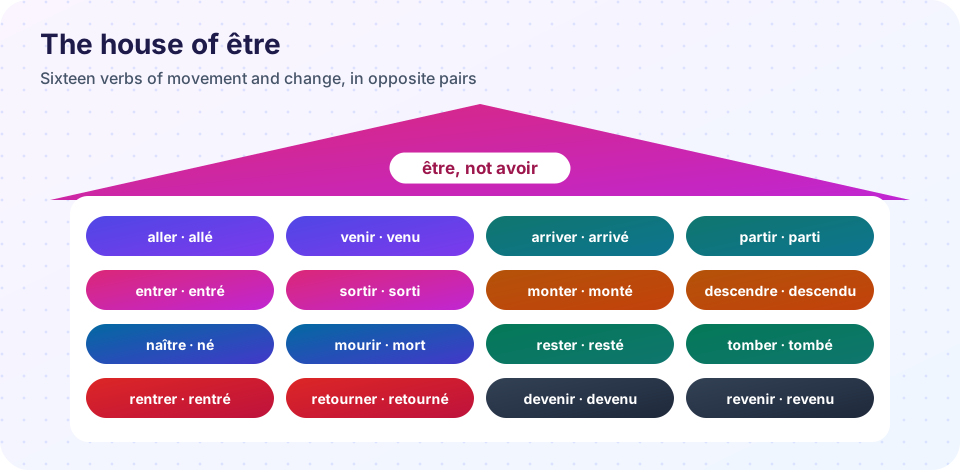
The rule is mechanical, and a visual trick helps: imagine the verbs as a house, with people entering, leaving, climbing stairs and falling down them. There is one extra rule to master: when you use être, the past participle behaves like an adjective and agrees with the subject. Il est parti, but elle est partie, ils sont partis, elles sont parties.
The house of être: sixteen verbs, grouped in opposite pairs, all form the passé composé with être.
un verbe de mouvement: a verb of movement. l'accord (m.): agreement (matching gender and number). un verbe pronominal / réfléchi: a reflexive verb, used with a reflexive pronoun (me, te, se, nous, vous). le complément d'objet direct (COD): the direct object, the thing or person the verb acts on.
They come in opposite pairs, which makes them easy to remember. The participle is in parentheses.
Pair
Meaning
Example (passé composé)
aller (allé) / venir (venu)
go / come
Je suis allé au cinéma. Il est venu hier.
arriver (arrivé) / partir (parti)
arrive / leave
Nous sommes arrivés à midi. Elle est partie tôt.
entrer (entré) / sortir (sorti)
enter / go out
Il est entré. Ils sont sortis ce soir.
monter (monté) / descendre (descendu)
go up / go down
Je suis monté. Elle est descendue du train.
naître (né) / mourir (mort)
be born / die
Je suis né en 2005. Il est mort en 1990.
rester (resté) / tomber (tombé)
stay / fall
Nous sommes restés. Elle est tombée.
rentrer (rentré) / retourner (retourné)
come home / go back
Je suis rentré tard. Il est retourné à Rome.
devenir (devenu) / revenir (revenu)
become / come back
Elle est devenue médecin. Il est revenu.
English speakers use a nickname for the group: "DR and Mrs Vandertramp", the first letters of devenir, revenir, monter, rester, sortir, venir, aller, naître, descendre, entrer, retourner, tomber, rentrer, arriver, mourir, partir. If a mnemonic helps you, use it; if not, the opposite-pairs picture works too.
With être, the participle matches the subject in gender and number. Here is aller:
Subject
Passé composé
je
je suis allé (man) / allée (woman)
tu
tu es allé / allée
il
il est allé
elle
elle est allée
on
on est allé(s) (usually meaning "we": on est allés)
nous
nous sommes allés / allées
vous
vous êtes allé / allée / allés / allées
ils
ils sont allés
elles
elles sont allées
The pattern is simple: add -e for a feminine subject, -s for a plural subject, and -es for a feminine plural. A mixed group of men and women takes the masculine plural: Paul et Marie sont partis. The vowel sounds do not change in speech (allé and allée are pronounced the same), so agreement is a spelling matter. It matters most in writing.
Check these examples:
Marie est arrivée à neuf heures. (feminine singular)
Les enfants sont rentrés tard. (masculine plural)
Mes sœurs sont parties hier. (feminine plural)
Elle est née à Dakar. She was born in Dakar.
Il est mort en 1998. He died in 1998. (mort becomes morte, morts, mortes.)
Reflexive verbs have a pronoun that refers back to the subject: je me lève (I get up). In the passé composé, they all use être, and the pronoun goes before the auxiliary.
Subject
se lever (to get up)
je
je me suis levé(e)
tu
tu t'es levé(e)
il / on
il s'est levé
elle
elle s'est levée
nous
nous nous sommes levé(e)s
vous
vous vous êtes levé(e)(s)
ils
ils se sont levés
elles
elles se sont levées
Useful ones: se réveiller (wake up), se coucher (go to bed), se laver (wash), s'habiller (get dressed), se promener (take a walk), se dépêcher (hurry), s'amuser (have fun), s'appeler (be called). Examples: Ce matin, je me suis réveillé à sept heures. (This morning I woke up at seven.) Nous nous sommes bien amusés. (We had a good time.) Elle s'est promenée au parc. (She took a walk in the park.)
The negation wraps the auxiliary and also surrounds the pronoun: Je ne me suis pas levé. (I didn't get up.) Elle ne s'est pas couchée tôt. (She didn't go to bed early.)
Five verbs on the list can take a direct object. In that case they use avoir, and the participle does not agree with the subject.
With être (no object)
With avoir (direct object)
Je suis monté. I went up.
J'ai monté les valises. I carried the suitcases up.
Il est descendu. He came down.
Il a descendu l'escalier. He went down the stairs.
Elle est sortie. She went out.
Elle a sorti la voiture. She took the car out.
Nous sommes rentrés. We went home.
Nous avons rentré le linge. We brought the laundry in.
Je suis retourné à Rome. I went back to Rome.
J'ai retourné la crêpe. I flipped the crêpe.
Je suis passé chez toi. I stopped by your place.
J'ai passé une semaine à Nice. I spent a week in Nice.
Passer is not on the list of sixteen, but it behaves the same way: être when it means "go by, stop by", and avoir when it takes an object ("spend time", "take an exam": J'ai passé un examen).
Most other verbs, including all the ones you knew from the last lesson, use avoir. That includes habiter, voyager, marcher, courir, nager: J'ai habité à Paris, Elle a voyagé en Italie, Nous avons marché une heure.
"J'ai allé." Very common learner error. Aller takes être: je suis allé(e).
"The participle with être never changes." It agrees with the subject: elle est allée, ils sont partis.
"I always add -e if I am a woman, in any tense." Only in the passé composé with être (and with the direct-object rule). With avoir and no preceding object, nothing changes: elle a mangé.
"Reflexive verbs use avoir because the English translation is 'have'." All reflexive verbs use être: Je me suis lavé, not je m'ai lavé.
Learn each pair with the matching game. Match the infinitive with its participle.
Être verbs and participles
<style>:root{--ink:#1e1b4b;--mut:#475569;--a:#4f46e5;--b:#db2777}*{box-sizing:border-box}body{margin:0;padding:14px;font-family:system-ui,-apple-system,'Segoe UI',sans-serif;background:linear-gradient(135deg,#faf5ff,#eff6ff);color:var(--ink)}.wrap{max-width:640px;margin:0 auto}button{font:inherit;cursor:pointer;border:0;border-radius:999px;padding:8px 16px;color:#fff;background:linear-gradient(135deg,#4f46e5,#7c3aed);box-shadow:0 4px 10px rgba(79,70,229,.25)}button.alt{background:#fff;color:var(--a);border:1px solid #c7d2fe;box-shadow:none}button:disabled{opacity:.45;cursor:default}.row{display:flex;gap:8px;flex-wrap:wrap;justify-content:center;margin:12px 0}.card{background:#fff;border-radius:18px;box-shadow:0 10px 24px rgba(67,56,202,.16);padding:26px 18px;text-align:center;min-height:130px;display:flex;flex-direction:column;justify-content:center;align-items:center;width:100%;color:var(--ink);cursor:pointer;border:0}.card .big{font-size:28px;font-weight:700}.card .sm{font-size:14px;color:var(--mut);margin-top:6px}.cnt{text-align:center;color:var(--mut);font-size:14px;margin-bottom:8px}.msg{text-align:center;min-height:22px;color:var(--mut);font-size:14px}.ok{color:#047857;font-weight:600}.bad{color:#be123c;font-weight:600}input[type=text]{font:inherit;border:2px solid #c7d2fe;border-radius:10px;padding:5px 8px;width:150px;background:#fff;color:var(--ink)}input.good{border-color:#10b981;background:#ecfdf5}input.wrong{border-color:#ef4444;background:#fef2f2}.item{background:#fff;border-radius:14px;padding:10px 14px;margin:8px 0;box-shadow:0 4px 12px rgba(67,56,202,.10);line-height:2}.item small{display:block;color:var(--mut);line-height:1.3}.keys{display:flex;flex-wrap:wrap;gap:6px;justify-content:center;margin:8px 0}.keys button{padding:4px 11px;background:#fff;color:var(--a);border:1px solid #c7d2fe;box-shadow:none;border-radius:8px}.cols{display:grid;grid-template-columns:1fr 1fr;gap:10px}.cols button{display:block;width:100%;border-radius:12px;background:#fff;color:var(--ink);border:2px solid #c7d2fe;box-shadow:none;padding:10px 8px;margin-bottom:8px;text-align:center}.cols button.sel{border-color:#4f46e5;background:#eef2ff}.cols button.done{border-color:#10b981;background:#ecfdf5;color:#047857;cursor:default}.cols button.no{border-color:#ef4444;background:#fef2f2}</style><divclass="wrap"><divclass="cols"><divid="L"></div><divid="R"></div></div><divclass="row"><buttonclass="alt"id="again">Shuffle again</button></div><divclass="msg"id="msg">Tap a French item, then its English match.</div></div><script>constD=[["aller","allé"],["venir","venu"],["arriver","arrivé"],["partir","parti"],["entrer","entré"],["sortir","sorti"],["descendre","descendu"],["naître","né"],["mourir","mort"],["devenir","devenu"]];const$=id=>document.getElementById(id);let selL=null,done=0,tries=0;constsh=a=>{a=a.slice();for(let k=a.length-1;k>0;k--){const j=Math.floor(Math.random()*(k+1));[a[k],a[j]]=[a[j],a[k]];}return a;};functionbuild(){selL=null;done=0;tries=0;$('L').innerHTML='';$('R').innerHTML='';$('msg').textContent='Tap a French item, then its English match.';sh(D.map((d,k)=>k)).forEach(k=>{const b=document.createElement('button');b.textContent=D[k][0];b.dataset.k=k;b.onclick=()=>{if(b.classList.contains('done'))return;document.querySelectorAll('#L .sel').forEach(x=>x.classList.remove('sel'));b.classList.add('sel');selL=b;};$('L').append(b);});sh(D.map((d,k)=>k)).forEach(k=>{const b=document.createElement('button');b.textContent=D[k][1];b.dataset.k=k;b.onclick=()=>{if(!selL||b.classList.contains('done'))return;tries++;if(selL.dataset.k===b.dataset.k){selL.className='done';b.className='done';selL=null;done++;if(done===D.length)$('msg').innerHTML='<span class="ok">Complete in '+tries+' tries. Bravo !</span>';}else{b.classList.add('no');setTimeout(()=>b.classList.remove('no'),500);}};$('R').append(b);});}$('again').onclick=build;build();</script>
This Python helper conjugates the sixteen verbs, with agreement. Set fem and plural to see the participle change, and add a reflexive verb with the second function.
Python
Passé composé with être
ETRE ={"je":"suis","tu":"es","il":"est","elle":"est","on":"est","nous":"sommes","vous":"êtes","ils":"sont","elles":"sont"}
PART ={"aller":"allé","venir":"venu","arriver":"arrivé","partir":"parti","entrer":"entré","sortir":"sorti","monter":"monté","descendre":"descendu","naître":"né","mourir":"mort","rester":"resté","tomber":"tombé","rentrer":"rentré","retourner":"retourné","devenir":"devenu","revenir":"revenu"}
REFL ={"je":"me","tu":"te","il":"se","elle":"se","on":"se","nous":"nous","vous":"vous","ils":"se","elles":"se"}defagree(participle, fem, plural):return participle +("e"if fem else"")+("s"if plural else"")defpc_etre(subject, verb, fem=False, plural=False, neg=None):
aux = ETRE[subject]if neg:
aux =("n'"if aux[0]in"eê"else"ne ")+ aux +" "+ neg
returnf"{subject.capitalize()}{aux}{agree(PART[verb], fem, plural)}."defpc_reflexive(subject, participle, fem=False, plural=False):
pron = REFL[subject]
aux = ETRE[subject]if subject in("tu","il","elle","on","ils","elles"):
pron = pron[0]+"'"if aux[0]in"eêé"else pron
sp =""if pron.endswith("'")else" "returnf"{subject.capitalize()}{pron}{sp}{aux}{agree(participle, fem, plural)}."print(pc_etre("je","aller"))print(pc_etre("je","aller", fem=True))print(pc_etre("elle","arriver", fem=True))print(pc_etre("ils","partir", plural=True))print(pc_etre("elles","sortir", fem=True, plural=True))print(pc_etre("nous","naître", fem=True, plural=True))print(pc_etre("il","tomber", neg="pas"))print(pc_reflexive("je","levé", fem=True))print(pc_reflexive("tu","réveillé"))print(pc_reflexive("elle","promené", fem=True))print(pc_reflexive("ils","amusé", plural=True))print(pc_reflexive("nous","couché", plural=True))
Press Run (or Ctrl + Enter) to see the result here.
Program input · what you'd type while the program runs
Type the answers before you press Run, one per line. Each time the program reads a line (with input()), it gets the next line from this box.
Être or avoir?
<style>:root{--ink:#1e1b4b;--mut:#475569;--a:#4f46e5;--b:#db2777}*{box-sizing:border-box}body{margin:0;padding:14px;font-family:system-ui,-apple-system,'Segoe UI',sans-serif;background:linear-gradient(135deg,#faf5ff,#eff6ff);color:var(--ink)}.wrap{max-width:640px;margin:0 auto}button{font:inherit;cursor:pointer;border:0;border-radius:999px;padding:8px 16px;color:#fff;background:linear-gradient(135deg,#4f46e5,#7c3aed);box-shadow:0 4px 10px rgba(79,70,229,.25)}button.alt{background:#fff;color:var(--a);border:1px solid #c7d2fe;box-shadow:none}button:disabled{opacity:.45;cursor:default}.row{display:flex;gap:8px;flex-wrap:wrap;justify-content:center;margin:12px 0}.card{background:#fff;border-radius:18px;box-shadow:0 10px 24px rgba(67,56,202,.16);padding:26px 18px;text-align:center;min-height:130px;display:flex;flex-direction:column;justify-content:center;align-items:center;width:100%;color:var(--ink);cursor:pointer;border:0}.card .big{font-size:28px;font-weight:700}.card .sm{font-size:14px;color:var(--mut);margin-top:6px}.cnt{text-align:center;color:var(--mut);font-size:14px;margin-bottom:8px}.msg{text-align:center;min-height:22px;color:var(--mut);font-size:14px}.ok{color:#047857;font-weight:600}.bad{color:#be123c;font-weight:600}input[type=text]{font:inherit;border:2px solid #c7d2fe;border-radius:10px;padding:5px 8px;width:150px;background:#fff;color:var(--ink)}input.good{border-color:#10b981;background:#ecfdf5}input.wrong{border-color:#ef4444;background:#fef2f2}.item{background:#fff;border-radius:14px;padding:10px 14px;margin:8px 0;box-shadow:0 4px 12px rgba(67,56,202,.10);line-height:2}.item small{display:block;color:var(--mut);line-height:1.3}.keys{display:flex;flex-wrap:wrap;gap:6px;justify-content:center;margin:8px 0}.keys button{padding:4px 11px;background:#fff;color:var(--a);border:1px solid #c7d2fe;box-shadow:none;border-radius:8px}.cols{display:grid;grid-template-columns:1fr 1fr;gap:10px}.cols button{display:block;width:100%;border-radius:12px;background:#fff;color:var(--ink);border:2px solid #c7d2fe;box-shadow:none;padding:10px 8px;margin-bottom:8px;text-align:center}.cols button.sel{border-color:#4f46e5;background:#eef2ff}.cols button.done{border-color:#10b981;background:#ecfdf5;color:#047857;cursor:default}.cols button.no{border-color:#ef4444;background:#fef2f2}</style><divclass="wrap"><divclass="keys"id="keys"></div><divid="list"></div><divclass="row"><buttonid="chk">Check answers</button><buttonclass="alt"id="show">Show answers</button></div><divclass="msg"id="msg">Type each answer. Use the accent buttons if your keyboard has no accents.</div></div><script>constD=[{"s":"Elle est ___ (arriver) à midi.","a":["arrivée"],"h":"Feminine subject."},{"s":"Nous sommes ___ (partir, men).","a":["partis"],"h":"Masculine plural."},{"s":"J’___ mangé une pizza.","a":["ai"],"h":"Manger uses avoir."},{"s":"Je suis ___ (né, a woman) en 2008.","a":["née"],"h":""},{"s":"Il s’___ levé tôt.","a":["est"],"h":"Reflexive verbs use être."},{"s":"Ils sont ___ (rester) à la maison.","a":["restés"],"h":""}];const$=id=>document.getElementById(id);let last=null;constnorm=s=>s.trim().toLowerCase().replace(/[\u2019\u2018]/g,"'").replace(/\s+/g,' ');D.forEach((d,k)=>{const p=d.s.split('___');const div=document.createElement('div');div.className='item';
div.append(p[0]);const inp=document.createElement('input');inp.type='text';inp.id='i'+k;inp.autocomplete='off';inp.spellcheck=false;inp.setAttribute('aria-label','Answer '+(k+1));inp.onfocus=()=>last=inp;div.append(inp);div.append(p[1]||'');if(d.h){const s=document.createElement('small');s.textContent=d.h;div.append(s);}$('list').append(div);});['é','è','ê','à','â','ç','î','ï','ô','ù','û','œ'].forEach(ch=>{const b=document.createElement('button');b.textContent=ch;b.setAttribute('aria-label','Insert '+ch);b.onmousedown=e=>e.preventDefault();b.onclick=()=>{const t=last||$('i0');t.focus();const s=t.selectionStart,e=t.selectionEnd;t.setRangeText(ch,s,e,'end');};$('keys').append(b);});$('chk').onclick=()=>{let n=0;D.forEach((d,k)=>{const t=$('i'+k);const ok=d.a.some(a=>norm(a)===norm(t.value));t.className=ok?'good':'wrong';if(ok)n++;});$('msg').innerHTML=n===D.length?'<span class="ok">All '+n+' correct. Bravo !</span>':'<span class="bad">'+n+' of '+D.length+' correct.</span> Check accents and endings.';};$('show').onclick=()=>{D.forEach((d,k)=>{$('i'+k).value=d.a[0];$('i'+k).className='good';});$('msg').textContent='Answers shown. Reload the preview to reset.';};</script>