A glossary of French grammar terms and the key vocabulary of Chapters 5 to 8, organized by topic, with flashcards, a matching game and a lookup tool.
A glossary is a map of a language. When you meet a word you half remember, you can look it up; when you want to review, you can scan a whole topic at once. This one has two parts: the grammar terms (in English and French, because French textbooks, teachers and exams use the French names) and the everyday vocabulary from Chapters 5 to 8, grouped by situation.
Words stick better in groups than in alphabetical lists, so the vocabulary tables follow the structure of the chapters. After the tables you will find flashcards, a matching game and a Python lookup tool you can search by French or English.
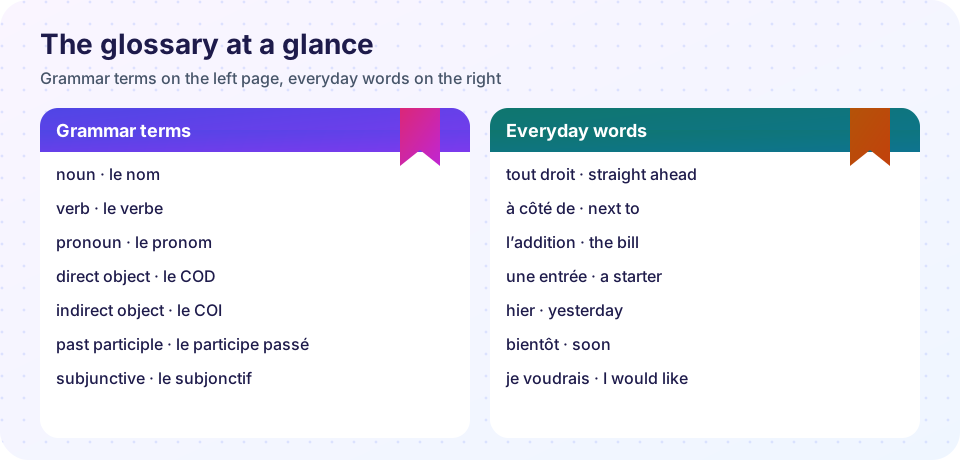
An open glossary: grammar terms on the left, everyday words on the right.
A paper flashcard box makes spaced review easy. Prepare five compartments and label them chaque jour (every day), tous les trois jours, chaque semaine, tous les quinze jours and chaque mois. Put every new card in the first compartment. When you answer correctly, the card moves one compartment forward, so you see it less often; when you answer wrongly, it goes back to the first compartment. In this system, easy words quickly move out of the way and difficult words come back until they stick, and you never waste time on what you already know. The digital flashcards on this page do not save your progress, so for long-term learning copy the vocabulary into a notebook or a flashcard tool you control, and write both the French word with its article and a short example sentence on the card.
"I should memorize a word list top to bottom." Short, frequent, mixed review beats one long pass.
"A word has one English translation." Words have ranges: quel can be "which" or "what" depending on the sentence.
"Grammar terms are optional." You can speak without them, but knowing COD, COI or subjonctif makes grammar books, teachers and corrections much easier to follow.
<style>:root{--ink:#1e1b4b;--mut:#475569;--a:#4f46e5;--b:#db2777}*{box-sizing:border-box}body{margin:0;padding:14px;font-family:system-ui,-apple-system,'Segoe UI',sans-serif;background:linear-gradient(135deg,#faf5ff,#eff6ff);color:var(--ink)}.wrap{max-width:640px;margin:0 auto}button{font:inherit;cursor:pointer;border:0;border-radius:999px;padding:8px 16px;color:#fff;background:linear-gradient(135deg,#4f46e5,#7c3aed);box-shadow:0 4px 10px rgba(79,70,229,.25)}button.alt{background:#fff;color:var(--a);border:1px solid #c7d2fe;box-shadow:none}button:disabled{opacity:.45;cursor:default}.row{display:flex;gap:8px;flex-wrap:wrap;justify-content:center;margin:12px 0}.card{background:#fff;border-radius:18px;box-shadow:0 10px 24px rgba(67,56,202,.16);padding:26px 18px;text-align:center;min-height:130px;display:flex;flex-direction:column;justify-content:center;align-items:center;width:100%;color:var(--ink);cursor:pointer;border:0}.card .big{font-size:28px;font-weight:700}.card .sm{font-size:14px;color:var(--mut);margin-top:6px}.cnt{text-align:center;color:var(--mut);font-size:14px;margin-bottom:8px}.msg{text-align:center;min-height:22px;color:var(--mut);font-size:14px}.ok{color:#047857;font-weight:600}.bad{color:#be123c;font-weight:600}input[type=text]{font:inherit;border:2px solid #c7d2fe;border-radius:10px;padding:5px 8px;width:150px;background:#fff;color:var(--ink)}input.good{border-color:#10b981;background:#ecfdf5}input.wrong{border-color:#ef4444;background:#fef2f2}.item{background:#fff;border-radius:14px;padding:10px 14px;margin:8px 0;box-shadow:0 4px 12px rgba(67,56,202,.10);line-height:2}.item small{display:block;color:var(--mut);line-height:1.3}.keys{display:flex;flex-wrap:wrap;gap:6px;justify-content:center;margin:8px 0}.keys button{padding:4px 11px;background:#fff;color:var(--a);border:1px solid #c7d2fe;box-shadow:none;border-radius:8px}.cols{display:grid;grid-template-columns:1fr 1fr;gap:10px}.cols button{display:block;width:100%;border-radius:12px;background:#fff;color:var(--ink);border:2px solid #c7d2fe;box-shadow:none;padding:10px 8px;margin-bottom:8px;text-align:center}.cols button.sel{border-color:#4f46e5;background:#eef2ff}.cols button.done{border-color:#10b981;background:#ecfdf5;color:#047857;cursor:default}.cols button.no{border-color:#ef4444;background:#fef2f2}</style><divclass="wrap"><divclass="cnt"id="cnt"></div><buttonclass="card"id="card"aria-live="polite"><spanclass="big"id="big"></span><spanclass="sm"id="sm"></span></button><divclass="row"><buttonclass="alt"id="prev">Back</button><buttonid="flip">Flip</button><buttonclass="alt"id="next">Next</button></div><divclass="row"><buttonclass="alt"id="dir">French first</button><buttonclass="alt"id="shuf">Shuffle</button><buttonclass="alt"id="say">Listen</button></div><divclass="msg"id="msg"></div></div><script>constD=[["le passé composé","compound past (auxiliary + participle)"],["l'imparfait","imperfect (scenes and habits)"],["le futur proche","near future (aller + infinitive)"],["le subjonctif","subjunctive mood"],["le COD","direct object"],["le COI","indirect object"],["le participe passé","past participle"],["l'accord","agreement"],["le verbe pronominal","reflexive verb"],["l'inversion","verb-subject inversion"]];let i=0,showFr=true,fr=true;const$=id=>document.getElementById(id);functiondraw(){const c=D[i];$('cnt').textContent='Card '+(i+1)+' of '+D.length;const q=fr?c[0]:c[1],a=fr?c[1]:c[0];$('big').textContent=showFr?q:a;$('sm').textContent=showFr?'Tap to flip':(fr?'English':'French');}functionflip(){showFr=!showFr;draw();}$('card').onclick=flip;$('flip').onclick=flip;$('next').onclick=()=>{i=(i+1)%D.length;showFr=true;draw();};$('prev').onclick=()=>{i=(i-1+D.length)%D.length;showFr=true;draw();};$('dir').onclick=()=>{fr=!fr;$('dir').textContent=fr?'French first':'English first';showFr=true;draw();};$('shuf').onclick=()=>{for(let k=D.length-1;k>0;k--){const j=Math.floor(Math.random()*(k+1));[D[k],D[j]]=[D[j],D[k]];}i=0;showFr=true;draw();};$('say').onclick=()=>{try{if(!('speechSynthesis'in window))throw0;const u=newSpeechSynthesisUtterance(D[i][0]);u.lang='fr-FR';speechSynthesis.cancel();speechSynthesis.speak(u);$('msg').textContent='';}catch(e){$('msg').textContent='Speech is not available in this preview. Say it aloud yourself.';}};draw();</script>
A matching game for the everyday vocabulary.
Vocabulary matching
<style>:root{--ink:#1e1b4b;--mut:#475569;--a:#4f46e5;--b:#db2777}*{box-sizing:border-box}body{margin:0;padding:14px;font-family:system-ui,-apple-system,'Segoe UI',sans-serif;background:linear-gradient(135deg,#faf5ff,#eff6ff);color:var(--ink)}.wrap{max-width:640px;margin:0 auto}button{font:inherit;cursor:pointer;border:0;border-radius:999px;padding:8px 16px;color:#fff;background:linear-gradient(135deg,#4f46e5,#7c3aed);box-shadow:0 4px 10px rgba(79,70,229,.25)}button.alt{background:#fff;color:var(--a);border:1px solid #c7d2fe;box-shadow:none}button:disabled{opacity:.45;cursor:default}.row{display:flex;gap:8px;flex-wrap:wrap;justify-content:center;margin:12px 0}.card{background:#fff;border-radius:18px;box-shadow:0 10px 24px rgba(67,56,202,.16);padding:26px 18px;text-align:center;min-height:130px;display:flex;flex-direction:column;justify-content:center;align-items:center;width:100%;color:var(--ink);cursor:pointer;border:0}.card .big{font-size:28px;font-weight:700}.card .sm{font-size:14px;color:var(--mut);margin-top:6px}.cnt{text-align:center;color:var(--mut);font-size:14px;margin-bottom:8px}.msg{text-align:center;min-height:22px;color:var(--mut);font-size:14px}.ok{color:#047857;font-weight:600}.bad{color:#be123c;font-weight:600}input[type=text]{font:inherit;border:2px solid #c7d2fe;border-radius:10px;padding:5px 8px;width:150px;background:#fff;color:var(--ink)}input.good{border-color:#10b981;background:#ecfdf5}input.wrong{border-color:#ef4444;background:#fef2f2}.item{background:#fff;border-radius:14px;padding:10px 14px;margin:8px 0;box-shadow:0 4px 12px rgba(67,56,202,.10);line-height:2}.item small{display:block;color:var(--mut);line-height:1.3}.keys{display:flex;flex-wrap:wrap;gap:6px;justify-content:center;margin:8px 0}.keys button{padding:4px 11px;background:#fff;color:var(--a);border:1px solid #c7d2fe;box-shadow:none;border-radius:8px}.cols{display:grid;grid-template-columns:1fr 1fr;gap:10px}.cols button{display:block;width:100%;border-radius:12px;background:#fff;color:var(--ink);border:2px solid #c7d2fe;box-shadow:none;padding:10px 8px;margin-bottom:8px;text-align:center}.cols button.sel{border-color:#4f46e5;background:#eef2ff}.cols button.done{border-color:#10b981;background:#ecfdf5;color:#047857;cursor:default}.cols button.no{border-color:#ef4444;background:#fef2f2}</style><divclass="wrap"><divclass="cols"><divid="L"></div><divid="R"></div></div><divclass="row"><buttonclass="alt"id="again">Shuffle again</button></div><divclass="msg"id="msg">Tap a French item, then its English match.</div></div><script>constD=[["tout droit","straight ahead"],["à côté de","next to"],["l'addition","the bill"],["une entrée","a starter"],["hier","yesterday"],["bientôt","soon"],["je voudrais","I would like"],["quand","when"]];const$=id=>document.getElementById(id);let selL=null,done=0,tries=0;constsh=a=>{a=a.slice();for(let k=a.length-1;k>0;k--){const j=Math.floor(Math.random()*(k+1));[a[k],a[j]]=[a[j],a[k]];}return a;};functionbuild(){selL=null;done=0;tries=0;$('L').innerHTML='';$('R').innerHTML='';$('msg').textContent='Tap a French item, then its English match.';sh(D.map((d,k)=>k)).forEach(k=>{const b=document.createElement('button');b.textContent=D[k][0];b.dataset.k=k;b.onclick=()=>{if(b.classList.contains('done'))return;document.querySelectorAll('#L .sel').forEach(x=>x.classList.remove('sel'));b.classList.add('sel');selL=b;};$('L').append(b);});sh(D.map((d,k)=>k)).forEach(k=>{const b=document.createElement('button');b.textContent=D[k][1];b.dataset.k=k;b.onclick=()=>{if(!selL||b.classList.contains('done'))return;tries++;if(selL.dataset.k===b.dataset.k){selL.className='done';b.className='done';selL=null;done++;if(done===D.length)$('msg').innerHTML='<span class="ok">Complete in '+tries+' tries. Bravo !</span>';}else{b.classList.add('no');setTimeout(()=>b.classList.remove('no'),500);}};$('R').append(b);});}$('again').onclick=build;build();</script>
This Python tool searches a mini dictionary in both directions. Type part of a French or English word. Add your own entries to grow your personal glossary.
Python
Glossary lookup
GLOSSARY ={"tout droit":"straight ahead","à gauche":"to the left","à droite":"to the right","à côté de":"next to","en face de":"opposite","près de":"near","loin de":"far from","hier":"yesterday","demain":"tomorrow","bientôt":"soon","déjà":"already","pas encore":"not yet","jamais":"never","rien":"nothing","personne":"nobody","l'addition":"the bill","une entrée":"a starter","le plat":"main course","je voudrais":"I would like","combien":"how much, how many","quand":"when","pourquoi":"why","où":"where","comment":"how","bonjour":"hello","au revoir":"goodbye","merci":"thank you","s'il vous plaît":"please","cordialement":"kind regards","septante":"seventy (Belgium, Switzerland)","souper":"dinner (Belgium, Switzerland, Québec)","le quai":"the platform",}deflookup(query):
q = query.lower()
hits =[(fr, en)for fr, en in GLOSSARY.items()if q in fr.lower()or q in en.lower()]ifnot hits:print(f"{query!r}: no entry yet")for fr, en in hits:print(f"{fr:<18} = {en}")for q in["hier","the","droit","xyz"]:print(">", q)
lookup(q)print()
Press Run (or Ctrl + Enter) to see the result here.
Program input · what you'd type while the program runs
Type the answers before you press Run, one per line. Each time the program reads a line (with input()), it gets the next line from this box.