


















Lesson 27 of 48 · Daily Life and Questions
Negation in French: ne ... pas and Friends
Learn how French says no: ne ... pas, jamais, rien, personne, plus, ne ... que, and why du, de la and des turn into de after a negation.
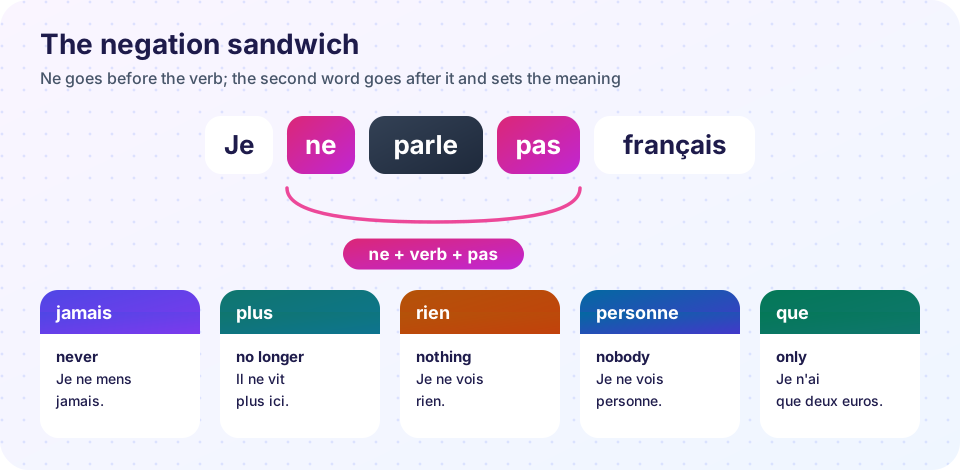
English makes a sentence negative by adding one word: "I do not speak German". French wraps the verb in two: Je ne parle pas allemand. That small "sandwich" is the whole trick, and once you can see it, the rest of this lesson (never, nothing, no one, no longer) is just swapping the second slice of bread.
There is also one grammar surprise: after a negation, the articles du, de la, des, un and une usually shrink to a plain de. You will learn that rule and its single big exception. By the end you can refuse politely, correct a waiter and say "I have never been to Paris".
What you will learn
- Build the ne ... pas sandwich around a verb
- Use jamais, rien, personne, plus, pas encore, ne ... que and ni ... ni
- Place negations in the passé composé, with an infinitive and in the imperative
- Change du / de la / des / un / une to de after a negation
- Recognize spoken French that drops ne
Key terms
la négation: the grammar of "not". ne: the first half of the negation; it becomes n' before a vowel or silent h. pas: the standard second half ("not"). un adverbe négatif: a second part that changes the meaning (jamais never, rien nothing, personne no one, plus no longer).
The basic sandwich: ne + verb + pas
Put ne before the conjugated verb and pas right after it.
| Affirmative | Negative |
|---|---|
| Je parle allemand. | Je ne parle pas allemand. |
| Tu comprends. | Tu ne comprends pas. |
| Nous sommes prêts. | Nous ne sommes pas prêts. |
| Elle a faim. | Elle **n'**a pas faim. |
| J'aime le café. | Je **n'**aime pas le café. |
Before a vowel or a silent h, ne becomes n': Il n'habite pas ici, Je n'ai pas d'argent, Elle n'hésite pas. This elision is mandatory in writing and speech.
In everyday spoken French, the ne is very often dropped: Je sais pas, C'est pas grave, J'ai pas le temps. This is normal, and you will hear it constantly. But in writing, in formal speech and in class, always keep the ne. As a learner, you should say it fully until your ear tells you that dropping it fits the situation.
The other second halves
Replace pas with another word and the meaning changes. The ne stays put.
| Pattern | Meaning | Example |
|---|---|---|
| ne ... pas | not | Je ne mange pas de viande. I don't eat meat. |
| ne ... jamais | never | Il ne fume jamais. He never smokes. |
| ne ... plus | no longer, not any more | Elle ne travaille plus ici. She doesn't work here any more. |
| ne ... rien | nothing, not anything | Je ne vois rien. I see nothing. |
| ne ... personne | no one, nobody | Nous ne connaissons personne. We know nobody. |
| ne ... pas encore | not yet | Je n'ai pas encore fini. I haven't finished yet. |
| ne ... que | only | Je n'ai que deux euros. I have only two euros. |
| ne ... ni ... ni | neither ... nor | Il ne parle ni anglais ni espagnol. He speaks neither English nor Spanish. |
Rien and personne can also be subjects, and then ne comes after them: Rien ne change. (Nothing changes.) Personne ne parle. (Nobody speaks.) Notice there is no pas anywhere. A negation word and pas never appear together. Not Je ne vois pas rien, but Je ne vois rien.
You can answer a question with the second word alone: Tu veux quelque chose ? — Rien, merci. (Anything? — Nothing, thanks.) Qui est là ? — Personne. (Who's there? — Nobody.) Tu y vas souvent ? — Jamais ! (Do you go there often? — Never!)
Negation with two-part verbs: the passé composé
In compound tenses (you will learn the passé composé in Chapter 6), the sandwich goes around the auxiliary, which is the first verb: *Je **n'*ai pas mangé. (I didn't eat.) *Elle **n'*est jamais venue. (She never came.) *Nous **n'*avons rien compris. (We understood nothing.)
Personne is the exception, because it goes after the whole verb: *Je **n'*ai vu personne. (I saw nobody.) Your ears will get used to this. Study the pattern in the passé composé lesson when you reach it.
Negation with an infinitive and in commands
With an infinitive, both negation words go in front of the infinitive: Je préfère ne pas partir. (I prefer not to leave.) Il vaut mieux ne rien dire. (It's better to say nothing.) Il a promis de ne jamais revenir. (He promised never to come back.)
In the imperative, wrap the verb as usual: Ne parle pas ! (Don't talk!) Ne partez pas ! (Don't leave!) Ne vous inquiétez pas. (Don't worry.)
The big surprise: du, de la, des turn into de
After a negation of quantity, the partitive and indefinite articles become de (or d' before a vowel).
| Affirmative | Negative |
|---|---|
| Je mange du pain. | Je ne mange pas de pain. |
| Elle boit de la limonade. | Elle ne boit pas de limonade. |
| Il y a des chaises. | Il n'y a pas de chaises. |
| J'ai une sœur. | Je n'ai pas de sœur. |
| Nous avons un chat. | Nous n'avons pas de chat. |
| Il a des enfants. | Il n'a pas **d'**enfants. |
The logic is simple: "not any bread" has no need for du. There are two traps:
- Definite articles do not change: J'aime le café → Je n'aime pas le café (the whole category is the topic).
- After être, the article stays: C'est un problème → Ce n'est pas un problème. C'est du chocolat → Ce n'est pas du chocolat. The sentence identifies a thing, so the article remains.
Use these in daily life: Il n'y a pas de problème. (There's no problem.) Pas de souci. (No worries.) Je n'ai pas de monnaie. (I have no change.)
Short answers and agreements
- Moi aussi. Me too. — Moi non plus. Me neither. (Je n'aime pas le froid. — Moi non plus.)
- Pas du tout. Not at all.
- Pas mal. Not bad.
- Pas encore. Not yet.
- Pas de chance. Bad luck.
Common misconceptions
"Just put 'pas' after the verb, like 'not' in English." French needs ne too in standard writing. Je parle pas is spoken French, not written French.
"Je ne vois pas personne." Two negation words cannot be stacked this way. It is Je ne vois personne.
"After a negation I keep 'du' and 'des'." They become de, except after être: Je n'ai pas de frère, but Ce n'est pas un frère.
"Rien means 'something'." Rien means nothing. For something say quelque chose, and for someone say quelqu'un.
Try it
Turn affirmative sentences negative with this Python helper. It handles elision and the du / de la / des → de rule, so you can check your own sentences against it.
Press Run (or Ctrl + Enter) to see the result here.
Program input · what you'd type while the program runs
Type the answers before you press Run, one per line. Each time the program reads a line (with input()), it gets the next line from this box.
Now a gap-fill. Watch for the de rule and the elision.
Check your understanding
Quick check · 5 questions
of 5 answered You scored / 5 · perfect!
-
1. Which is the correct negative form of 'Elle a faim'?
Ne becomes n' before a vowel, and the sandwich goes around the verb: Elle n'a pas faim. -
2. How do you say 'I have no brother'?
After a negation, un, une, du, de la and des become de. -
3. What does 'Il ne fume jamais' mean?
Ne ... jamais means never. Ne ... plus would mean no longer. -
4. Which sentence keeps the article after the negation?
After être the article stays: ce n'est pas un problème. In the other two sentences the article should become de: je n'ai pas de problème, il n'y a pas de problèmes. -
5. In a spoken sentence, 'J'sais pas', what has been dropped?
Casual speech often drops ne. Writing and formal speech keep it.
Summary
- Standard negation is a sandwich: ne before the verb (n' before a vowel) and a second word after it.
- The second word sets the meaning: pas, jamais, plus, rien, personne, pas encore, que; ni ... ni works with nouns.
- In the passé composé the sandwich goes around the auxiliary; personne follows the participle.
- With an infinitive both words precede it: ne pas partir.
- After a negation, du, de la, des, un, une become de or d', except after être.
- Casual speech often drops ne; writing keeps it.
Next: Chapter 5 review
Track your progress
Create a free account to tick off lessons and pick up where you left off on any device.
of French for Beginners lessons completed