


















Lesson 1 of 48 · Getting Started
Course map: your route through French for Beginners
See the whole French for Beginners course at a glance: who it is for, how the nine chapters fit together, and how to study so the words and grammar stay with you.
Welcome to French for Beginners. This course takes you from "I have never studied French" to the point where you can greet people, talk about your day, ask questions, describe the past and the future, and read simple texts with confidence. It is written for English speakers, so it keeps comparing French with English: where the two languages agree you can relax, and where they differ the course slows down and shows you exactly why.
French has a reputation for being hard. Part of that reputation is unfair. English borrowed thousands of words from French after 1066, so you already recognize a lot of vocabulary: restaurant, menu, entrée, rendez-vous, café. What is genuinely new is the sound system, the idea that every noun has a gender, and a verb system with more endings than English. This course teaches those three things first and slowly, so that everything else rests on solid ground.
What you will learn
- Who this course is for and what you need before you start (almost nothing).
- How the nine chapters build on each other.
- A weekly study routine that fits around real life.
- What this course can and cannot do for your speaking.
Key terms
Learner level is the way schools describe progress. The Common European Framework (CEFR) has six levels, A1 to C2; this course aims at A1 and the first half of A2.
Target language is the language you are learning. Here it is French.
Input is French you read or hear. Output is French you speak or write. You need both.
Spaced repetition is reviewing an item just before you would forget it, at growing intervals.
Who this course is for
You are in the right place if you are a school student starting French, an adult who wants French for travel, work or family, or someone who studied French long ago and wants to rebuild it from the ground up. You do not need to know any grammar terms. Whenever a term such as "noun", "adjective" or "tense" appears, it is explained in plain words with an English example before the French one.
You do need a few simple habits: a notebook or a notes app, about twenty minutes a day, and the willingness to say sentences out loud even when you are alone. Speaking aloud feels silly at first, but it trains your mouth and your ears at the same time, and that is the fastest way to remember vocabulary.
An honest note about speaking
A written course cannot replace speaking with other people. This course has no audio recordings. It teaches pronunciation with the International Phonetic Alphabet (IPA, shown between slashes, like /bɔ̃ʒuʁ/) and with simple English-style respellings, and some interactive cards can read French aloud through your browser's speech synthesis if it is available. Treat all of that as a map, not as the territory. To make real progress, find a way to hear French spoken by people: a language exchange partner, a class, a tutor, French radio, films with French subtitles. The course gives you the skeleton; conversation gives it muscle.
The nine chapters
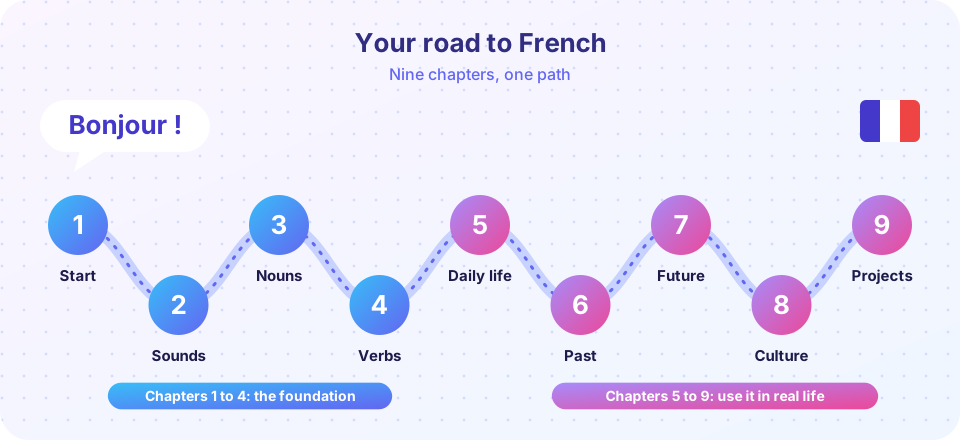
Each chapter has an overview, three to five lessons, and a review. This is the route, in order.
| Chapter | Title | What you will be able to do |
|---|---|---|
| 1 | Getting Started | Understand how the course and the language work, and read the alphabet and accents |
| 2 | Sounds, Greetings and Basics | Pronounce French words, greet people, introduce yourself, count to 100 |
| 3 | Nouns, Articles and Adjectives | Say "a", "the" and "some" correctly and describe people and things |
| 4 | Present Tense Verbs | Say what you do, have and are, with regular and key irregular verbs |
| 5 | Daily Life and Questions | Talk about routines, food, shopping, time, and ask questions |
| 6 | Past Tenses | Tell what happened, with the passé composé and the imparfait |
| 7 | Future, Pronouns and Subjunctive Basics | Plan ahead, replace nouns with pronouns, and meet the subjunctive |
| 8 | Conversation and Culture | Hold longer conversations and understand French habits and etiquette |
| 9 | Projects and Practice | Put everything together, with glossary, cheat sheet and what to study next |
This page belongs to the first group of chapters (1 to 4), which form the foundation. Chapters 5 to 9 are in the second half of the course; you can find all of them from the course page.
Your road to French
Four steps in the first half of the course
Chapters 1 and 2
Chapters 3 and 4
Later chapters
How to study each lesson
Every content lesson follows the same shape so you always know where you are. It begins with learning goals, then a box of key terms, then explanations with examples and a picture. After that come common misconceptions (the mistakes English speakers really make), a "Try it" section with interactive practice, a short quiz, and a summary.
Here is a routine that works well. Read the lesson once without stopping, then read it again out loud, pausing at each example. Open the Try it section and play with the cards and drills until you can answer without hesitating. Do the quiz last, and write down the questions you missed. A day later, reread only the summary and redo the drills. That second visit, a day later, matters more than most learners expect: memory research going back to Hermann Ebbinghaus in the 1880s shows that forgetting is steepest in the first day or two, and a well-timed review flattens the curve.
What a typical week looks like
A realistic week has five short sessions and one longer one. On Monday, read a new lesson and work through its Try it section. On Tuesday, reread only the summary of Monday's lesson, redo the quiz questions you missed, and say the examples aloud. On Wednesday, start the next lesson. On Thursday, run through your flashcards for both lessons. On Friday, read the third lesson of the week. On Saturday, take a longer session: replay the dialogues, record yourself reading one, and listen to ten minutes of real French, such as a song, a radio station or a short video. Sunday is for rest or a light review.
At this pace a chapter takes one to two weeks, so the foundation (chapters 1 to 4) takes about two months. That is a good, sustainable speed. If you want to go faster, add more listening and speaking rather than more lessons, because the bottleneck for most beginners is not information but practice. If you want to go slower, keep the daily five minutes alive; a tiny streak beats a perfect plan you abandon.
Finally, set a concrete goal that fits your life. It might be to order a meal in French on your next trip, to talk to a relative, to pass an exam, or to read a French newspaper article. A concrete goal tells you which parts of the course to emphasize, and it turns practice from an obligation into preparation for something you actually want to do.
Common misconceptions
"I must memorize every rule before I speak." No. You will say wrong things for a while, and that is how everyone learns. Aim to be understood first and accurate second; accuracy grows with exposure.
"French is just English with funny spelling." The two languages share a lot of vocabulary, but word order, gender, verb endings and pronunciation work differently. Treat French as its own system.
"I need a perfect accent." You need a clear accent. Nobody expects a beginner to sound Parisian. Correct vowels and good rhythm matter far more than a perfect French r.
Try it
First, warm up with ten survival phrases. Flip each card, say the French aloud, and try to remember it before you flip. If your browser supports speech synthesis, the "Say it" button reads the card; if not, ignore it.
Now match some French words that look like English. These are real cognates (they have the same origin), but be careful: a few French words that resemble English ones mean something different, and you will meet those "false friends" later.
Check your understanding
Quick check · 4 questions
of 4 answered You scored / 4 · perfect!
-
1. Which CEFR levels does this course mainly aim at?
The course is for true beginners and takes you to A1 and the early part of A2. -
2. Why does the course recommend reviewing a lesson one day later?
Spaced repetition reviews items just as you start to forget them, which flattens the forgetting curve. -
3. What does IPA stand for?
The International Phonetic Alphabet writes sounds precisely; this course shows it between slashes. -
4. What can a written course not replace?
A course gives structure, but you also need to hear and speak French with people.
Summary
- The course has nine chapters that move from sounds to conversation; this first half covers chapters 1 to 4.
- English and French share many words, but sounds, gender and verb endings are new and get special attention.
- Study in short daily sessions, speak aloud, and review a day later.
- Use IPA and respellings as a guide, and add real listening and conversation as soon as you can.
Track your progress
Create a free account to tick off lessons and pick up where you left off on any device.
of French for Beginners lessons completed