Lesson 36 of 48 · Future, Pronouns and Subjunctive Basics
Object Pronouns: le, la, les, lui, leur, y, en
Learn French direct and indirect object pronouns, y and en, where they go before the verb, and how they work in the passé composé and the infinitive.
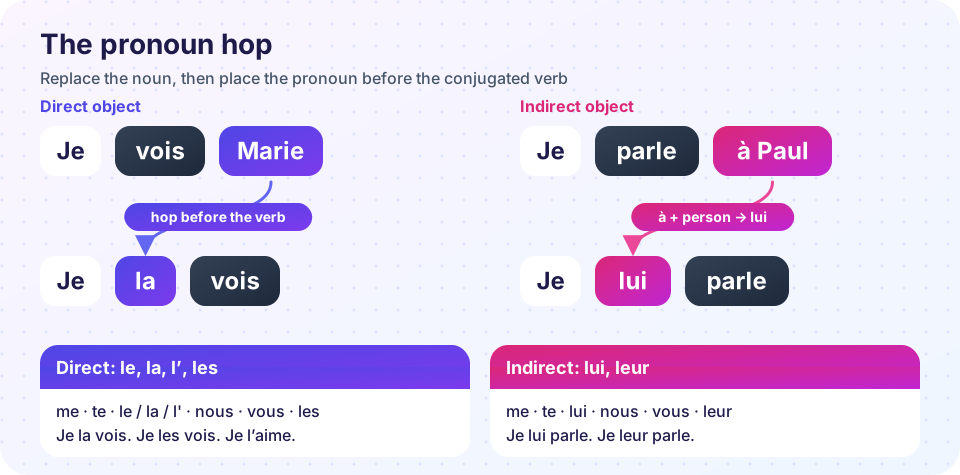
Imagine telling a story in English without ever using "him", "her", "it" or "them". You would repeat every name in every sentence. French uses small words called object pronouns to avoid that: Je vois Marie becomes Je la vois. Je parle à Paul becomes Je lui parle. They are short, they are everywhere, and they make your French sound natural.
The main difficulty is word order. In English the pronoun comes after the verb ("I see her"). In French it jumps in front: Je la vois. Once you see that hop, the rest is a small table to learn.
The pronoun hop: replace the noun, then place the pronoun directly before the conjugated verb.
le complément d'objet direct (COD): the person or thing that receives the action directly (je vois Marie). le complément d'objet indirect (COI): the person introduced by à (je parle à Paul). un pronom complément: a pronoun that replaces an object. y: there / to it. en: of it, some, any.
A direct object answers "whom?" or "what?" with no preposition: J'aime ce film.Elle regarde les enfants. An indirect object needs à: Je téléphone à ma sœur.Elle donne un cadeau à Paul.
Watch the verbs, because they do not always match English:
French verb
Takes
English
regarder, écouter, attendre, chercher
direct object
look at, listen to, wait for, look for
téléphoner à, répondre à, parler à
indirect object (à)
to call, to answer, to talk to
donner à, dire à, écrire à, offrir à
direct thing + indirect person
to give / tell / write / offer someone something
So Je l'attends means "I'm waiting for him/her" (no preposition in French), and Je lui téléphone means "I'm calling him/her".
Three things to notice. The first and second persons are the same in both columns. For "him" and "her", the direct pronoun is gendered (le / la), but the indirect is lui for both. And les (direct) and leur (indirect) are both for several people or things. Le, la and me, te become l', m', t' before a vowel or silent h.
Rule number one: the pronoun goes right before the conjugated verb.
Sentence
With a pronoun
Je vois Marie.
Je la vois.
Tu aimes ce film ?
Tu **l'**aimes ?
Il regarde les enfants.
Il les regarde.
Nous parlons à Paul.
Nous lui parlons.
Vous téléphonez aux voisins.
Vous leur téléphonez.
Negation wraps pronoun and verb: Je ne la vois pas.Il ne leur parle jamais.
Passé composé: the pronoun stands before the auxiliary: Je l'ai vu.Nous leur avons parlé.Je ne l'ai pas vu. A direct-object pronoun makes the participle agree with it: Je la vois → Je l'ai vue. *Il les regarde → Il les a regardés.* The agreement rule applies only to direct objects (la, les, l', me, te, nous, vous when direct). Lui and leur never cause agreement: Nous leur avons parlé.
With an infinitive, the pronoun goes directly before the infinitive, because that is the verb it belongs to: Je veux le voir.Il va leur téléphoner. *Nous allons **l'*acheter.
Commands: in an affirmative command the pronoun goes after the verb with a hyphen: Regarde-le !Écoutez-moi ! (me becomes moi.) In a negative command it goes before: Ne le regarde pas !
When there are two, me, te, nous, vous come first, and le, la, les before lui, leur: Il me le donne. (He gives it to me.) Je le lui dis. (I tell it to him/her.) Treat these as a small preview; the order will become familiar.
"The pronoun goes after the verb, as in English." In French it goes before: je la vois, not je vois la. The exception is the affirmative command: Regarde-la !
"Lui means only 'him'."Lui is for him and her when the object is indirect: Je lui parle can be "I'm talking to him" or "to her".
"Je l'ai vu: vu never changes." If the pronoun stands for a feminine or plural direct object, it agrees: Je l'ai vue, Je les ai vus.
"Attendre means wait for, so I need a preposition." French attendre takes a direct object: Je l'attends.
"In the passé composé, the pronoun goes between the auxiliary and the participle." It goes before the auxiliary: je l'ai vu.
<style>:root{--ink:#1e1b4b;--mut:#475569;--a:#4f46e5;--b:#db2777}*{box-sizing:border-box}body{margin:0;padding:14px;font-family:system-ui,-apple-system,'Segoe UI',sans-serif;background:linear-gradient(135deg,#faf5ff,#eff6ff);color:var(--ink)}.wrap{max-width:640px;margin:0 auto}button{font:inherit;cursor:pointer;border:0;border-radius:999px;padding:8px 16px;color:#fff;background:linear-gradient(135deg,#4f46e5,#7c3aed);box-shadow:0 4px 10px rgba(79,70,229,.25)}button.alt{background:#fff;color:var(--a);border:1px solid #c7d2fe;box-shadow:none}button:disabled{opacity:.45;cursor:default}.row{display:flex;gap:8px;flex-wrap:wrap;justify-content:center;margin:12px 0}.card{background:#fff;border-radius:18px;box-shadow:0 10px 24px rgba(67,56,202,.16);padding:26px 18px;text-align:center;min-height:130px;display:flex;flex-direction:column;justify-content:center;align-items:center;width:100%;color:var(--ink);cursor:pointer;border:0}.card .big{font-size:28px;font-weight:700}.card .sm{font-size:14px;color:var(--mut);margin-top:6px}.cnt{text-align:center;color:var(--mut);font-size:14px;margin-bottom:8px}.msg{text-align:center;min-height:22px;color:var(--mut);font-size:14px}.ok{color:#047857;font-weight:600}.bad{color:#be123c;font-weight:600}input[type=text]{font:inherit;border:2px solid #c7d2fe;border-radius:10px;padding:5px 8px;width:150px;background:#fff;color:var(--ink)}input.good{border-color:#10b981;background:#ecfdf5}input.wrong{border-color:#ef4444;background:#fef2f2}.item{background:#fff;border-radius:14px;padding:10px 14px;margin:8px 0;box-shadow:0 4px 12px rgba(67,56,202,.10);line-height:2}.item small{display:block;color:var(--mut);line-height:1.3}.keys{display:flex;flex-wrap:wrap;gap:6px;justify-content:center;margin:8px 0}.keys button{padding:4px 11px;background:#fff;color:var(--a);border:1px solid #c7d2fe;box-shadow:none;border-radius:8px}.cols{display:grid;grid-template-columns:1fr 1fr;gap:10px}.cols button{display:block;width:100%;border-radius:12px;background:#fff;color:var(--ink);border:2px solid #c7d2fe;box-shadow:none;padding:10px 8px;margin-bottom:8px;text-align:center}.cols button.sel{border-color:#4f46e5;background:#eef2ff}.cols button.done{border-color:#10b981;background:#ecfdf5;color:#047857;cursor:default}.cols button.no{border-color:#ef4444;background:#fef2f2}</style><divclass="wrap"><divclass="cols"><divid="L"></div><divid="R"></div></div><divclass="row"><buttonclass="alt"id="again">Shuffle again</button></div><divclass="msg"id="msg">Tap a French item, then its English match.</div></div><script>constD=[["Je vois Marie.","Je la vois."],["Tu aimes ce film.","Tu l'aimes."],["Il regarde les enfants.","Il les regarde."],["Nous parlons à Paul.","Nous lui parlons."],["Vous téléphonez aux voisins.","Vous leur téléphonez."],["Je vais à Rome.","J'y vais."],["Tu veux du pain ?","Tu en veux ?"]];const$=id=>document.getElementById(id);let selL=null,done=0,tries=0;constsh=a=>{a=a.slice();for(let k=a.length-1;k>0;k--){const j=Math.floor(Math.random()*(k+1));[a[k],a[j]]=[a[j],a[k]];}return a;};functionbuild(){selL=null;done=0;tries=0;$('L').innerHTML='';$('R').innerHTML='';$('msg').textContent='Tap a French item, then its English match.';sh(D.map((d,k)=>k)).forEach(k=>{const b=document.createElement('button');b.textContent=D[k][0];b.dataset.k=k;b.onclick=()=>{if(b.classList.contains('done'))return;document.querySelectorAll('#L .sel').forEach(x=>x.classList.remove('sel'));b.classList.add('sel');selL=b;};$('L').append(b);});sh(D.map((d,k)=>k)).forEach(k=>{const b=document.createElement('button');b.textContent=D[k][1];b.dataset.k=k;b.onclick=()=>{if(!selL||b.classList.contains('done'))return;tries++;if(selL.dataset.k===b.dataset.k){selL.className='done';b.className='done';selL=null;done++;if(done===D.length)$('msg').innerHTML='<span class="ok">Complete in '+tries+' tries. Bravo !</span>';}else{b.classList.add('no');setTimeout(()=>b.classList.remove('no'),500);}};$('R').append(b);});}$('again').onclick=build;build();</script>
This Python helper turns a noun phrase into the right pronoun for you in three tenses. It shows the present, the negative, and the passé composé with agreement.
Python
Pronoun replacer
AUX ={"je":"ai","tu":"as","il":"a","elle":"a","nous":"avons","vous":"avez","ils":"ont","elles":"ont"}
VOWELS ="aeiouhéèêâîôû"defpronoun(kind, gender, number, nxt):if kind =="coi":return"lui"if number =="sg"else"leur"if number =="pl":return"les"if nxt[0]in VOWELS:return"l'"return"le"if gender =="m"else"la"defput(pron, word):return pron + word if pron.endswith("'")else pron +" "+ word
defshow(subj, verb, participle, kind, gender, number):
S = subj.capitalize()
p1 = pronoun(kind, gender, number, verb)
pres =f"{S}{put(p1, verb)}."
neg =f"{S} ne {put(p1, verb)} pas."
aux = AUX[subj]
p2 = pronoun(kind, gender, number, aux)
part = participle
if kind =="cod":
part +=("e"if gender =="f"else"")+("s"if number =="pl"else"")
pc =f"{S}{put(p2, aux)}{part}."print(pres,"|", neg,"|", pc)
show("je","vois","vu","cod","f","sg")# Marie
show("tu","aimes","aimé","cod","m","sg")# ce film
show("il","regarde","regardé","cod","m","pl")# les enfants
show("nous","parlons","parlé","coi","m","sg")# à Paul
show("vous","téléphonez","téléphoné","coi","m","pl")# aux voisins
Press Run (or Ctrl + Enter) to see the result here.
Program input · what you'd type while the program runs
Type the answers before you press Run, one per line. Each time the program reads a line (with input()), it gets the next line from this box.
Pronouns
<style>:root{--ink:#1e1b4b;--mut:#475569;--a:#4f46e5;--b:#db2777}*{box-sizing:border-box}body{margin:0;padding:14px;font-family:system-ui,-apple-system,'Segoe UI',sans-serif;background:linear-gradient(135deg,#faf5ff,#eff6ff);color:var(--ink)}.wrap{max-width:640px;margin:0 auto}button{font:inherit;cursor:pointer;border:0;border-radius:999px;padding:8px 16px;color:#fff;background:linear-gradient(135deg,#4f46e5,#7c3aed);box-shadow:0 4px 10px rgba(79,70,229,.25)}button.alt{background:#fff;color:var(--a);border:1px solid #c7d2fe;box-shadow:none}button:disabled{opacity:.45;cursor:default}.row{display:flex;gap:8px;flex-wrap:wrap;justify-content:center;margin:12px 0}.card{background:#fff;border-radius:18px;box-shadow:0 10px 24px rgba(67,56,202,.16);padding:26px 18px;text-align:center;min-height:130px;display:flex;flex-direction:column;justify-content:center;align-items:center;width:100%;color:var(--ink);cursor:pointer;border:0}.card .big{font-size:28px;font-weight:700}.card .sm{font-size:14px;color:var(--mut);margin-top:6px}.cnt{text-align:center;color:var(--mut);font-size:14px;margin-bottom:8px}.msg{text-align:center;min-height:22px;color:var(--mut);font-size:14px}.ok{color:#047857;font-weight:600}.bad{color:#be123c;font-weight:600}input[type=text]{font:inherit;border:2px solid #c7d2fe;border-radius:10px;padding:5px 8px;width:150px;background:#fff;color:var(--ink)}input.good{border-color:#10b981;background:#ecfdf5}input.wrong{border-color:#ef4444;background:#fef2f2}.item{background:#fff;border-radius:14px;padding:10px 14px;margin:8px 0;box-shadow:0 4px 12px rgba(67,56,202,.10);line-height:2}.item small{display:block;color:var(--mut);line-height:1.3}.keys{display:flex;flex-wrap:wrap;gap:6px;justify-content:center;margin:8px 0}.keys button{padding:4px 11px;background:#fff;color:var(--a);border:1px solid #c7d2fe;box-shadow:none;border-radius:8px}.cols{display:grid;grid-template-columns:1fr 1fr;gap:10px}.cols button{display:block;width:100%;border-radius:12px;background:#fff;color:var(--ink);border:2px solid #c7d2fe;box-shadow:none;padding:10px 8px;margin-bottom:8px;text-align:center}.cols button.sel{border-color:#4f46e5;background:#eef2ff}.cols button.done{border-color:#10b981;background:#ecfdf5;color:#047857;cursor:default}.cols button.no{border-color:#ef4444;background:#fef2f2}</style><divclass="wrap"><divclass="keys"id="keys"></div><divid="list"></div><divclass="row"><buttonid="chk">Check answers</button><buttonclass="alt"id="show">Show answers</button></div><divclass="msg"id="msg">Type each answer. Use the accent buttons if your keyboard has no accents.</div></div><script>constD=[{"s":"Je vois Marie. → Je ___ vois.","a":["la"],"h":"Direct, feminine."},{"s":"Il regarde les enfants. → Il ___ regarde.","a":["les"],"h":""},{"s":"Nous parlons à Paul. → Nous ___ parlons.","a":["lui"],"h":"Indirect."},{"s":"Tu vas à Paris ? → Oui, j’___ vais.","a":["y"],"h":""},{"s":"Tu veux du pain ? → Oui, j’___ veux.","a":["en"],"h":""},{"s":"Je vois Marie. (passé composé) → Je l’ai ___.","a":["vue"],"h":"Agreement with the direct object la."}];const$=id=>document.getElementById(id);let last=null;constnorm=s=>s.trim().toLowerCase().replace(/[\u2019\u2018]/g,"'").replace(/\s+/g,' ');D.forEach((d,k)=>{const p=d.s.split('___');const div=document.createElement('div');div.className='item';
div.append(p[0]);const inp=document.createElement('input');inp.type='text';inp.id='i'+k;inp.autocomplete='off';inp.spellcheck=false;inp.setAttribute('aria-label','Answer '+(k+1));inp.onfocus=()=>last=inp;div.append(inp);div.append(p[1]||'');if(d.h){const s=document.createElement('small');s.textContent=d.h;div.append(s);}$('list').append(div);});['é','è','ê','à','â','ç','î','ï','ô','ù','û','œ'].forEach(ch=>{const b=document.createElement('button');b.textContent=ch;b.setAttribute('aria-label','Insert '+ch);b.onmousedown=e=>e.preventDefault();b.onclick=()=>{const t=last||$('i0');t.focus();const s=t.selectionStart,e=t.selectionEnd;t.setRangeText(ch,s,e,'end');};$('keys').append(b);});$('chk').onclick=()=>{let n=0;D.forEach((d,k)=>{const t=$('i'+k);const ok=d.a.some(a=>norm(a)===norm(t.value));t.className=ok?'good':'wrong';if(ok)n++;});$('msg').innerHTML=n===D.length?'<span class="ok">All '+n+' correct. Bravo !</span>':'<span class="bad">'+n+' of '+D.length+' correct.</span> Check accents and endings.';};$('show').onclick=()=>{D.forEach((d,k)=>{$('i'+k).value=d.a[0];$('i'+k).className='good';});$('msg').textContent='Answers shown. Reload the preview to reset.';};</script>