Order a meal, ask for the bill, buy bread, try on clothes and pay in French, with polite phrases, dialogues, quantities and a bill calculator.
Food is a large part of French culture, and restaurants and shops are where most visitors use the language every day. The vocabulary is small, and the polite formulas are repeated again and again. If you can say Bonjour, Je voudrais ..., Combien ça coûte ?, Merci and Au revoir, you can handle most of it.
This lesson also teaches a cultural rule that surprises many learners: in French shops you greet the staff when you come in, and you say goodbye when you leave. That small courtesy changes how people treat you.
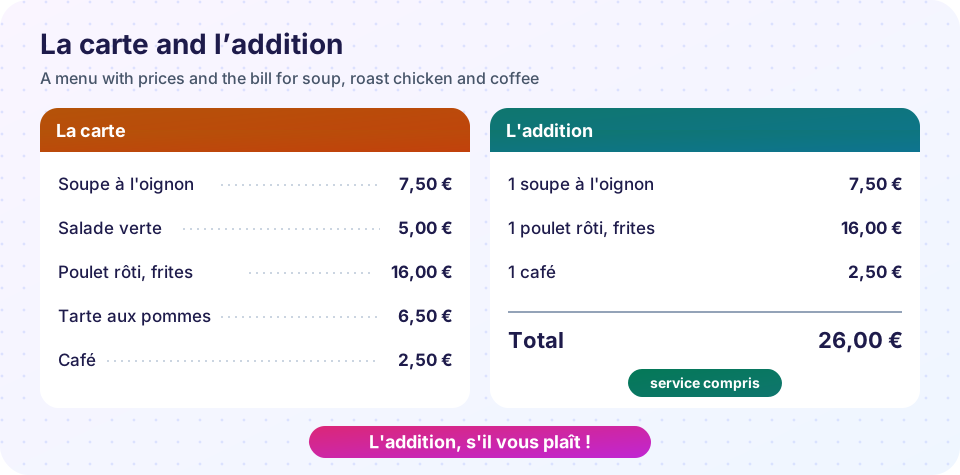
A menu (la carte) and the bill (l'addition): note the comma as the decimal sign and the euro sign after the number.
la carte: the menu list (all dishes). le menu: a fixed-price meal (a "set menu"). l'addition (f.): the bill. le pourboire: the tip. les soldes (m. pl.): the sales. la taille / la pointure: clothing size / shoe size.
Je voudrais ("I would like") is the polite way to order. Je vais prendre ("I'll have", literally "I'm going to take") is also very common. Avoid Je veux ("I want") with strangers: it sounds blunt.
A typical menu has three parts: une entrée (a starter: note that in French it is not the main course!), un plat (main course) and un dessert. A formule or menu is a fixed-price combination of two or three courses, and the plat du jour is the dish of the day. Bread is usually free at the table, and you can ask for une carafe d'eau of tap water at no charge. Service is normally included in the price on the menu (service compris), so leaving a tip is optional; people often round up or leave a few coins.
Coffee words:un café in France is a small espresso. For a larger milky coffee ask for un café crème; un café allongé is an espresso with more water; un déca is decaf. Say Bon appétit ! before eating, and Santé ! when you clink glasses.
Meals follow a rhythm that is worth knowing. Lunch is often served roughly between noon and two o'clock, and dinner usually starts in the evening, around half past seven or later, so many traditional restaurants close between the two services. In a longer meal you may start with an apéritif (a drink and a snack, often called an apéro), then the starter, the main course, sometimes a cheese course, then dessert and coffee. Waiters do not bring the bill automatically, because rushing guests is considered impolite: you ask for it with L'addition, s'il vous plaît, often catching the server's eye or raising a hand slightly. It is normal to stay at the table for a while after you have finished, and no one will hurry you. Reserving a table is a good idea for dinner: Je voudrais réserver une table pour deux personnes, ce soir, à vingt heures.
First, flashcards for the key phrases. Flip, flip back and say each one aloud.
Restaurant and shop phrases
<style>:root{--ink:#1e1b4b;--mut:#475569;--a:#4f46e5;--b:#db2777}*{box-sizing:border-box}body{margin:0;padding:14px;font-family:system-ui,-apple-system,'Segoe UI',sans-serif;background:linear-gradient(135deg,#faf5ff,#eff6ff);color:var(--ink)}.wrap{max-width:640px;margin:0 auto}button{font:inherit;cursor:pointer;border:0;border-radius:999px;padding:8px 16px;color:#fff;background:linear-gradient(135deg,#4f46e5,#7c3aed);box-shadow:0 4px 10px rgba(79,70,229,.25)}button.alt{background:#fff;color:var(--a);border:1px solid #c7d2fe;box-shadow:none}button:disabled{opacity:.45;cursor:default}.row{display:flex;gap:8px;flex-wrap:wrap;justify-content:center;margin:12px 0}.card{background:#fff;border-radius:18px;box-shadow:0 10px 24px rgba(67,56,202,.16);padding:26px 18px;text-align:center;min-height:130px;display:flex;flex-direction:column;justify-content:center;align-items:center;width:100%;color:var(--ink);cursor:pointer;border:0}.card .big{font-size:28px;font-weight:700}.card .sm{font-size:14px;color:var(--mut);margin-top:6px}.cnt{text-align:center;color:var(--mut);font-size:14px;margin-bottom:8px}.msg{text-align:center;min-height:22px;color:var(--mut);font-size:14px}.ok{color:#047857;font-weight:600}.bad{color:#be123c;font-weight:600}input[type=text]{font:inherit;border:2px solid #c7d2fe;border-radius:10px;padding:5px 8px;width:150px;background:#fff;color:var(--ink)}input.good{border-color:#10b981;background:#ecfdf5}input.wrong{border-color:#ef4444;background:#fef2f2}.item{background:#fff;border-radius:14px;padding:10px 14px;margin:8px 0;box-shadow:0 4px 12px rgba(67,56,202,.10);line-height:2}.item small{display:block;color:var(--mut);line-height:1.3}.keys{display:flex;flex-wrap:wrap;gap:6px;justify-content:center;margin:8px 0}.keys button{padding:4px 11px;background:#fff;color:var(--a);border:1px solid #c7d2fe;box-shadow:none;border-radius:8px}.cols{display:grid;grid-template-columns:1fr 1fr;gap:10px}.cols button{display:block;width:100%;border-radius:12px;background:#fff;color:var(--ink);border:2px solid #c7d2fe;box-shadow:none;padding:10px 8px;margin-bottom:8px;text-align:center}.cols button.sel{border-color:#4f46e5;background:#eef2ff}.cols button.done{border-color:#10b981;background:#ecfdf5;color:#047857;cursor:default}.cols button.no{border-color:#ef4444;background:#fef2f2}</style><divclass="wrap"><divclass="cnt"id="cnt"></div><buttonclass="card"id="card"aria-live="polite"><spanclass="big"id="big"></span><spanclass="sm"id="sm"></span></button><divclass="row"><buttonclass="alt"id="prev">Back</button><buttonid="flip">Flip</button><buttonclass="alt"id="next">Next</button></div><divclass="row"><buttonclass="alt"id="dir">French first</button><buttonclass="alt"id="shuf">Shuffle</button><buttonclass="alt"id="say">Listen</button></div><divclass="msg"id="msg"></div></div><script>constD=[["Je voudrais ...","I would like ..."],["Je vais prendre ...","I'll have ..."],["L'addition, s'il vous plaît.","The bill, please."],["Combien ça coûte ?","How much does it cost?"],["Je le prends.","I'll take it."],["Quelle taille ?","What size?"],["C'est trop cher.","It's too expensive."],["Je regarde seulement.","I'm just looking."],["Vous acceptez les cartes ?","Do you accept cards?"],["Bon appétit !","Enjoy your meal!"]];let i=0,showFr=true,fr=true;const$=id=>document.getElementById(id);functiondraw(){const c=D[i];$('cnt').textContent='Card '+(i+1)+' of '+D.length;const q=fr?c[0]:c[1],a=fr?c[1]:c[0];$('big').textContent=showFr?q:a;$('sm').textContent=showFr?'Tap to flip':(fr?'English':'French');}functionflip(){showFr=!showFr;draw();}$('card').onclick=flip;$('flip').onclick=flip;$('next').onclick=()=>{i=(i+1)%D.length;showFr=true;draw();};$('prev').onclick=()=>{i=(i-1+D.length)%D.length;showFr=true;draw();};$('dir').onclick=()=>{fr=!fr;$('dir').textContent=fr?'French first':'English first';showFr=true;draw();};$('shuf').onclick=()=>{for(let k=D.length-1;k>0;k--){const j=Math.floor(Math.random()*(k+1));[D[k],D[j]]=[D[j],D[k]];}i=0;showFr=true;draw();};$('say').onclick=()=>{try{if(!('speechSynthesis'in window))throw0;const u=newSpeechSynthesisUtterance(D[i][0]);u.lang='fr-FR';speechSynthesis.cancel();speechSynthesis.speak(u);$('msg').textContent='';}catch(e){$('msg').textContent='Speech is not available in this preview. Say it aloud yourself.';}};draw();</script>
This Python script totals a French restaurant bill. Prices are stored in cents to avoid decimal errors, and the output uses the French style (comma and euro sign after the number). Change the order and run it again.
Python
Bill calculator
MENU ={"soupe à l'oignon":750,"salade verte":500,"poulet rôti, frites":1600,"tarte aux pommes":650,"café":250,"carafe d'eau":0}defeur(cents):
euros, c =divmod(cents,100)returnf"{euros},{c:02d} €"defaddition(order):
total =0print("L'ADDITION")print("-"*42)for item, qty in order:
price = MENU[item]* qty
total += price
label =f"{qty} x {item}"print(label.ljust(30), eur(price).rjust(10))print("-"*42)print("Total".ljust(30), eur(total).rjust(10))print("Service compris.")return total
addition([("soupe à l'oignon",1),("poulet rôti, frites",1),("café",1),("carafe d'eau",1)])print()
addition([("salade verte",2),("tarte aux pommes",2),("café",2)])
Press Run (or Ctrl + Enter) to see the result here.
Program input · what you'd type while the program runs
Type the answers before you press Run, one per line. Each time the program reads a line (with input()), it gets the next line from this box.
Polite phrases
<style>:root{--ink:#1e1b4b;--mut:#475569;--a:#4f46e5;--b:#db2777}*{box-sizing:border-box}body{margin:0;padding:14px;font-family:system-ui,-apple-system,'Segoe UI',sans-serif;background:linear-gradient(135deg,#faf5ff,#eff6ff);color:var(--ink)}.wrap{max-width:640px;margin:0 auto}button{font:inherit;cursor:pointer;border:0;border-radius:999px;padding:8px 16px;color:#fff;background:linear-gradient(135deg,#4f46e5,#7c3aed);box-shadow:0 4px 10px rgba(79,70,229,.25)}button.alt{background:#fff;color:var(--a);border:1px solid #c7d2fe;box-shadow:none}button:disabled{opacity:.45;cursor:default}.row{display:flex;gap:8px;flex-wrap:wrap;justify-content:center;margin:12px 0}.card{background:#fff;border-radius:18px;box-shadow:0 10px 24px rgba(67,56,202,.16);padding:26px 18px;text-align:center;min-height:130px;display:flex;flex-direction:column;justify-content:center;align-items:center;width:100%;color:var(--ink);cursor:pointer;border:0}.card .big{font-size:28px;font-weight:700}.card .sm{font-size:14px;color:var(--mut);margin-top:6px}.cnt{text-align:center;color:var(--mut);font-size:14px;margin-bottom:8px}.msg{text-align:center;min-height:22px;color:var(--mut);font-size:14px}.ok{color:#047857;font-weight:600}.bad{color:#be123c;font-weight:600}input[type=text]{font:inherit;border:2px solid #c7d2fe;border-radius:10px;padding:5px 8px;width:150px;background:#fff;color:var(--ink)}input.good{border-color:#10b981;background:#ecfdf5}input.wrong{border-color:#ef4444;background:#fef2f2}.item{background:#fff;border-radius:14px;padding:10px 14px;margin:8px 0;box-shadow:0 4px 12px rgba(67,56,202,.10);line-height:2}.item small{display:block;color:var(--mut);line-height:1.3}.keys{display:flex;flex-wrap:wrap;gap:6px;justify-content:center;margin:8px 0}.keys button{padding:4px 11px;background:#fff;color:var(--a);border:1px solid #c7d2fe;box-shadow:none;border-radius:8px}.cols{display:grid;grid-template-columns:1fr 1fr;gap:10px}.cols button{display:block;width:100%;border-radius:12px;background:#fff;color:var(--ink);border:2px solid #c7d2fe;box-shadow:none;padding:10px 8px;margin-bottom:8px;text-align:center}.cols button.sel{border-color:#4f46e5;background:#eef2ff}.cols button.done{border-color:#10b981;background:#ecfdf5;color:#047857;cursor:default}.cols button.no{border-color:#ef4444;background:#fef2f2}</style><divclass="wrap"><divclass="keys"id="keys"></div><divid="list"></div><divclass="row"><buttonid="chk">Check answers</button><buttonclass="alt"id="show">Show answers</button></div><divclass="msg"id="msg">Type each answer. Use the accent buttons if your keyboard has no accents.</div></div><script>constD=[{"s":"Je ___ un café, s’il vous plaît. (I would like)","a":["voudrais"],"h":"Polite conditional."},{"s":"___ , Madame. (Hello, on entering a shop)","a":["Bonjour"],"h":"Always greet."},{"s":"Un kilo ___ pommes. (of)","a":["de"],"h":"No article after a quantity."},{"s":"L’___ , s’il vous plaît. (the bill)","a":["addition"],"h":""},{"s":"Je fais ___ M. (I'm a medium)","a":["du"],"h":"faire du + size."},{"s":"Vous ___ les cartes ? (accept)","a":["acceptez"],"h":""}];const$=id=>document.getElementById(id);let last=null;constnorm=s=>s.trim().toLowerCase().replace(/[\u2019\u2018]/g,"'").replace(/\s+/g,' ');D.forEach((d,k)=>{const p=d.s.split('___');const div=document.createElement('div');div.className='item';
div.append(p[0]);const inp=document.createElement('input');inp.type='text';inp.id='i'+k;inp.autocomplete='off';inp.spellcheck=false;inp.setAttribute('aria-label','Answer '+(k+1));inp.onfocus=()=>last=inp;div.append(inp);div.append(p[1]||'');if(d.h){const s=document.createElement('small');s.textContent=d.h;div.append(s);}$('list').append(div);});['é','è','ê','à','â','ç','î','ï','ô','ù','û','œ'].forEach(ch=>{const b=document.createElement('button');b.textContent=ch;b.setAttribute('aria-label','Insert '+ch);b.onmousedown=e=>e.preventDefault();b.onclick=()=>{const t=last||$('i0');t.focus();const s=t.selectionStart,e=t.selectionEnd;t.setRangeText(ch,s,e,'end');};$('keys').append(b);});$('chk').onclick=()=>{let n=0;D.forEach((d,k)=>{const t=$('i'+k);const ok=d.a.some(a=>norm(a)===norm(t.value));t.className=ok?'good':'wrong';if(ok)n++;});$('msg').innerHTML=n===D.length?'<span class="ok">All '+n+' correct. Bravo !</span>':'<span class="bad">'+n+' of '+D.length+' correct.</span> Check accents and endings.';};$('show').onclick=()=>{D.forEach((d,k)=>{$('i'+k).value=d.a[0];$('i'+k).className='good';});$('msg').textContent='Answers shown. Reload the preview to reset.';};</script>