


















Lesson 24 of 48 · Daily Life and Questions
Chapter 5 Overview: Daily Life and Questions
Chapter 5 of French for Beginners: count, tell the time, give dates, ask questions and say no. Overview, dialogue and lesson map.
Up to now you have met the sounds of French, greetings, nouns, articles, adjectives and the present tense. That is enough to say who you are and what you have. Daily life asks for more. You need to ask the price of a coffee, say what time a train leaves, find out where the toilets are, and politely say that you do not understand.
This chapter gives you four tools that appear in nearly every real conversation: numbers and time, questions, and negation. None of them is hard on its own. Together they turn a handful of memorized phrases into a language you can steer.
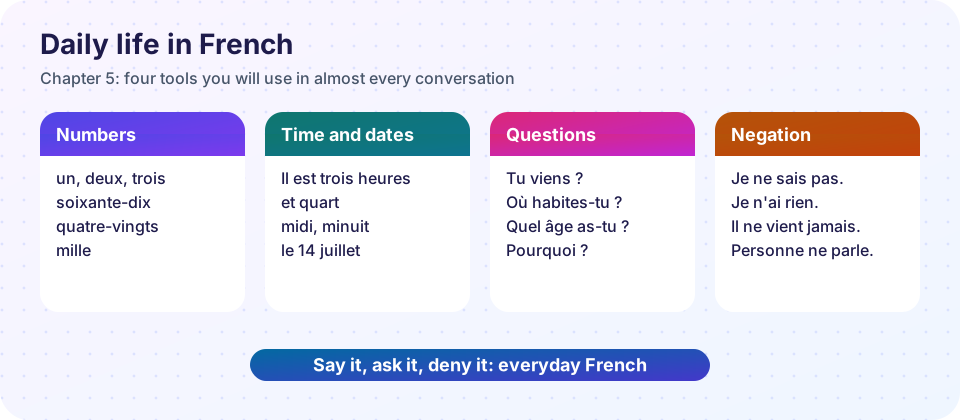
What you will learn
- How the chapter is organized and why these four tools belong together
- A short dialogue that uses all four, so you see them working as a team
- What each lesson in the chapter covers
- How to study this chapter in short daily sessions
The chapter in five slides
Count and tell time
Ask anything
Say no the French way
How to practice
Speak every example, even if you are alone.
A first look: one conversation, four tools
Read this dialogue slowly. Do not worry about every word. Look for numbers, a time, a question and a negation.
| French | English |
|---|---|
| Léa : Excusez-moi, à quelle heure part le train pour Lyon ? | Excuse me, what time does the train for Lyon leave? |
| Employé : Il part à quatorze heures quinze. | It leaves at 2:15 p.m. |
| Léa : Et il coûte combien ? | And how much does it cost? |
| Employé : Quarante-deux euros. | Forty-two euros. |
| Léa : Je n'ai pas de carte. Vous acceptez les espèces ? | I don't have a card. Do you accept cash? |
| Employé : Bien sûr. Mais je n'ai plus de billets pour ce train. | Of course. But I have no tickets left for this train. |
Count what you found. quatorze heures quinze and quarante-deux euros are numbers. à quelle heure and il coûte combien are questions, built in two different ways. je n'ai pas de carte and je n'ai plus de billets are negations, and each uses a different second word (pas, plus). By the end of the chapter you will build sentences like these yourself.
Key terms for the chapter. Cardinal number: one, two, three (un, deux, trois). Question word: a word like où (where) or quand (when) that starts an information question. Inversion: swapping the subject and verb to make a formal question (Parlez-vous français ?). Negation: the grammar that turns a statement into "not".
What each lesson covers
- Numbers, time and dates: the numbers from zero to one million, why 97 is "four-twenty-seventeen", how to say 3:45 and 14 July, and how to read prices and phone numbers.
- Asking questions: three registers of question (casual, neutral, formal), the question words, and short polite phrases you can use on your first day in a French-speaking town.
- Negation: ne ... pas and its relatives jamais, rien, personne, plus, plus the surprising rule that du, de la and des turn into de after a negation.
- Chapter review: a one-page picture, a recap table and a ten-question quiz.
Each lesson contains interactive flashcards, drills or Python helpers. These run inside the page, and the Listen button on flashcards uses your browser's speech voice when one is available. A page cannot replace talking with a real person, so use the cards to warm up, then find a speaking partner, a tutor or a language exchange.
Study plan. Spend ten minutes a day, not two hours once a week. Day 1: numbers 0 to 20. Day 2: tens up to 100. Day 3: time. Day 4: question words. Day 5: negation. Then repeat, adding a little more each round. Memory prefers frequent contact over one long session.
Check your understanding
Quick check · 3 questions
of 3 answered You scored / 3 · perfect!
-
1. Which tools does Chapter 5 teach?
Chapter 5 gives you the everyday tools: counting and telling time, asking questions and saying no. Past tenses come in Chapter 6. -
2. In the dialogue, what does 'Je n'ai pas de carte' mean?
The ne ... pas pair around the verb makes the sentence negative: I do not have a card. -
3. Which is a French question word?
Combien (how much, how many) starts a question. Jamais means never, and midi means noon.
Summary
- Chapter 5 teaches numbers, time, dates, questions and negation.
- Real conversations mix all four, as the train-ticket dialogue showed.
- Study in short daily sessions and always speak the examples aloud.
Next: Numbers, time and dates
Track your progress
Create a free account to tick off lessons and pick up where you left off on any device.
of French for Beginners lessons completed