


















Lesson 7 of 48 · Sounds, Greetings and Basics
Consonants, silent letters, elision and liaison
Learn how French consonants work: the French r, soft and hard c and g, ch, gn, silent final letters and the silent h, plus elision (l'ami) and liaison (les amis).
If vowels are the soul of French pronunciation, consonants and linking are its rhythm. Most consonants will look familiar, but a handful behave in ways that surprise English speakers: the throaty French r, the c and g that change sound, and a large number of letters that are written but never spoken. On top of that, French speakers join words together in two ways, called elision and liaison, which explain why a sentence you can read easily is hard to understand at speed.
This lesson gives you rules you can apply to any new word, with the exceptions that actually matter at beginner level.
What you will learn
- How to pronounce the French r, ch, gn, j, qu, ph, th and the changing c, g and s.
- Which final letters are silent and how the silent h works.
- How elision turns le ami into l'ami.
- When liaison is required, forbidden and optional, and what sounds appear.
Key terms
Uvular r is the French /ʁ/, made at the back of the mouth near the uvula.
Mute h (h muet) is a silent h that behaves like a vowel: l'homme. Aspirated h (h aspiré) is a silent h that behaves like a consonant: le héros.
Elision drops the final vowel of a short word before a vowel sound and replaces it with an apostrophe.
Liaison pronounces a normally silent final consonant when the next word begins with a vowel sound.
Consonants that match English, mostly
B, d, f, k, l, m, n, p, t, v and z are close to English. Two details help your accent. First, French p, t and k have no puff of air: say Paris /paʁi/ with the lips barely releasing a breath, as in English "spin" rather than "pin". Second, French t and d touch the back of the upper teeth, not the ridge behind them. Double consonants are not pronounced longer: belle /bɛl/ and pomme /pɔm/ have a single, normal consonant.
The consonants that need attention
R /ʁ/. The French r is made in the throat, a light, voiced scrape like a soft gargle. To find it, say "ga" and notice where the back of your tongue touches your soft palate, then relax the contact so air can flow, and keep your tongue tip behind your lower teeth. Practice on rue, rouge, merci, parler, très. A rough version is fine; listeners understand it.
C. It has two sounds. Before a, o, u or a consonant it is /k/: café, cola, cure, classe. Before e, i, y it is /s/: ce, ici, cycle. The cedilla ç gives /s/ before a, o, u: garçon, ça, reçu.
G. Before a, o, u or a consonant it is /ɡ/ (hard): gare, gorge, grand. Before e, i, y it is /ʒ/ (soft, like the s in "measure"): gens, girafe, gymnase. To keep a hard g before e or i, French adds a u: guerre (war), guide, guitare. To keep a soft g before a or o, French adds an e: nous mangeons /nu mɑ̃ʒɔ̃/.
J /ʒ/. Always soft: je, jour, jaune (yellow), bonjour.
CH /ʃ/. Like English "sh": chat (cat), chien (dog), chaud (hot), chercher. In a few words of Greek origin it is /k/: chorale, orchestre.
GN /ɲ/. Like the "ny" of "canyon": montagne (mountain), ligne (line), espagnol.
QU /k/. Always /k/: que, qui, musique, quatre. The u is silent.
PH /f/ and TH /t/. Photo /fɔto/, pharmacie, thé /te/ (tea), théâtre. The th is never like English "th".
S. At the start of a word or after a consonant, s is /s/: sac, sœur. Between two vowels, a single s is /z/: maison /mɛzɔ̃/, rose /ʁoz/, musique /myzik/. A double ss is always /s/, which is why poisson (fish) /pwasɔ̃/ differs from poison (poison) /pwazɔ̃/. Learn this pair; it is a classic.
X. Usually /ks/ (taxi), or /ɡz/ at the start of ex- before a vowel (exemple /ɛɡzɑ̃pl/). A final x is silent: deux /dø/, prix /pʁi/, heureux.
H. Never pronounced: homme (man) /ɔm/, hôtel /otɛl/, heure (hour) /œʁ/, huit (eight) /ɥit/.
W. In loanwords, /v/ in wagon, /w/ in week-end and whisky.
Silent final letters
Most final consonants are silent: petit /pəti/, grand /ɡʁɑ̃/, vous /vu/, Paris /paʁi/, trop /tʁo/, chez /ʃe/, temps /tɑ̃/, beaucoup /boku/, et /e/ (and). Remember the CaReFuL tendency: c, r, f, l are often pronounced (sac, mer, vif, bal) but there are exceptions such as the verb ending -er, where the r is silent (parler /paʁle/), and clef.
The final -e is silent in most words, but it leaves a consonant sounding in front of it. That difference is how you hear gender: petit /pəti/ (masculine) versus petite /pətit/ (feminine), grand /ɡʁɑ̃/ versus grande /ɡʁɑ̃d/. The plural -s and the verb ending -ent are silent: les chats, ils parlent /il paʁl/. We will use this a lot in chapters 3 and 4.
Elision
When a short word ending in a vowel meets a word beginning with a vowel sound, the first vowel is dropped and replaced by an apostrophe. This is elision, and it is not optional.
- le or la becomes l': l'ami (the friend), l'école (the school), l'homme (the man).
- je becomes j': j'aime (I like/love), j'habite (I live).
- me, te, se, ne, de, ce, que become m', t', s', n', d', c', qu': il m'aime, je n'ai pas, d'accord, c'est, qu'est-ce que.
- si becomes s' only before il or ils: s'il vous plaît, but si elle stays si elle.
A word beginning with a mute h counts as a vowel: l'hôtel, j'habite. A word with an aspirated h does not elide: le héros (the hero), la haine (hatred), le hamburger. Dictionaries mark aspirated h words with a dot or an asterisk; you will learn them as you meet them.
Liaison
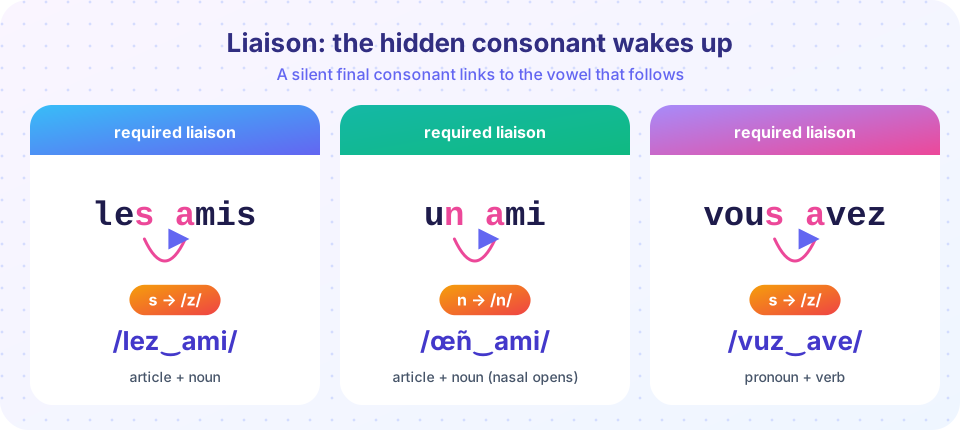
A liaison happens inside a group of words that belong together. The silent final consonant of the first word is pronounced and joins the vowel of the next word. The sound sometimes changes: s, x, z → /z/, d → /t/, n → /n/, t → /t/.
| Written | Spoken | Group |
|---|---|---|
| les amis | /lez‿ami/ | article + noun |
| deux enfants | /døz‿ɑ̃fɑ̃/ | number + noun |
| un ami | /œ̃n‿ami/ (the nasal becomes oral) | article + noun |
| petit ami | /pətit‿ami/ | adjective + noun |
| grand arbre | /ɡʁɑ̃t‿aʁbʁ/ | adjective + noun |
| vous avez | /vuz‿ave/ | pronoun + verb |
| très utile | /tʁɛz‿ytil/ | adverb + adjective |
| ils ont | /ilz‿ɔ̃/ | pronoun + verb |
Liaison is required after articles and numbers, after possessives (mon ami), after subject pronouns (vous avez, ils ont) and in many fixed phrases. It is forbidden after et (et elle is /e‿ɛl/, never /et‿ɛl/), before an aspirated h (les héros, no z), and after most singular nouns (un enfant intelligent, no liaison between enfant and intelligent). In other places it is optional and depends on how formal the speaker is. Beginners are safe if they apply liaison to the required cases and skip the rest.
A related effect is enchaînement: a final consonant that is always pronounced simply slides into the next vowel, so il‿a (he has) is i-la and elle‿est is è-lè. English does this too, but French does it everywhere.
Common misconceptions
"Silent letters are useless." They preserve history and gender (petit versus petite) and wake up in liaison. Do not drop them when you write.
"Liaison is a sign of being fancy." Required liaisons are part of standard speech. Missing them makes you sound unnatural: les amis said as /le ami/ is wrong.
"The h is pronounced in French like in English." It is always silent; only the mute-versus-aspirated difference matters, and it affects elision and liaison, not sound.
Try it
Practice elision first. The Python helper below applies the elision rule to a list of word pairs, and checks for an aspirated h. It is a simplified rule, not a full dictionary.
Press Run (or Ctrl + Enter) to see the result here.
Program input · what you'd type while the program runs
Type the answers before you press Run, one per line. Each time the program reads a line (with input()), it gets the next line from this box.
Next, a liaison explorer. Given a word and the next word, it tells you which consonant sound is added, following the table above. Again, it is a model of the usual rule, not a complete theory.
Press Run (or Ctrl + Enter) to see the result here.
Program input · what you'd type while the program runs
Type the answers before you press Run, one per line. Each time the program reads a line (with input()), it gets the next line from this box.
Finally, apply the elision rule yourself. Combine the words into one, writing the apostrophe like this: l' j' n'
Check your understanding
Quick check · 5 questions
of 5 answered You scored / 5 · perfect!
-
1. How is the c pronounced in the word ici?
C before e, i or y is /s/. Ici is /isi/. -
2. How do you say les amis?
The s of les becomes /z/ and joins amis: /lez‿ami/. -
3. Which word begins with an aspirated h, blocking elision?
Le héros keeps le; l'homme, l'hôtel and l'heure begin with a mute h. -
4. How is the g pronounced in girafe?
G before i is /ʒ/, as in je. -
5. Which pair is correctly described?
Double ss is /s/, a single s between vowels is /z/.
Summary
- Most consonants resemble English, but French p, t and k are unaspirated and the r is made at the back of the throat.
- C and g are soft before e, i, y and hard otherwise; ç, gu and ge change that.
- Many final consonants are silent; the final e is silent but makes the consonant before it sound.
- Elision is required: l'ami, j'aime, n'est; a mute h acts like a vowel, an aspirated h does not.
- Liaison is required after articles, numbers and subject pronouns and forbidden after et and before an aspirated h.
Track your progress
Create a free account to tick off lessons and pick up where you left off on any device.
of French for Beginners lessons completed