


















Lesson 32 of 48 · Past Tenses
The Imparfait and Choosing Your Past Tense
Learn to form the French imparfait, when to use it for scenes and habits, and how to choose between the imparfait and the passé composé.
The passé composé tells you what happened. The imparfait tells you what things were like. It is the tense of childhood memories, of weather, of descriptions and of things that used to happen again and again. Its name means "unfinished": the action has no clear beginning or end in the story.
The imparfait is easy to form, and almost completely regular. The hard part is the choice: j'ai mangé or je mangeais? That is the real skill of this lesson, and it will take practice. You will learn the forms first, then a few simple tests for choosing the right tense.
What you will learn
- Form the imparfait for any verb with the nous trick
- Conjugate être and handle spelling changes (mangeais, commençais)
- Use the imparfait for description, habit and background
- Choose between the imparfait and the passé composé using time words and story logic
Key terms
l'imparfait (m.): the past tense of scenes and habits. la description: how things were (weather, age, feelings). l'habitude (f.): a repeated action. un événement: a single event. l'action interrompue: an ongoing action interrupted by another.
Forming the imparfait
- Take the nous form of the present tense: nous parlons, nous finissons, nous prenons.
- Drop -ons: parl-, finiss-, pren-.
- Add the endings: -ais, -ais, -ait, -ions, -iez, -aient.
| Subject | parler | finir | prendre |
|---|---|---|---|
| je | parlais | finissais | prenais |
| tu | parlais | finissais | prenais |
| il / elle / on | parlait | finissait | prenait |
| nous | parlions | finissions | prenions |
| vous | parliez | finissiez | preniez |
| ils / elles | parlaient | finissaient | prenaient |
Three endings (-ais, -ait, -aient) sound the same, so je parlais, il parlait and ils parlaient are pronounced alike. Use the subject to know the form when you write.
More examples: faire → nous faisons → je faisais. aller → nous allons → j'allais. avoir → nous avons → j'avais. boire → nous buvons → je buvais.
The single exception: être
Être has an irregular stem, ét-, but regular endings: j'étais, tu étais, il était, nous étions, vous étiez, ils étaient. This is the most common imparfait verb of all, so learn it first.
Spelling changes
- -ger verbs keep the e before a: je mangeais, il mangeait, ils mangeaient, but nous mangions, vous mangiez.
- -cer verbs add a cedilla before a: je commençais, il commençait, but nous commencions.
What the imparfait is for
Use it for five jobs:
- Description of the past: La maison était grande. Elle avait un jardin. (The house was big. It had a garden.)
- Age, weather, time and feelings: J'avais dix ans. Il pleuvait. Il était huit heures. Nous étions fatigués.
- Habits and repeated actions: Quand j'étais enfant, j'allais chez ma grand-mère tous les dimanches. (When I was a child, I went to my grandmother's every Sunday.)
- Ongoing actions: Je lisais pendant que mon frère dormait. (I was reading while my brother slept.)
- Background for an event: Il faisait nuit quand nous sommes arrivés. (It was dark when we arrived.)
A bonus use: a friendly suggestion with si (if): Si on allait au cinéma ? (How about going to the cinema?).
Choosing: imparfait or passé composé?
Ask these questions about the verb.
| Question | Yes → | Example |
|---|---|---|
| Is it a single finished event? | passé composé | Hier, j'ai visité le musée. |
| Did it happen a specific number of times? | passé composé | Je l'ai vu deux fois. |
| Is it a description, state or habit? | imparfait | Le musée était grand. |
| Is it ongoing when something happened? | imparfait | Je visitais le musée quand il a plu. |
| Does it move the story forward? | passé composé | Je suis entré, j'ai payé, j'ai regardé. |
| Does it set the scene? | imparfait | Il y avait beaucoup de monde. |
Signal words
| Often imparfait | Often passé composé |
|---|---|
| souvent, toujours | soudain, tout à coup |
| d'habitude, chaque jour | hier, ce matin, un jour |
| tous les étés, le lundi | une fois, deux fois |
| à cette époque, autrefois | à ce moment-là, enfin |
| pendant que | puis, ensuite, alors |
These are hints, not rules. The meaning of the whole sentence decides.
Interrupted action
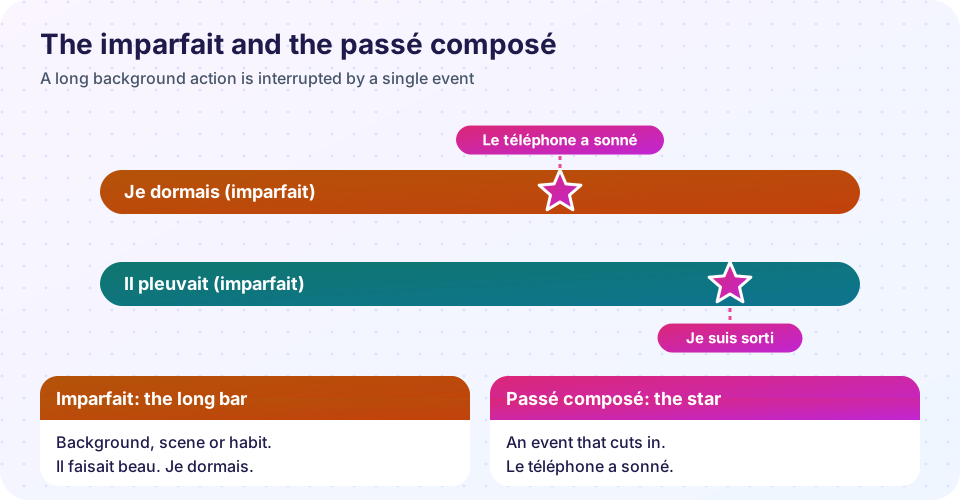
The classic pattern is imparfait for what was going on, passé composé for what interrupted it:
- Je dormais quand le téléphone a sonné. (I was sleeping when the phone rang.)
- Il pleuvait quand je suis sorti. (It was raining when I went out.)
- Nous mangions quand Paul est arrivé. (We were eating when Paul arrived.)
A short story
Read this paragraph. Which verbs are the scene, and which are the plot?
Il était huit heures du soir. Il pleuvait et il faisait froid. Je rentrais à pied. Soudain, j'ai entendu un bruit. Je me suis retourné et j'ai vu un petit chat. Il avait peur. Je l'ai pris dans mes bras et je suis rentré.
Scene (imparfait): il était, il pleuvait, il faisait, je rentrais, il avait peur. Plot (passé composé): j'ai entendu, je me suis retourné, j'ai vu, je l'ai pris, je suis rentré. The translation: "It was eight in the evening. It was raining and it was cold. I was walking home. Suddenly, I heard a noise. I turned around and saw a little cat. It was scared. I picked it up and went home."
Common misconceptions
"The imparfait always means 'used to'." Often, but not always. Il pleuvait is "it was raining", and j'avais dix ans is "I was ten".
"Imparfait is for long actions and passé composé for short ones." Length is not the test. J'ai habité à Paris pendant dix ans uses the passé composé because the period is closed and viewed as a whole.
"Je mangeai instead of je mangeais." In the imparfait, je always takes -ais. Mangeai belongs to the literary passé simple.
"Être in the imparfait is regular." It is not: the stem is ét- (j'étais), not ê-.
Try it
This Python conjugator builds the imparfait from the nous stem, with the spelling rules for -ger and -cer. Try your own verbs.
Press Run (or Ctrl + Enter) to see the result here.
Program input · what you'd type while the program runs
Type the answers before you press Run, one per line. Each time the program reads a line (with input()), it gets the next line from this box.
Now a picture of the two tenses on a timeline. The long bars are the imparfait (background), and the stars are the passé composé (events).
Press Run (or Ctrl + Enter) to see the result here.
Program input · what you'd type while the program runs
Type the answers before you press Run, one per line. Each time the program reads a line (with input()), it gets the next line from this box.
Now choose the right tense yourself.
Check your understanding
Quick check · 5 questions
of 5 answered You scored / 5 · perfect!
-
1. How do you form the imparfait stem of 'finir'?
Always take the nous form of the present and drop -ons: finiss- + ais = finissais. -
2. Which is correct for 'I was ten years old'?
Age uses avoir, and a state in the past takes the imparfait: j'avais dix ans. -
3. 'Nous ___ quand Paul est arrivé.' (manger)
An ongoing action interrupted by an event takes the imparfait: nous mangions. -
4. Which spelling is right?
-cer verbs need ç before a: je commençais. -
5. Which signal word usually points to the passé composé?
Soudain (suddenly) introduces an event, so it goes with the passé composé.
Summary
- Imparfait = nous stem without -ons + -ais, -ais, -ait, -ions, -iez, -aient; only être has an irregular stem (ét-).
- Spelling: mangeais (but mangions), commençais (but commencions).
- Use the imparfait for description, age, weather, habits, ongoing actions and background; use the passé composé for completed events that move the story.
- Typical pattern: imparfait for the scene, passé composé for the interruption.
Next: Chapter 6 review
Track your progress
Create a free account to tick off lessons and pick up where you left off on any device.
of French for Beginners lessons completed