


















Lesson 4 of 48 · Getting Started
Chapter 1 review: Getting Started
Review chapter 1 of French for Beginners: the course route, where French is spoken, study methods, the alphabet and accents, with a recap table, a dialogue and a ten-question quiz.
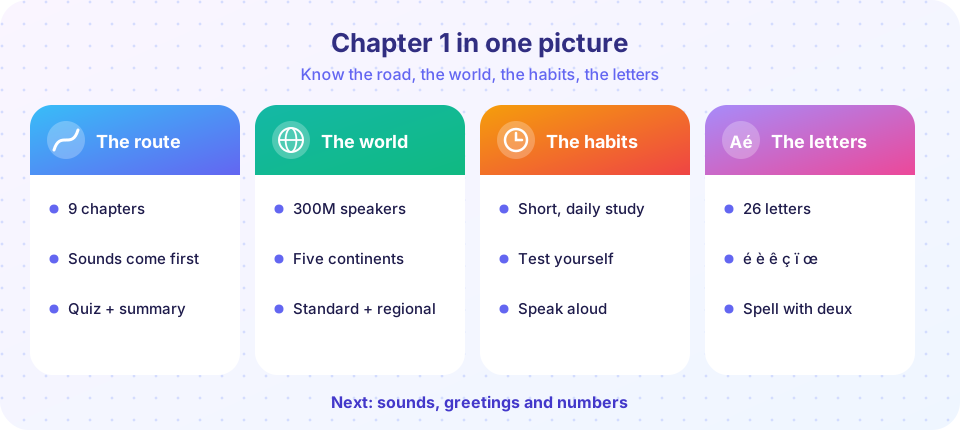
You have finished the first chapter. It had no verbs and no long vocabulary lists, but it set up everything that follows: you know why you are learning French, what the road looks like, how to study so that words stay in your memory, and how the written language works, including the accents that trip up so many beginners. This review pulls it all into one picture, gives you a recap table, lets you read a short dialogue that uses the alphabet, and then tests you with ten questions.
What you will learn
- How to recall the four big ideas of chapter 1 without looking back.
- How to spell a name and an email address aloud in French.
- Which topics to revisit if the quiz shows a weak spot.
Key terms
Francophone: French-speaking. Cognate: a word that has the same origin as an English word. False friend: a look-alike with a different meaning. Diacritic: an accent mark. Spaced repetition: reviewing items at growing intervals. Comment ça s'écrit ?: how is that spelled?
Chapter 1 in four ideas
1. The route. The course has nine chapters. Sounds and greetings come before grammar, so you can pronounce what you learn. Nouns, adjectives and verbs follow. Then come questions, the past, the future and pronouns, and finally conversation, culture and projects. Each lesson has the same shape: goals, key terms, explanations, misconceptions, practice, quiz, summary. If you ever feel lost, return to the course map.
2. The world. French is spoken on every continent, with roughly three hundred million speakers, and it is an everyday language in Europe, North America, Africa, the Caribbean and the Pacific. Standard French works everywhere, and regional words (septante, nonante, magasiner) are normal variation. English and French share cognates because of the Norman conquest of 1066, but false friends such as librairie (bookshop) and actuellement (currently) can mislead you. More in Why learn French, and how to study it well.
3. The habits. Study in short, regular sessions. Test yourself instead of rereading. Say everything aloud. Add real French through radio, films and conversation, because no course can replace speaking with people.
4. The letters. The alphabet has 26 letters with French names. Accents are part of the spelling: acute é (/e/), grave è (/ɛ/), circumflex ê (often a lost s), cedilla ç (/s/ before a, o, u), diaeresis ë and ï (separate the vowels), and the ligature œ. The words ou and où, a and à, la and là differ only by an accent. See The French alphabet and accents.
Recap table
| Topic | Key fact | Example |
|---|---|---|
| Letter e | named "uh", not "ee" | e is /ə/ |
| Acute accent | closed /e/ | été, école |
| Grave accent on e | open /ɛ/ | mère, très |
| Grave on a and u | separates look-alikes | à / a, où / ou, là / la |
| Circumflex | often a lost s | forêt, hôpital, île |
| Cedilla | c becomes /s/ before a, o, u | garçon, ça |
| Diaeresis | pronounce vowels apart | Noël, naïf, maïs |
| Ligature œ | cœur, sœur, œuf | rounded vowel, see chapter 2 |
| Spelling a double letter | say deux first | Anne: a, deux n, e |
| Email address | arobase, point, tiret | [email protected] |
A short dialogue: spelling a name
Read it aloud twice. First without looking at the translation, then with it.
| Français | English |
|---|---|
| Bonjour, madame. Votre nom, s'il vous plaît ? | Hello, madam. Your name, please? |
| Dupont. | Dupont. |
| Comment ça s'écrit ? | How is that spelled? |
| D, u, p, o, n, t. | D, u, p, o, n, t. |
| Et votre prénom ? | And your first name? |
| Hélène : H, é accent aigu, l, è accent grave, n, e. | Hélène: H, e acute, l, e grave, n, e. |
| Merci. Votre adresse e-mail ? | Thank you. Your email address? |
| helene point dupont arobase exemple point fr. | helene dot dupont at example dot fr. |
Notice that this short exchange uses only things from chapter 1 plus a few polite words you will meet properly in chapter 2: Bonjour, madame, s'il vous plaît and merci. The grammar behind votre nom ("your name") appears in chapter 3.
If the quiz shows a weak spot
Go back to the lesson named in the explanation. If you mix up accents, spend ten minutes writing twenty accented words by hand. If the alphabet names slip away, say the alphabet aloud while you walk. If you struggle to keep a study routine, shrink it: five minutes a day is better than an hour once a week, and a small habit grows into a larger one.
How to check yourself without the quiz
Quizzes are useful, but the strongest self-test is free recall: close the lesson and produce the material from memory. Try this routine. Say the alphabet aloud with the French letter names. Spell your own name and your email address in French. Name the five accents and give one word for each. List three false friends and three cognates. Then explain, in your own words, why you should review a lesson the day after you read it. If you stumble on any item, you have found exactly what to revisit.
A worked example: reading an unfamiliar word
Suppose you meet the word château for the first time. You know that the circumflex often replaces an s that used to be pronounced, so try inserting it: chasteau. Now it looks like "castle", and that is exactly what it means. Next, the sound. The letters eau make /o/, the ch is /ʃ/, and the â is a long-ish /ɑ/, so the word is roughly /ʃɑto/, "shah-toh". Now try forêt. The ê is /ɛ/, the final t is silent, so you get /fɔʁɛ/; insert an s and you see "forest". Finally, try garçon. The cedilla tells you the c is /s/, and the on is nasal, so you get /ɡaʁsɔ̃/, "gar-sohn".
Three tiny steps, spell with the accent rules, check for a lost s, and mind the silent final letter, let you read and guess hundreds of words. The same method will carry you through chapter 2, where you will learn the vowel and consonant sounds in detail.
Looking ahead to chapter 2
Chapter 2 turns the written letters into sound. You will practice vowels that English does not have, learn why many final letters are silent, and see how words link together in speech. After that you will use those sounds in greetings, introductions and numbers. Keep your voice recorder ready, because chapter 2 is the most speaking-heavy chapter of the foundation.
Common misconceptions
"Chapter 1 has no real content." The habits and the writing system are the foundation for everything else; learners who skip them hit pronunciation and spelling problems later.
"I can ignore accents when I type." Texting without accents is common in French too, but in schoolwork and formal writing they are required, and learning them now trains your ear.
"Once I finish the quiz, I'm done." Review the same material the next day and again a week later.
Try it
Mix everything with these cards: letters, accents, cognates and false friends.
Now spell with accents. Type the word that matches the clue.
If you like numbers, this small program counts the accents in a French text and shows which accent is most common. This is a quick way to see that é is by far the most frequent accented letter in typical French.
Press Run (or Ctrl + Enter) to see the result here.
Program input · what you'd type while the program runs
Type the answers before you press Run, one per line. Each time the program reads a line (with input()), it gets the next line from this box.
Check your understanding
Quick check · 10 questions
of 10 answered You scored / 10 · perfect!
-
1. What is the name of the letter e in French?
The letter e is called /ə/, roughly 'uh'. The name 'ee' belongs to i. -
2. How do you say that a letter is doubled when you spell aloud?
Use deux: Anne is a, deux n, e. -
3. Which accent turns c into an /s/ sound before a, o or u?
The cedilla, as in garçon and ça. -
4. Which word is a false friend?
Librairie looks like library but means bookshop. -
5. What is the best study pattern for beginners?
Short, regular sessions plus spaced review beat long, rare ones. -
6. What does the circumflex often replace in older words?
A circumflex often stands where an s was lost: forêt, hôpital, île. -
7. In which country is Romandie, a French-speaking region?
Romandie is the French-speaking region in western Switzerland. -
8. How do you say the dot in an email address?
Point is the dot; arobase is @; tiret is the hyphen. -
9. Which pair differs only by an accent that does not change the sound?
Ou and où are pronounced the same way; the grave accent only separates the words. -
10. When did a great many French words enter English?
After 1066 French was the language of court and law in England for generations.
Summary
- Chapter 1 gave you the route, the world of French, a study method and the writing system.
- Accents carry meaning and sound; learn them with the words, not alone.
- Spell aloud with French letter names; say deux for doubled letters; say arobase, point and tiret in email addresses.
- Keep studying in short, regular, spaced sessions, and add real listening and speaking.
Track your progress
Create a free account to tick off lessons and pick up where you left off on any device.
of French for Beginners lessons completed