


















Lesson 39 of 48 · Conversation and Culture
Chapter 8 Overview: Conversation and Culture
Chapter 8 of French for Beginners: put your French to work in directions, restaurants and shops, and learn politeness, register and the Francophone world.
Grammar becomes a language when you use it with people. In this chapter you stop practicing isolated forms and start handling real situations: asking for directions, buying a train ticket, ordering a meal, shopping, and choosing the right level of politeness. You will also learn something just as important as grammar: the cultural habits that make French sound friendly instead of cold.
French is spoken by hundreds of millions of people on several continents, not only in France. The vocabulary changes a little from Paris to Brussels, Geneva, Montreal and Dakar. This chapter gives you the core that works everywhere, and flags the main differences.
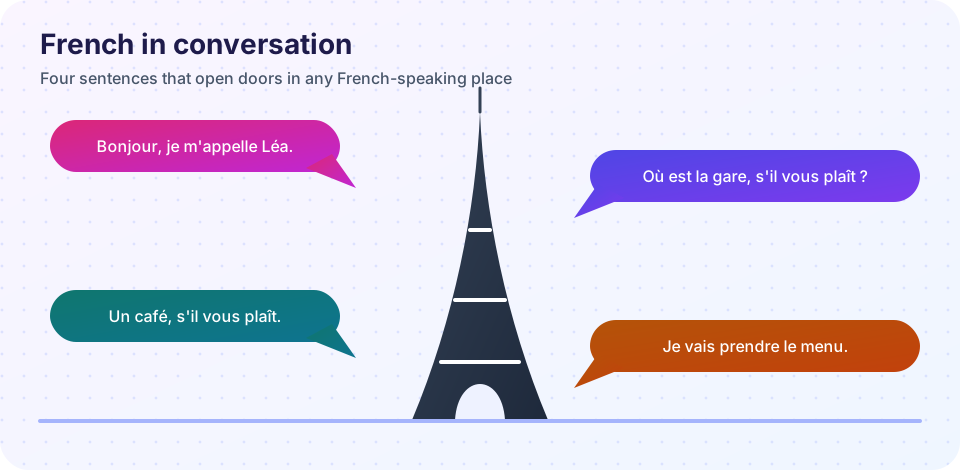
What you will learn
- The situations this chapter prepares you for
- A short conversation that combines vocabulary from every earlier chapter
- What each lesson covers
- How to rehearse dialogues so they stick
Key terms
le dialogue: a conversation. le registre: the level of formality. la politesse: politeness. la francophonie: the French-speaking world. un faux ami: a "false friend", a word that looks like an English word but means something else.
The chapter in five slides
Getting around
Eating and shopping
Tu or vous?
The Francophone world
Same language, different flavors.
A first look: meeting someone
| French | English |
|---|---|
| Camille : Bonjour ! Je m'appelle Camille. Et toi ? | Hello! I'm Camille. And you? |
| Sam : Moi, c'est Sam. Enchanté ! | I'm Sam. Nice to meet you! |
| Camille : D'où viens-tu ? | Where do you come from? |
| Sam : Je viens de Montréal, mais j'habite à Lyon depuis deux ans. | I come from Montreal, but I've lived in Lyon for two years. |
| Camille : Tu es étudiant ? | Are you a student? |
| Sam : Non, je travaille dans un café. Hier, j'ai travaillé jusqu'à minuit. | No, I work in a café. Yesterday I worked until midnight. |
| Camille : Quel courage ! On se voit demain ? | How brave! Shall we meet tomorrow? |
| Sam : Avec plaisir. Je serai libre à six heures. | With pleasure. I'll be free at six. |
Spot the earlier lessons at work: greetings, numbers and time (à six heures), the passé composé (j'ai travaillé), the future (je serai), and a question with inversion (D'où viens-tu ?). Two small new phrases: depuis deux ans (for two years, with the present tense: the action is still going on) and jusqu'à (until). Note also Moi, c'est Sam, a casual way of saying "I'm Sam".
What each lesson covers
- Travel and directions: vocabulary for places, the commands you will hear (tournez à gauche), tickets, trains and hotels, plus an interactive map.
- Restaurants and shopping: ordering, paying, quantities, sizes, polite shop phrases, and a bill calculator.
- Register, politeness and the Francophone world: tu versus vous, greetings and the bise, text-message abbreviations, false friends, and how French differs from country to country.
- Chapter review: a one-page picture, a recap table and a ten-question quiz.
How to rehearse a dialogue. Read it aloud once, with a translation. Cover the English and read it again. Then play both roles and change one detail (the place, the time, the price). This works much better than silent reading.
Check your understanding
Quick check · 3 questions
of 3 answered You scored / 3 · perfect!
-
1. What does 'depuis deux ans' mean in 'j'habite à Lyon depuis deux ans'?
Depuis + a period with the present tense means the action started in the past and continues now. -
2. Which phrase is a polite way to greet someone you just met?
Enchanté (or enchantée) means nice to meet you. À plus and tchao are casual goodbyes. -
3. What does 'On se voit demain ?' ask?
On se voit means we see each other (in casual speech), so the sentence suggests meeting tomorrow.
Summary
- Chapter 8 turns grammar into conversation: travel, food, shopping and politeness.
- French is a global language with regional differences; the core works everywhere.
- Rehearse dialogues aloud, play both parts and vary the details.
Next: Travel and directions
Track your progress
Create a free account to tick off lessons and pick up where you left off on any device.
of French for Beginners lessons completed