


















Lesson 10 of 48 · Sounds, Greetings and Basics
Chapter 2 review: Sounds, Greetings and Basics
Review French pronunciation, liaison, greetings, tu and vous, introductions and numbers to 100 with a one-picture summary, a recap table, a market dialogue and a ten-question quiz.
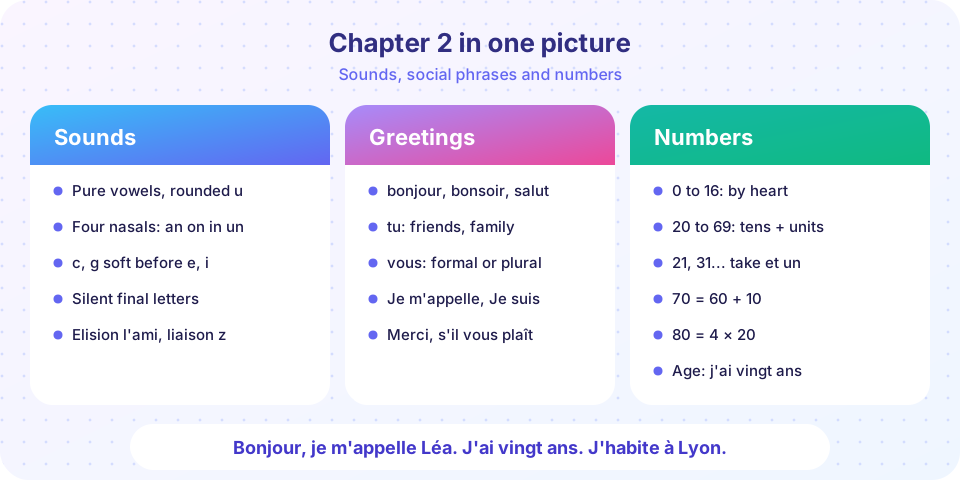
You can now do something many beginners cannot: you can say French words in a way that sounds like French, and you can greet someone, introduce yourself and handle numbers. This review gathers the chapter into one picture, a recap table and a longer dialogue that uses everything at once, then checks you with ten questions. Treat the dialogue as a model: read it aloud, shadow it (repeat after yourself with no pause), and then change the names, the items and the prices.
What you will learn
- To recall the key sound rules and the spelling patterns that produce them.
- To use greetings, polite phrases and introductions without hesitation.
- To count and to read prices aloud.
- To find the lesson to revisit when a question surprises you.
Key terms
Nasal vowel: a vowel with no pronounced n or m (bon, vin, vent, un). Rounded vowel: /y/, /ø/, /œ/. Elision: le ami becomes l'ami. Liaison: les amis is /lez‿ami/. Tu / vous: informal / formal or plural "you". Soixante-dix: 70, built from 60 + 10.
The chapter in five blocks
Vowels. Pure, not gliding. The three rounded vowels: tu /ty/, peu /pø/, peur /pœʁ/. Digraphs: ou /u/, oi /wa/, au and eau /o/, ai and ei /ɛ/ or /e/, eu /ø/ or /œ/, ui /ɥi/. The nasal vowels an/en /ɑ̃/, on /ɔ̃/, in/ain/ein /ɛ̃/, un /œ̃/ lose the nasal when the n or m is doubled or followed by a vowel (bon versus bonne). Revisit Vowels and nasal sounds if any of these feel shaky.
Consonants. c and g are hard before a, o, u and soft before e, i, y. ç and ge force the soft sound. ch /ʃ/, gn /ɲ/, qu /k/, ph /f/, th /t/. The r is made in the throat. The h is silent. A single s between vowels is /z/, while ss is /s/. Most final consonants are silent, apart from the CaReFuL tendency (c, r, f, l). Elision and liaison link words. See Consonants, silent letters, elision and liaison.
Greetings. Bonjour by day, bonsoir in the evening, salut among friends, au revoir and à bientôt when you leave. Polite words: s'il vous plaît, merci, de rien, excusez-moi, pardon. Tu for friends, family and children; vous for strangers, seniors, professional contacts and any group. See Greetings, politeness and introductions.
Introductions. Je m'appelle..., Je suis... (with nationality in the right gender), J'habite à..., Je viens de..., J'ai ... ans, Enchanté(e).
Numbers. 0 to 16 by heart, regular tens from 20 to 60, et un in 21 to 61 and 71, and the arithmetic of 70 to 99. See Numbers from 0 to 100.
Recap table
| Topic | Rule | Example |
|---|---|---|
| /y/ | say ee with rounded lips | tu, rue, salut |
| Nasal vs oral | doubled or followed by vowel = oral | bon / bonne |
| c before e, i | /s/ | ce, ici |
| g before e, i | /ʒ/ | gens, girafe |
| ss vs s | /s/ vs /z/ between vowels | poisson / poison |
| Elision | short word + vowel | l'ami, j'habite |
| Liaison | final consonant wakes up | les‿amis, vous‿avez |
| Time-of-day greeting | day / evening | bonjour / bonsoir |
| Formal "you" | also plural | vous parlez |
| 71 | 60 + 11, with et | soixante et onze |
| 80 | 4 × 20 | quatre-vingts |
A longer dialogue: at the market
Antoine is buying fruit on a Saturday. Read the French aloud, then check the translation.
| Français | English |
|---|---|
| Bonjour, madame ! | Hello, madam! |
| Bonjour, monsieur. Vous désirez ? | Hello, sir. What would you like? |
| Je voudrais des pommes, s'il vous plaît. | I would like some apples, please. |
| Combien de pommes ? | How many apples? |
| Six pommes. Et un kilo de poires. | Six apples. And a kilo of pears. |
| Voilà. Ça fait neuf euros cinquante. | Here you are. That comes to nine euros fifty. |
| Voici dix euros. | Here is ten euros. |
| Merci. Et voilà votre monnaie : cinquante centimes. | Thank you. And here is your change: fifty cents. |
| Merci, madame. Bonne journée ! | Thank you, madam. Have a good day! |
| Au revoir, monsieur, bonne journée ! | Goodbye, sir, have a good day! |
Notice the formal vous throughout, the greeting at the start and the end, and the number six before a consonant (six pommes /si pɔm/, the x is silent). The prices use the words euros and centimes. Before a vowel, neuf may turn its f into /v/ (neuf ans), but in neuf euros many speakers keep /f/; both are heard, so just be ready to recognize either.
The word monnaie (change, small coins) is a false friend of "money". The word for "money" is l'argent.
Worked example: from spelling to sound
Let us read three short phrases from this chapter and turn each spelling into a sound, step by step. First, Je m'appelle Claire. The je has a weak vowel /ʒə/. The m'appelle is me appelle with elision, and the double l is a single /l/, giving /mapɛl/. In Claire, the ai is /ɛ/, the r is the throaty /ʁ/, and the final e is silent, so we get /klɛʁ/. Together: /ʒə mapɛl klɛʁ/.
Second, Les amis habitent à Paris. Between the article and the noun there is a required liaison, so les amis is /lez‿ami/. Then habitent starts with a mute h, so it begins with a vowel sound, and the -ent ending is silent: /abit/. There is no liaison between amis and habitent because liaison is not made between a plural noun and a verb. Then à Paris /a paʁi/, with silent s. Together: /lez‿ami abit a paʁi/.
Third, J'ai quinze euros. J'ai is /ʒe/, quinze is /kɛ̃z/, and euros begins with a vowel, so the z of quinze is easy to link: /ʒe kɛ̃z‿øʁo/. The eu is /ø/. Working through phrases like these once a day for a week will train your eye to see the sound behind the spelling.
A listening routine for the next week
Choose one dialogue from this chapter, such as the market dialogue above. On day one, read it silently. On day two, read it aloud twice, covering the English. On day three, record yourself and listen back for three things: pure vowels, silent final consonants and liaison. On day four, repeat the recording after a native speaker if you can find one online. On day five, change the details, using new items and prices, and say it again. On day six, try to say the whole thing from memory. This routine uses the dialogue as a script, and rehearsing scripts is how most people become fluent in routine conversations.
Common misconceptions
"If I learn all the rules, I will pronounce perfectly." Rules help, but pronunciation comes from listening and repeating. Use the rules to know what to listen for.
"A beginner should use tu with everyone to sound friendly." Start with vous with strangers; it is never wrong to be polite.
"Numbers are just memorization." From 17 on, most of them are built by patterns; know the patterns and you only need to learn 17 words.
Try it
The cards below are a mixed deck for the whole chapter. Say each French item aloud before you flip.
Next, a Python helper that reads prices aloud in French, as the seller does in the dialogue. It reuses the number rules from the numbers lesson.
Press Run (or Ctrl + Enter) to see the result here.
Program input · what you'd type while the program runs
Type the answers before you press Run, one per line. Each time the program reads a line (with input()), it gets the next line from this box.
Last, type the correct number words. The checker is not strict about accents or hyphens.
Check your understanding
Quick check · 10 questions
of 10 answered You scored / 10 · perfect!
-
1. Which word has a nasal vowel?
Vent /vɑ̃/ ends in an + t, so it is nasal. In bonne, année and une the n is doubled or followed by a vowel. -
2. Which is correct for the pronunciation of les amis?
The s in les links to amis and sounds like z. -
3. What is correct about the h in l'hôtel and le héros?
Mute h acts like a vowel; aspirated h acts like a consonant. -
4. A teenager greets a friend. Which is natural?
Salut, ça va ? is the casual greeting among friends. -
5. What does c sound like in the word cinéma?
C before i is /s/: cinéma /sinema/. -
6. How is 71 written?
71 is 60 + 11 with et: soixante et onze. -
7. Which is a false friend from this chapter?
La monnaie means change or currency, not money. -
8. How do you say 'I live in Lyon'?
J'habite à + a city. -
9. Which pair differs by the vowels /y/ and /u/?
Tu /ty/ has the front rounded vowel; tout /tu/ has the back vowel /u/. -
10. Which number word is irregular and must simply be memorized?
0 to 16 are basic words; the others are built from smaller ones.
Summary
- Chapter 2 gave you pure, rounded and nasal vowels, consonant rules, elision and liaison.
- You can greet by time of day, choose tu or vous, introduce yourself, and count to 100.
- The numbers 70 to 99 are arithmetic: 60 + 10, 4 × 20, 4 × 20 + 10.
- Keep reviewing with the cards, and say each example aloud.
Track your progress
Create a free account to tick off lessons and pick up where you left off on any device.
of French for Beginners lessons completed