


















Lesson 20 of 47 · Bleeding, Wounds and Shock
Wounds, Dressings and Infection
Learn the types of wound, how to clean and dress cuts and grazes, how wounds heal, when to see a doctor, plus nosebleeds and amputated parts.
Most wounds are small: a scraped knee, a kitchen cut, a splinter. Good first aid for these everyday injuries is not dramatic, but it matters. Clean, protect and watch a wound well, and it heals fast with a small scar. Neglect it, and a minor cut can become an infection that takes weeks to treat. This lesson gives you a method that works for most wounds, plus the warning signs that say "this one needs a professional".
Educational information only. This lesson is not a substitute for a certified first-aid course or for medical care. If bleeding is severe or you are unsure, call your local emergency number or seek medical care.
What you will learn
- How to classify wounds and what each type tells you.
- How to clean and dress a minor wound step by step.
- How wounds heal and why moist, covered healing is usually best.
- How to recognize infection and when to see a doctor, including tetanus.
- First aid for nosebleeds, amputated parts, blisters and bites to the skin.
Key terms
Wound: any injury that breaks the skin or the tissue beneath it.
Dressing: a sterile pad placed directly over a wound to absorb blood and protect it.
Bandage: material that holds a dressing in place or provides pressure.
Tetanus: a serious bacterial illness caused by spores that can enter dirty wounds; preventable by vaccination.
Debridement: removing dead or contaminated tissue and debris from a wound, usually by a clinician.
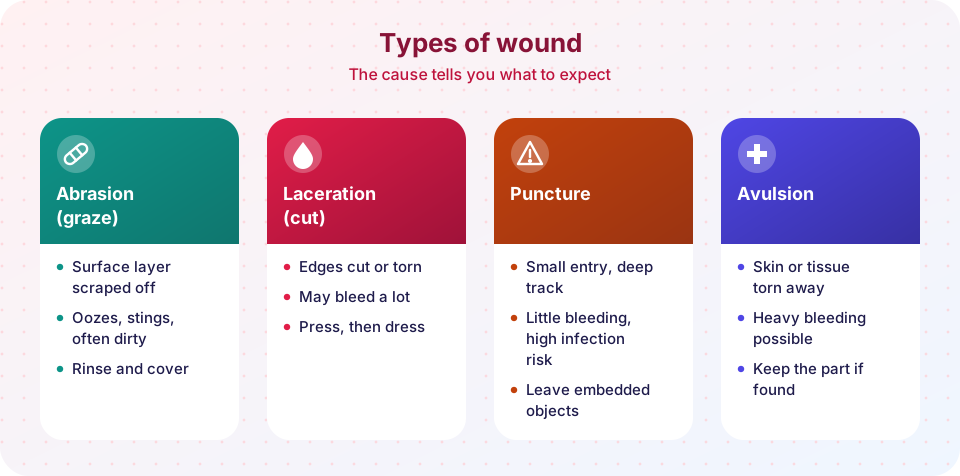
Types of wound
- Abrasion (graze). The top layers of skin are scraped away, typically by falling on a rough surface. It oozes, stings and often contains dirt, so cleaning matters.
- Incision and laceration. An incision is a clean cut from a sharp edge, such as a knife. A laceration is a tear with ragged edges, often from a blunt force. Both can bleed heavily, and deep ones may need stitches.
- Puncture. A small entry point with a deep track, as from a nail or a bite. It bleeds little but traps bacteria deep inside, so the infection risk is high.
- Avulsion. Skin or tissue is torn partly or fully away. Bleeding can be heavy and the torn flap should be kept.
- Contusion (bruise). Blood leaks under intact skin after a blow.
- Crush injury. A heavy force squashes tissue; damage under the skin may be more serious than it looks.
Cleaning and dressing a minor wound
- Protect yourself. Wash your hands and put on gloves if you have them.
- Stop any bleeding. Press with a clean pad for several minutes until it stops. Minor wounds usually stop in 5 to 10 minutes.
- Rinse. Hold the wound under clean running water, drinkable tap water if possible, for several minutes. This flushes out dirt and bacteria and is more important than any antiseptic. You may use mild soap on the skin around the wound but try not to scrub into it.
- Remove loose debris with clean, rinsed tweezers or let the water wash it away. Do not dig for embedded pieces; leave those to a clinician.
- Pat dry around the wound with a clean cloth or sterile gauze.
- Cover it with a sterile non-stick dressing or an adhesive plaster, large enough to extend beyond the edges. For a graze, a hydrocolloid or similar moisture-retaining dressing works well.
- Change the dressing daily, or sooner if it gets wet or dirty, and check the wound each time.
Antiseptic creams are not essential for most minor wounds, and some can irritate healing skin. Strong antiseptics such as hydrogen peroxide or undiluted iodine can damage new cells. Washing is the key.
Why covered and moist is better
In 1962 the zoologist George Winter published experiments on young pigs showing that wounds covered with a film dressing healed about twice as fast as wounds left open to dry into a scab. The finding led to modern moist wound care: a moist environment lets new skin cells migrate across the surface more easily. For minor wounds, a clean covering is usually better than leaving them open to air, although a dry scab is not harmful.
How a wound heals
Healing is a sequence of overlapping stages, shown below as a schematic.
- Hemostasis (minutes to hours): blood vessels narrow, platelets form a plug and clotting seals the wound.
- Inflammation (the first few days): white blood cells clear debris and bacteria. Redness, warmth, swelling and some pain are normal at first.
- Proliferation (roughly day 4 to 3 weeks): new tissue forms, with new capillaries and a collagen scaffold, and skin cells spread across the surface.
- Remodelling (weeks to a year or more): collagen is reorganized and the scar gains strength.
Press Run (or Ctrl + Enter) to see the result here.
Program input · what you'd type while the program runs
Type the answers before you press Run, one per line. Each time the program reads a line (with input()), it gets the next line from this box.
Recognizing infection
Bacteria can multiply in a wound, especially a dirty or deep one. Watch for these signs over the next days:
- Spreading redness, warmth and swelling that increase after the first two days;
- Increasing pain rather than easing pain;
- Pus or cloudy, smelly fluid;
- Red streaks running from the wound toward the heart;
- Fever, chills or feeling generally unwell.
Any of these means see a doctor soon; for fever with a spreading red area, seek care the same day.
When a wound needs a clinician
Seek medical help for a wound that:
- is deep, gaping, or longer than about 1 to 2 cm with edges that do not stay together, since it may need closing within hours;
- will not stop bleeding after 10 minutes of firm pressure;
- is on the face, hands, joints or genitals, or crosses a joint;
- has numbness, weakness or loss of movement beyond it, which can mean nerve or tendon damage;
- contains dirt or objects you cannot rinse away, or came from a bite, a rusty or contaminated object, soil, or farm or garden machinery;
- is a puncture wound, especially in the foot;
- happened to a person who is diabetic, has weakened immunity or poor circulation.
Tetanus
Tetanus spores live in soil and manure, and can enter through cuts and punctures. The illness causes painful muscle spasms and can be fatal, yet vaccination prevents it. Most countries immunize children in a series and recommend periodic boosters. If your last vaccine was more than about 10 years ago (5 years for a dirty wound in some schedules), or you are not sure, ask a doctor or pharmacist whether you need a booster after an injury.
Press Run (or Ctrl + Enter) to see the console output here.
No output.
Special cases
Nosebleed
Most nosebleeds come from small vessels at the front of the nose and are harmless. Sit the person upright and lean forward so the blood runs out of the nose rather than down the throat. Pinch the soft part of the nose, just below the bony bridge, firmly for 10 continuous minutes without releasing to check. Breathe through the mouth; spit out any blood. Do not tilt the head back. If it continues after 20 minutes, follows a head injury, or the person takes blood-thinning medicine, seek medical care.
Amputated part
Call emergency services. Control the bleeding as described in the last lesson. Rinse the part gently if dirty, wrap it in moist sterile gauze or a clean damp cloth, place it in a plastic bag, and put that bag on ice or in cold water, so that the part stays cool without touching ice directly. Label with the time and send it with the person. Do not soak it in water or place it directly on ice.
Blisters, splinters and foreign bodies
Leave intact blisters alone and cover them; a blister's roof protects the skin below. Remove a small splinter with clean tweezers after washing; leave deep or large objects. For eyes, see the later lesson on eye injuries.
Common misconceptions
"Let it breathe." Most wounds heal better covered and moist than left open.
"Pour alcohol or peroxide on it." They damage healthy cells and sting; running water works better.
"A small puncture is nothing." Punctures trap bacteria deep and can be dangerous, particularly in the foot.
"Tilt your head back for a nosebleed." This sends blood down the throat; lean forward instead.
Check your understanding
Quick check · 5 questions
of 5 answered You scored / 5 · perfect!
-
1. What is the most important step in cleaning a minor wound?
Running water flushes out dirt and bacteria without damaging tissue. -
2. Which is a sign of infection?
Spreading redness, pus, increasing pain and fever suggest infection. -
3. How do you manage a nosebleed?
Leaning forward and sustained pressure on the soft part of the nose is correct. -
4. How should an amputated part be stored?
It should be kept cool but not in direct contact with ice. -
5. Which type of wound has a small entry but a deep track?
Punctures can trap bacteria deep inside.
Summary
- Types of wound include abrasion, laceration, puncture, avulsion and bruise; cleaning with running water is the key step.
- Covered, moist wounds usually heal faster; check dressings daily.
- See a clinician for deep, dirty, bite, puncture or hand and face wounds, signs of infection or uncertain tetanus protection.
- For nosebleeds lean forward and pinch for 10 minutes; keep an amputated part cool and moist, not on ice directly.
Next: Shock
Track your progress
Create a free account to tick off lessons and pick up where you left off on any device.
of First Aid and Emergency Care lessons completed