


















Lesson 46 of 47 · Projects and Practice
First-aid cheat sheet: one-page recap
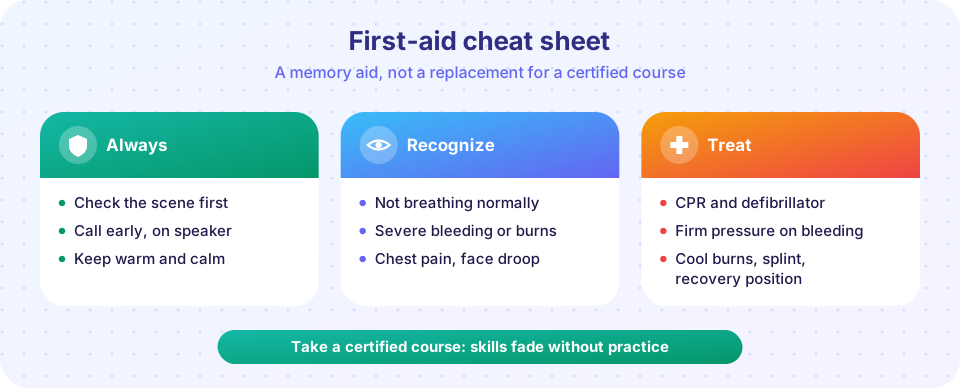
A one-page first-aid cheat sheet: the always-steps, CPR and bleeding basics, fractures, medical emergencies, heat, cold, burns, bites and poisons, with a reminder to take a certified course.
This lesson is a single page you can come back to. It condenses the whole course into the actions that matter most, in the order you would need them. It is a memory aid: it works best after you have learned the lessons behind each line, and it works best of all when you have practiced them in a certified, hands-on first-aid course.
Educational information, not a substitute for a certified course or emergency services. This cheat sheet summarizes general principles from international guidelines. Details such as aspirin advice, choking techniques, inhaler schedules, pressure-bandage rules, doses and emergency numbers vary between countries and change over time. In a real emergency call your local emergency number and follow the dispatcher.
What you will learn
- The always-steps that apply to every emergency.
- A quick table from situation to first action.
- The most common mistakes to avoid.
Key terms
- Cheat sheet: a short summary used as a memory aid.
- Call early: contact emergency services as soon as you recognize a serious problem.
- Do not: the mistakes that most often make an emergency worse.
- Handover: your clear summary to the professionals who take over.
Always
- Check the scene. Is it safe for you, for the casualty and for others? If not, do not go in.
- Check the response. Talk and touch. If unresponsive, check breathing.
- Call early for anything serious, with an exact location, and put the phone on speaker.
- Treat life threats first: not breathing, severe bleeding.
- Keep them warm, calm and watched until help arrives. Record times and hand over clearly.
Situation to first action
| Situation | First action | Do not |
|---|---|---|
| Not responding, not breathing normally | Call, start CPR, fetch and use an AED | Stop until help arrives or they recover |
| Severe bleeding | Firm direct pressure with a thick pad; add pressure bandage; tourniquet if trained and pressure fails | Remove soaked pads; wait |
| Shock (pale, clammy, fast pulse) | Lie down, treat the cause, keep warm, call | Give food or drink |
| Suspected fracture | Immobilize as found, splint past joints, check beyond | Straighten it, test it |
| Sprain or strain | Protect, elevate, compress, reload gradually | Assume it is only a sprain if bone is tender |
| Dislocation | Support in position found, urgent care | Force it back |
| Head injury | Cold pack, watch 24 hours, call for any red flag | Move a person with suspected spine injury |
| Spine injury suspected | Hold head in line, call | Move them unless in danger |
| Heart attack | Call, sit comfortably, aspirin if advised and not allergic | Let them drive or walk it off |
| Stroke (FAST/BE-FAST) | Call, note the time, nothing by mouth | Give aspirin, food or drink |
| Choking (adult, severe) | Back blows, abdominal thrusts, CPR if unresponsive | Slap while they can cough |
| Anaphylaxis | Adrenaline in the outer thigh, call, lie flat | Let them stand |
| Asthma attack | Sit up, reliever with spacer, call if severe | Lie them flat |
| Low blood sugar (awake) | 15 to 20 g fast sugar, reassess in 10 to 15 minutes | Give food to a drowsy person |
| Seizure | Protect, time it, recovery position afterward | Restrain or put things in the mouth |
| Faint | Lie flat, raise legs, check breathing | Sit up quickly |
| Heatstroke | Call, cool fast | Give drinks to a confused person |
| Hypothermia | Shelter, dry insulation, gentle handling, warm trunk | Alcohol, rubbing, hot bath |
| Burn or scald | Cool running water for 20 minutes, cover loosely | Ice, butter, bursting blisters |
| Electric shock | Switch off the power first | Touch while live |
| Drowning | Reach or throw, five breaths then CPR | Go in untrained |
| Bite, sting or tick | Wash, remove sting or tick, watch for allergy | Cut and suck snake bites |
| Poisoning | Call the poison center, keep the container | Force vomiting |
| Carbon monoxide | Fresh air, call, do not re-enter | Stay to investigate |
Numbers to remember
- Emergency numbers: 112 (EU and many countries), 911 (US, Canada), 999 (UK), 000 (Australia). Learn yours.
- Burn cooling: 20 minutes under cool running water.
- CPR rhythm: compressions at 100 to 120 per minute, 30 compressions to 2 breaths, pushing hard and fast in the center of the chest.
- Seizure: call at 5 minutes.
- Low blood sugar: 15 to 20 g of fast sugar, check again in 10 to 15 minutes.
- Tourniquet: note the time it was applied.
Try it
A tabbed version of the cheat sheet lets you scan by group. Click a tab to see the key actions. This is a revision tool, not a replacement for training.
Now a quick memory check in the console. It prints the always-steps with some words blanked out so you can complete them from memory.
Press Run (or Ctrl + Enter) to see the console output here.
No output.
Check your understanding
Quick check · 5 questions
of 5 answered You scored / 5 · perfect!
-
1. What is the first step in any emergency?
If the scene is unsafe, you may become a casualty. -
2. How long do you cool a burn?
Twenty minutes of cool running water. -
3. When should you call emergency services for a seizure?
Five minutes, a first seizure, injury or no recovery. -
4. Which should you never give to a person who may be having a stroke?
A stroke could be a bleed, and swallowing may be impaired. -
5. Why take a certified first-aid course?
A course gives practice with feedback and covers local protocols.
Summary
- Always: scene, response and breathing, call early, life threats first, keep warm and watched.
- Match the situation to the first action, and know the main "do nots".
- Remember the key numbers: emergency number, 20-minute burn cooling, 30:2 CPR, 5-minute seizure call.
- This cheat sheet is a memory aid; certified training gives the skills.
Track your progress
Create a free account to tick off lessons and pick up where you left off on any device.
of First Aid and Emergency Care lessons completed