


















Lesson 43 of 47 · Projects and Practice
Practice set: first-aid scenarios
Practice the same five-step method on realistic first-aid scenarios from fractures and heart attacks to burns and disasters, with worked answers, a scenario trainer and a quiz.
Knowing the facts is not the same as acting on them. In a real emergency you have to find the right fact, quickly, while your heart pounds. The cure is practice: working through scenarios until the steps become familiar. This lesson gives you a single method to use every time, three worked scenarios with full answers, a trainer with more scenarios, and a generator that creates new ones to talk through with a friend.
Educational information, not a substitute for training. Scenario practice on paper is a good complement to, never a replacement for, a certified hands-on first-aid course with an instructor, manikins and feedback. Follow your local emergency number and protocols in real emergencies.
What you will learn
- A five-step method that works in any first-aid scenario.
- How to think through a scenario aloud, step by step.
- How to spot the most important action among several tempting ones.
- How to practice with a partner using the scenario generator.
Key terms
- Scenario: a short story describing an emergency used for practice.
- Primary assessment: the fast check of scene, response, airway, breathing and bleeding that comes before everything else.
- Handover: a clear summary of what happened and what you did, given to the professionals who take over.
- Think aloud: saying your reasoning out loud to find gaps in it.
The method
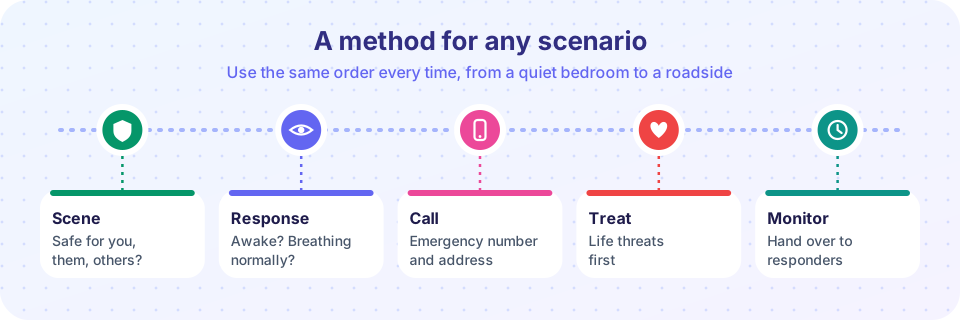
Use the same order every time, from a quiet bedroom to a roadside.
- Scene. Is it safe for you, for the casualty and for others? Look for traffic, fire, power, water, animals, crowds. Put on gloves if you have them.
- Response and breathing. Is the person awake? Talk to them. Is an unresponsive person breathing normally? If not, call for help and start CPR (chapter 3).
- Call. Send someone, or call yourself, with a clear location and a one-sentence description. Put the phone on speaker.
- Treat. Deal with life threats first: breathing, severe bleeding, then the specific problem from this chapter: a fracture, a burn, an allergic reaction. Give the first aid that matches.
- Monitor and hand over. Keep checking, keep the person warm and calm, record times and hand over clearly.
Worked scenarios
Scenario 1: the skateboard fall
A 15-year-old falls from a skateboard at a park. They are crying and hold their forearm, which is bent in the middle. Their fingers are pink and warm and they can feel your touch. There is no bleeding.
- Scene: safe once you move the board and others away from the path.
- Response: awake and talking, breathing normally.
- Call: a probable fracture without red flags can be handled by getting to care, but call if there are other injuries, if the person was moving fast, or if the fingers change color.
- Treat: support the forearm as it lies with your hands and make a padded splint (a rolled magazine, a folded jacket) past the wrist and the elbow, tied above and below the break. A sling holds the arm across the chest. Do not straighten it.
- Monitor: recheck the fingers' color, warmth and feeling every few minutes, give nothing to eat or drink and arrange an X-ray. Lesson: Fractures, bones and splinting.
Scenario 2: the family lunch
At a family lunch, a man in his sixties puts down his fork, says he feels a heaviness in his chest, and is pale and sweating. The pain goes into his left arm. He wants to "walk it off".
- Scene: safe.
- Response: awake and breathing.
- Call: immediately. Chest pressure with sweating and spreading pain is a possible heart attack. Do not let him walk it off or drive.
- Treat: help him sit comfortably, half-sitting with knees bent, loosen tight clothing, keep him calm. If local advice and the dispatcher support it and he is not allergic, he may chew an adult aspirin. If he has his own angina medicine, help him take it as prescribed. Prepare for CPR and fetch an AED if available.
- Monitor: watch his breathing and responsiveness; if he collapses and is not breathing normally, start CPR and use the AED. Lesson: Heart attack and stroke.
Scenario 3: the hot kitchen
A cook splashes boiling oil onto her forearm. The skin is red, blistered and very painful. There is a larger patch near the wrist that is white.
- Scene: turn off the heat, move the pan, make sure there is no fire.
- Response: awake, in pain.
- Call: the white area suggests a deep burn. Burns over a joint or deeper areas need urgent care. Call or go to the emergency department.
- Treat: cool with cool running water for 20 minutes, remove rings and watch, cover loosely with cling film along the arm. Do not use ice, butter or creams; do not burst blisters.
- Monitor: keep her warm and watch for shock. Hand over the time of the burn. Lesson: Burns, electric shock and drowning.
Try it
Here are eight more scenarios in a trainer. For each one, choose the best single next action. The feedback tells you why.
Next, a scenario generator for practice with a friend. It combines a setting, a person and a problem, and prints the five method steps as prompts. Change the seed to get a different scenario. Talk it through aloud before looking anything up.
Press Run (or Ctrl + Enter) to see the result here.
Program input · what you'd type while the program runs
Type the answers before you press Run, one per line. Each time the program reads a line (with input()), it gets the next line from this box.
Check your understanding
Quick check · 5 questions
of 5 answered You scored / 5 · perfect!
-
1. What is the correct order of the method?
Safety first, then assessment, then call, treatment and monitoring. -
2. In the skateboard scenario, what is the main treatment for the bent forearm?
Immobilize in the position found; do not straighten. -
3. Why should you not let a man with chest pressure walk it off?
Delay and effort are dangerous. Call, sit him down and be ready for CPR. -
4. What is the first aid for a deep or large burn?
Cool, cover loosely and seek urgent care. -
5. Why practice with scenarios?
Practice makes the steps familiar; it complements, not replaces, certified training.
Summary
- Use one method every time: scene, response and breathing, call, treat, monitor.
- Think aloud, look for the most important action and avoid tempting mistakes.
- Practice with scenarios, with a partner, and take a certified hands-on course.
Track your progress
Create a free account to tick off lessons and pick up where you left off on any device.
of First Aid and Emergency Care lessons completed