


















Lesson 1 of 47 · Getting Started
Course Map: First Aid and Emergency Care
Start here: who this first aid course is for, what you need, how the nine chapters fit together and how to study so the skills stay with you.
Most people will see a real emergency at some point: a relative who collapses, a child who chokes, a cyclist who falls in front of you. In those first minutes, before an ambulance can arrive, the person nearest to the patient is the most important responder in the world. This course teaches you what that person should do: calmly, safely and in the right order.
Important: educational information only. This course explains widely taught first-aid principles. It is not a substitute for a certified, hands-on first-aid course with a qualified instructor and a practice manikin, and it is not medical advice. In a real emergency, call your local emergency number first. Guidelines differ between countries and are updated every few years, so always follow your local training and the instructions of emergency services.
What you will learn
- Who this course is written for and what it assumes you already know.
- How the nine chapters are organized and why the order matters.
- A study method that turns reading into skills you can recall under stress.
- Where this course ends and professional training begins.
Key terms
First aid: the immediate help given to someone who is injured or suddenly ill, before professional care is available.
Emergency medical services (EMS): the ambulance and paramedic service you reach by phoning your local emergency number.
Casualty (or patient): the person you are helping.
Bystander: anyone present at the scene who is not part of the emergency services.
Guidelines: evidence-based recommendations, revised periodically by expert bodies such as the International Liaison Committee on Resuscitation (ILCOR), national resuscitation councils and the Red Cross and Red Crescent movement.
Who this course is for
The course is written for learners of about 11 and up, and for adults who want to refresh forgotten skills. You do not need any medical background. If you can follow a recipe, you can follow the steps in this course. You will meet a few body terms such as "airway" or "pulse"; every one is defined where it first appears.
Common reasons to take a course like this:
- You are a parent, grandparent or carer of children or older adults.
- You work with the public: teaching, sports coaching, hospitality, childcare, travel or outdoor activities.
- You want to be ready for ordinary emergencies at home, in traffic or on holiday.
- You are preparing for a formal first-aid certificate and want a clear grounding first.
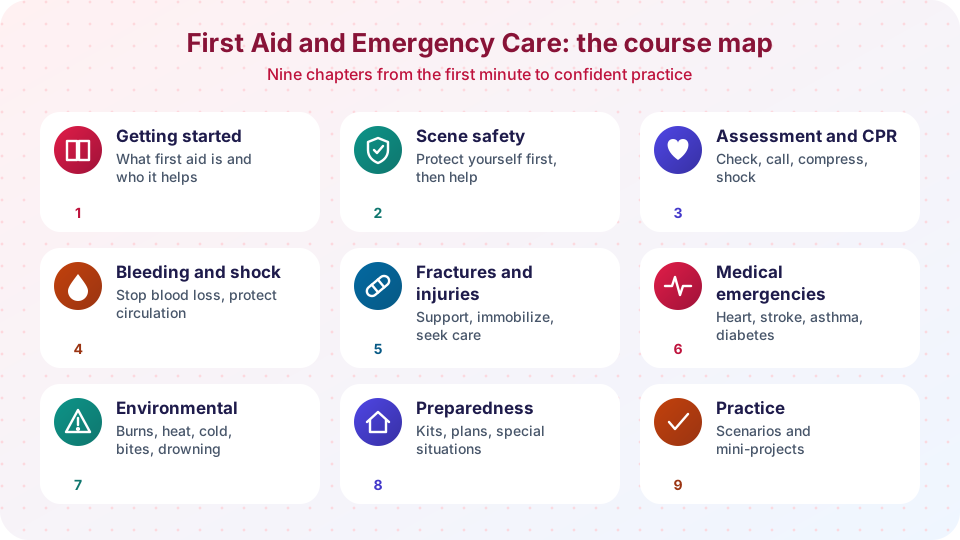
How the nine chapters fit together
Think of an emergency as a sequence of decisions, and of the chapters as the tools for each decision.
- Getting Started explains what first aid is, how to phone for help and what the law and ethics say about helping.
- Principles and Scene Safety teaches you to protect yourself first and handle the people around you.
- Assessment and CPR covers the checks that decide what to do next, and the life-saving skills for a person who is not breathing normally: chest compressions, using a defibrillator and clearing a blocked airway.
- Bleeding, Wounds and Shock covers the other threat to life you can often stop with your hands: blood loss.
- Fractures and Injuries covers broken bones, sprains, head and spine injuries.
- Medical Emergencies covers heart attack, stroke, asthma, diabetes, seizures and more.
- Environmental Emergencies covers burns, heat, cold, bites and drowning.
- Preparedness and Special Situations covers kits, plans and unusual settings.
- Projects and Practice puts it all together in scenarios.
The order is deliberate. The most urgent problems, those that kill in minutes, come first. Later chapters deal with conditions that are serious but usually give you more time.
The course in five moves
Every chapter returns to this pattern
Priorities
Practice makes it automatic
How to study so it sticks
Research on memory (you will meet it in the psychology tracks) shows that reading once is a weak way to learn. Three habits work much better for emergency skills:
- Retrieve, do not re-read. After each lesson, close the page and say the steps aloud from memory. The quizzes do the same job.
- Space it out. Revisit a topic after a day, a week and a month. Skills such as CPR fade within months if they are never rehearsed.
- Practice the body movements. A cushion works for compressions and a rolled towel for a baby. A real course with a manikin gives feedback on depth and rate that no book can.
Where this course ends
This course gives you knowledge and decision rules. It cannot give you a certificate, feedback on your technique or practice with real equipment. If you can, finish with a hands-on course from your national Red Cross or Red Crescent society, St John Ambulance, the American Heart Association or the American Red Cross, or a local provider approved in your country. Many workplaces and schools require current certification, usually renewed every one to three years.
Try it
A study planner shows how the nine chapters could be spread over the time you have.
Press Run (or Ctrl + Enter) to see the console output here.
No output.
A second demonstration is a preparedness self-check. It only counts boxes you tick; it is a reflection tool, not an assessment of your skills.
Press Run (or Ctrl + Enter) to see the console output here.
No output.
Check your understanding
Quick check · 4 questions
of 4 answered You scored / 4 · perfect!
-
1. What is the best definition of first aid?
First aid is the immediate help given before professional care is available; it is not hospital treatment and it is not about medicines. -
2. Why does the course begin with the most urgent problems?
Priority follows urgency: threats to life that develop in minutes come before problems that leave more time. -
3. Which study habit is best supported by memory research?
Retrieval practice and spacing beat passive re-reading for long-term recall. -
4. How does this course relate to a certified first-aid course?
Reading cannot give feedback on technique; a hands-on course with an instructor and manikin is the proper next step.
Summary
- First aid is immediate help before professional care; this course gives you knowledge and decision rules, not certification.
- The nine chapters run from the most urgent problems to preparation and practice.
- Retrieve from memory, space your practice and rehearse the movements.
- In a real emergency, call your local emergency number first and follow trained responders.
Next: What Is First Aid?
Track your progress
Create a free account to tick off lessons and pick up where you left off on any device.
of First Aid and Emergency Care lessons completed