


















Lesson 38 of 47 · Preparedness and Special Situations
Chapter 8 overview: preparedness and special situations
See how preparation, the law, special groups such as children and older adults, and disasters shape first aid, and why a plan made before an emergency makes the first minutes safer.
Emergencies rarely arrive at a convenient time. They happen at a family dinner, on a school trip, in a car park, during a storm. The people who cope best are usually not those with the most knowledge in the moment, but those who prepared: they knew where the first-aid kit was, had the numbers in their phone, had a plan for who does what, and had practiced the basic skills. Preparation turns panic into a sequence of known steps.
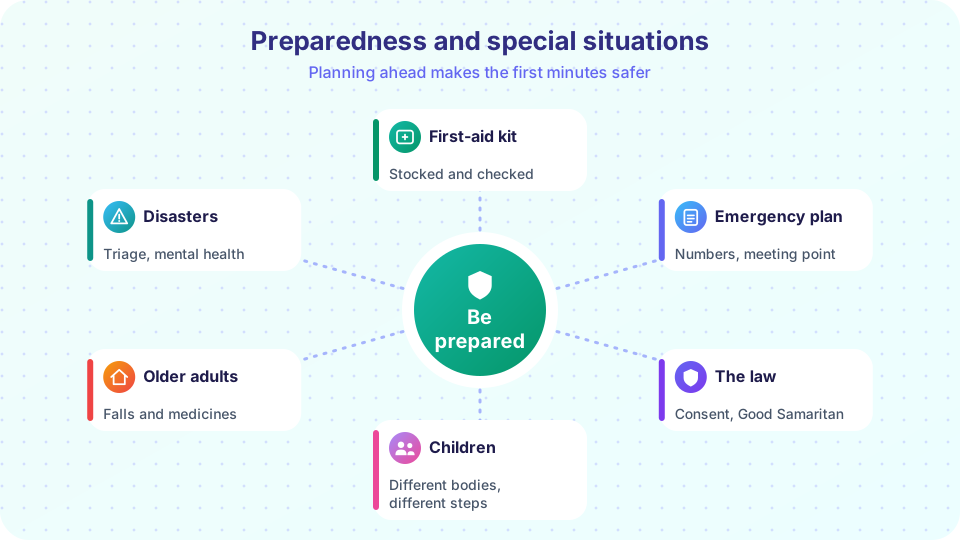
This chapter widens the view in four ways. First, preparation: kits, plans, training and knowing the law. Second, people who need adapted first aid: babies, children, older adults, pregnant people and people with disabilities. Third, large-scale situations: disasters where many people are hurt and help is delayed. And finally, minds as well as bodies: psychological first aid and how to help someone in mental distress.
Educational information, not medical or legal advice. This chapter explains general principles for learners worldwide. Laws on consent, duty to assist and liability differ widely between countries and regions, and first-aid techniques for infants, children and pregnant people are specific. This course cannot replace a certified, hands-on first-aid course, including pediatric training, or the advice of emergency services and qualified professionals.
What you will learn
- What a basic first-aid kit and a household emergency plan contain.
- How consent, duty of care and Good Samaritan laws work in general terms.
- How first aid changes for infants, children and older adults.
- How triage works in disasters, and what psychological first aid is.
Key terms
- Consent: permission to help. A conscious adult can accept or refuse; for an unresponsive person, consent is implied.
- Good Samaritan law: a law, in many places, that protects people who give reasonable help in good faith from being sued.
- Triage: sorting casualties by urgency so that the most good is done with limited help.
- Psychological first aid: practical and emotional support to people in distress after a crisis.
- Emergency action plan: a written plan of who does what and where to go in an emergency.
Why prepare?
Three simple facts explain why preparation matters. First, in many emergencies the first minutes decide the outcome, and the first person present is you. Second, stress makes thinking slow and narrow, so a plan that you can follow almost automatically helps. Third, the right tools in the right place cost little and save time: a pressure bandage in a kit is useless in the car if the kit is at home.
Preparation has four parts:
- Knowledge: a certified course, refreshed regularly.
- Equipment: a kit suited to your home, vehicle and activities, a phone with emergency numbers and, in many public places, an AED.
- Planning: a plan for the home, workplace, school or trip: who calls, who fetches the kit, where the meeting point is.
- Awareness: of the law, local hazards and people with special needs near you.
Chapter 8 in three words
Plan before you need it
Preparation turns panic into a plan.
What each lesson covers
- Kits, plans and the law covers a basic first-aid kit, a household emergency plan, consent and Good Samaritan laws.
- Children, infants and older adults covers the adjustments for choking, CPR, common childhood emergencies and the risks of age.
- Disasters and mental health covers triage, earthquakes and floods, psychological first aid and helping someone in a mental health crisis.
- Chapter 8 review summarizes the chapter.
Try it
Check how prepared a typical household is. Tick what you already have and see which gaps you could close this week. This is a self-check for learning, not an assessment of anyone's safety.
Check your understanding
Quick check · 4 questions
of 4 answered You scored / 4 · perfect!
-
1. Why does preparation help in an emergency?
A plan, a kit and practiced skills let you act despite stress. -
2. What is triage?
Triage sorts people so the most urgent get help first when resources are limited. -
3. What does a Good Samaritan law usually do?
Many places protect good-faith helpers from being sued, but details differ. -
4. Consent is implied when the casualty is:
For an unresponsive person, consent is implied. A conscious adult can refuse.
Summary
- Preparation has four parts: knowledge, equipment, planning and awareness.
- Special groups and large-scale events need adapted first aid.
- Mental health matters: psychological first aid is practical, calm support.
- This course is educational; certified courses and local laws are the authority.
Next: Kits, plans and the law
Track your progress
Create a free account to tick off lessons and pick up where you left off on any device.
of First Aid and Emergency Care lessons completed