


















Lesson 14 of 47 · Assessment and CPR
Using an AED: Automated External Defibrillators
Learn what an AED does, which heart rhythms it can treat, where to put the pads, how to stay safe during a shock and special cases such as children and pacemakers.
An automated external defibrillator, or AED, is a small, portable device that can restart a heart that has fallen into a chaotic rhythm. It looks intimidating, but it is designed for people who have never used one: it speaks aloud, shows pictures, checks the rhythm for you and will only deliver a shock if one is needed. In studies of public-access defibrillation, trained lay volunteers equipped with AEDs roughly doubled survival compared with those who gave CPR alone, and some casino-security programs, where the first shock was given within about three minutes, reported that around three quarters of those shocked survived. The numbers vary by setting, but the lesson is consistent: shock early.
Educational information only. This lesson is not a substitute for a certified, hands-on CPR and AED course. AED models differ; always follow the device's voice prompts, the pictures on the pads and the dispatcher. Call your local emergency number first.
What you will learn
- How an AED works and which rhythms it treats.
- The steps for using an AED with CPR.
- Where to put the pads, and the special cases: wet chests, hair, patches, pacemakers, children.
- How to stay safe, and what happens after a shock.
- Where AEDs are and how to find one.
Key terms
Ventricular fibrillation (VF): a chaotic, quivering rhythm of the lower heart chambers that does not pump blood. It is the commonest shockable rhythm in cardiac arrest.
Pulseless ventricular tachycardia (pVT): a very fast, organized but ineffective rhythm; also shockable.
Defibrillation: delivering a brief electric shock to the heart to stop a chaotic rhythm so the heart's natural pacemaker can resume control.
Shockable / non-shockable: whether the device recognizes a rhythm that a shock can treat. Asystole (flat line) and pulseless electrical activity are non-shockable.
Electrode pads: sticky pads that read the rhythm and carry the shock.
How an AED works
When you attach the pads, the AED measures the electrical signal of the heart through the skin. A computer in the device compares it with patterns it has been programmed to recognize. If it detects VF or pVT, it charges and tells you to deliver a shock; some models shock automatically, others ask you to press a button. If the rhythm is not shockable, it says "no shock advised" and tells you to continue CPR.
A shock does not restart a heart that has stopped completely. It works on chaotic rhythms: the shock briefly stops all electrical activity, and the heart's own pacemaker, if the muscle still has enough oxygen, can then take over. CPR keeps the heart muscle supplied with oxygen, which is why the two go together: CPR to keep the heart ready, shock to reset it, CPR again to support it.
An AED cannot hurt a person who does not need a shock. It will not deliver a shock to a normal heart or to one that has stopped completely, so there is no good reason to hesitate.
The steps
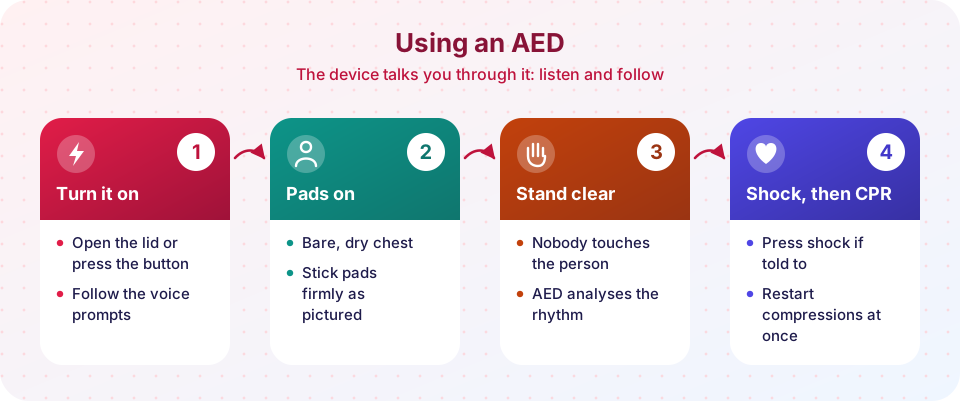
- Call emergency services and send someone for the AED. Begin CPR immediately if you are alone and the AED is not close.
- Switch the AED on by opening the lid or pressing the power button. Follow the voice prompts.
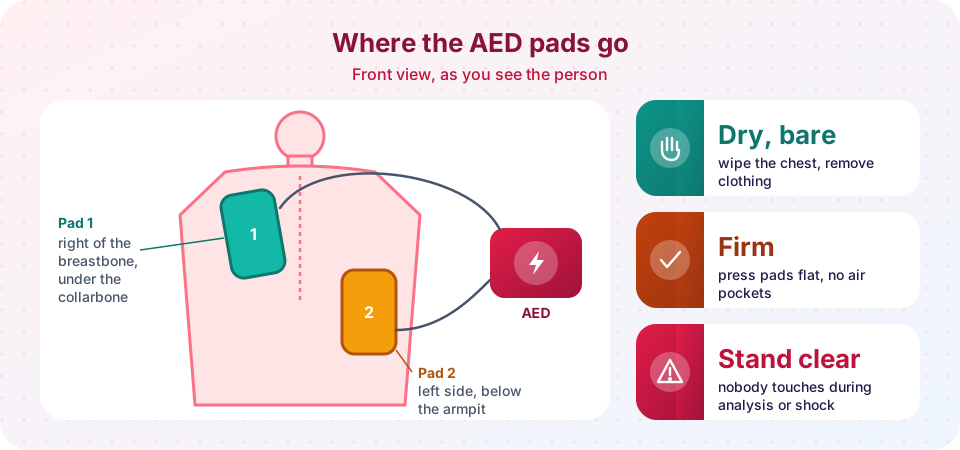
- Prepare the chest. Remove or cut the clothing so the chest is bare. Dry it with a towel if wet or sweaty. If the chest is very hairy, quickly shave or press hard, since the pads must contact the skin. Many AEDs carry a razor.
- Place the pads as shown on the pads: one on the right upper chest, below the collarbone, and one on the left lower side of the chest, below the armpit. Press them flat so no air bubbles lie under the gel. Plug in the connector if needed.
- Stand clear while it analyses. Say "Everybody clear". Nobody should touch the person while the AED checks the rhythm.
- If a shock is advised, check again that nobody is touching the person, then press the shock button (or wait for an automatic shock).
- Resume CPR immediately, starting with compressions, for two minutes. Keep the pads on. The AED will analyse again every two minutes and talk you through it.
Staying safe
The shock passes through the chest, so the main danger is to people touching the patient. Keep safe by:
- Stand clear. Nobody touches the person during analysis or shock. Check your own and others' contact: hands, knees, equipment.
- Dry surroundings. Move the person away from standing water; dry the chest.
- No flammable gas. Do not use an AED in a setting with oxygen or flammable fumes leaking nearby; move the person away from an oxygen mask or tank.
- Nothing between pads and skin. Remove bras with metal wires if they get in the way, and jewelry on the chest.
- Remove medication patches. Wipe off nitroglycerin or similar patches from the pad area with a gloved hand.
- Implanted devices. If there is a visible lump under the skin from a pacemaker or implanted defibrillator, usually below the collarbone, place the pad at least 8 cm from it.
Children and infants
A child is the same except that the pads and the energy are smaller. Many AEDs have paediatric pads or a key that switches the device to a child mode; for children under about eight years old or lighter than about 25 kg, use these if available. If you have only adult pads, use them rather than not shocking, placing one pad on the front of the chest and one on the back, so the pads do not touch. The ERC and AHA both agree that AEDs are safe for children and infants, even though most cardiac arrests in children are caused by breathing problems and need breaths and CPR first.
After a shock
Whether or not a shock was given, restart compressions without a pause. A shock rarely "restarts" a visible heartbeat at once; often the pulse is weak and the person is still unresponsive. Wait for the next prompt from the AED (after two minutes), and if the person starts to move or breathe normally, stop CPR, put them in the recovery position and keep monitoring them, with the pads still attached, until the ambulance crew arrives. If the person collapses again, the AED can analyse again.
Finding an AED
Public AEDs are placed in airports, train stations, shopping centers, sports halls, offices, schools and some street cabinets. They usually carry a green sign with a heart and a lightning bolt. Many regions have registries or apps that show nearby devices, and emergency dispatchers know where the closest ones are. Learn where the AED is in the places you spend time.
Try it
First, a picture of what an AED looks for. This plot draws synthetic heart-rhythm traces. They are cartoons for teaching and not real recordings.
Press Run (or Ctrl + Enter) to see the result here.
Program input · what you'd type while the program runs
Type the answers before you press Run, one per line. Each time the program reads a line (with input()), it gets the next line from this box.
The second demonstration plays the part of an AED. It follows a typical sequence of prompts and shows how CPR and shocks alternate. It is a simplified model, not a real device.
Press Run (or Ctrl + Enter) to see the console output here.
No output.
Common misconceptions
"The AED will shock me into doing it wrong." It does nothing unless you attach pads, and it delivers a shock only if its analysis calls for one.
"I could kill someone with an AED." A person in cardiac arrest is already near death; the device cannot shock a heart that does not need it.
"You must check the person's pulse after a shock." Not for lay rescuers; restart CPR immediately.
"Do not use it on a wet person." Dry the chest and move away from standing water, then use it.
Check your understanding
Quick check · 5 questions
of 5 answered You scored / 5 · perfect!
-
1. Which rhythms can an AED treat with a shock?
VF and pVT are shockable; a flat line is not. -
2. Where does the first pad go on an adult?
One pad is on the right upper chest below the collarbone, the other on the left side below the armpit. -
3. What should you do straight after a shock?
Restart CPR without delay and keep the pads on. -
4. How far from an implanted pacemaker should you place a pad?
Place pads away from the lump to avoid interfering with the device. -
5. If only adult pads are available for a child, what is best?
An adult-size shock is safer than none; place the pads so they do not touch.
Summary
- An AED analyses the rhythm and shocks only VF or pVT; it cannot harm a person who does not need a shock.
- Turn it on, bare and dry the chest, attach pads, stand clear, shock if advised, then restart CPR.
- Special cases: dry wet chests, move away from standing water, keep pads away from implanted devices, wipe off patches, use child pads or the front-and-back position for children.
- Learn where the nearest AED is.
Track your progress
Create a free account to tick off lessons and pick up where you left off on any device.
of First Aid and Emergency Care lessons completed