


















Lesson 27 of 47 · Fractures and Injuries
Chapter 5 review: fractures and injuries
Review the key ideas of chapter 5: splinting, sprains and strains, dislocations, head, neck and spine injuries, with a one-page picture, a recap table and a ten-question quiz.
You have now covered the injuries that damage the body's frame: broken bones, damaged ligaments and muscles, joints out of place, and the head, neck and spine. Before you move on to medical emergencies, this lesson pulls the chapter together. Read the picture, scan the table, try the flashcards and answer the ten questions. If you miss a question, the explanation tells you which lesson to revisit.
Reminder: this is educational information, not a substitute for a certified first-aid course or for emergency services. Practice splinting and head support hands-on with a trained instructor.
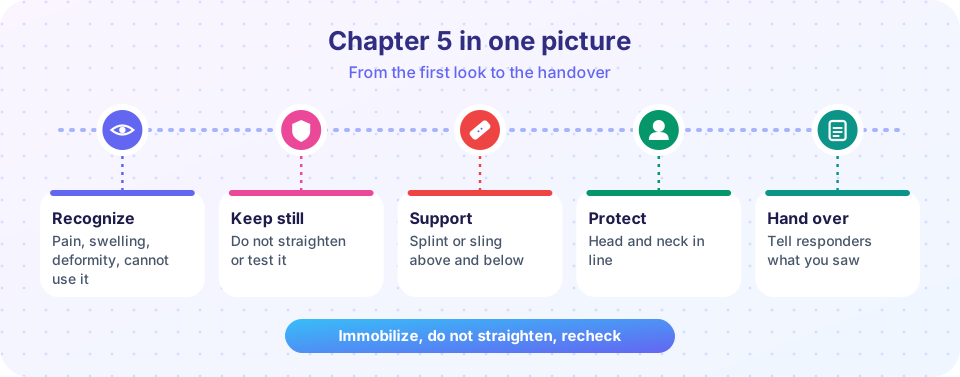
What you will learn
- How to link the signs of each injury to the correct first-aid action.
- Which of your habits (look, support, call) apply to every injury in this chapter.
- Which mistakes to avoid: straightening, forcing, moving and testing.
Recap table
| Injury | What it is | Typical signs | First aid | Call emergency services if |
|---|---|---|---|---|
| Closed fracture | Bone broken, skin intact | Pain, swelling, deformity, cannot use limb | Immobilize as found, splint past joints above and below, check beyond | Pale or cold limb, thigh, pelvis, neck or back suspected |
| Open fracture | Bone or wound reaches the break | Wound, bleeding, bone visible | Cover with sterile dressing, press around the wound, do not push bone back | Always |
| Sprain | Ligament stretched or torn | Swelling, bruise, pain on use | Protect, elevate, compress, reload gradually | Cannot bear weight, deformity |
| Strain | Muscle or tendon stretched or torn | Sudden pain, tightness, cramp | Rest briefly, gentle movement as pain allows | Severe pain, numbness, back strain with leg weakness |
| Dislocation | Joint out of place | Deformity, severe pain, cannot move | Support in position found, do not reduce, check beyond | Pale, cold or numb limb, severe pain |
| Head injury | Blow to head, possible brain injury | Headache, vomiting, drowsiness | Rest, cold pack, watch 24 hours | Any red flag |
| Spine injury | Backbone or cord injury | Neck or back pain, numbness, weakness | Hold head in line, keep still | Always when suspected |
The chapter in three rules
- Keep it still. Movement is what hurts injured bone and joints, and what damages vessels and nerves. A splint, a sling or your hands all do the same job.
- Do not force it. Do not straighten a limb, push a joint back or pull on a head. Support what you find.
- Watch and tell. Check circulation, sensation and movement beyond the injury, watch alertness after a head injury, and tell responders what you saw and when it started.
Try it
Flip through flashcards on the chapter. Click a card to see the answer.
Check your understanding
Quick check · 10 questions
of 10 answered You scored / 10 · perfect!
-
1. You suspect a fracture of the forearm. Which is the best first step after scene safety?
Support as found and check circulation, sensation and movement beyond the injury. -
2. Where do you tie the bandages of a splint?
Tying over the break presses on the injury and can cause pain. -
3. A sprain is an injury to:
Ligaments connect bone to bone. Tendons connect muscle to bone. -
4. What is the correct first-aid approach to a dislocated shoulder?
Do not try to reduce a dislocation. -
5. Which of these is a head-injury red flag?
A seizure after a head injury means call emergency services. -
6. Why do you not test a suspected fracture by moving it?
Moving a fracture causes pain and may damage vessels, nerves and skin. -
7. How do you support a suspected neck injury?
Hand support keeps the head level with the body until trained responders arrive. -
8. When is it acceptable to move someone with a suspected spine injury?
Moving is a last resort for danger or airway and breathing. -
9. What is the main role of cold packs on a sprain?
Ice is for comfort. Use a cloth barrier and 10 to 20 minutes at a time. -
10. A concussed player says they feel fine after a few minutes. What do you do?
If in doubt, sit them out. Return to sport is graduated and cleared by a clinician.
Summary
- Keep injuries still, support them as found and never force them.
- Check beyond the injury before and after you support it.
- Head and spine injuries have red flags and call for hands-on head support.
- Immobilize, do not straighten, recheck, and tell responders what you saw.
Track your progress
Create a free account to tick off lessons and pick up where you left off on any device.
of First Aid and Emergency Care lessons completed