


















Lesson 26 of 47 · Fractures and Injuries
Head, neck and spine injuries
Recognize red flags after a head injury, learn how to support a suspected spine injury, and understand concussion care and why returning to sport is gradual.
Most bumps on the head are minor: the child who runs into a table, the cyclist who falls at low speed with a helmet on. A small number are not. The skull is a rigid box, and if the brain is bruised or blood collects inside it, pressure rises and the brain can be damaged. Injuries to the neck and back carry a different risk: the spinal cord, which carries signals between brain and body, can be hurt, and wrong movement may make that worse.
First aid for these injuries is mostly about two things: recognizing red flags that mean a person needs urgent care, and keeping the person still and watching them until help arrives. This lesson covers the signs, what to do, how to support a suspected spine injury, and what concussion means for sports and school.
What you will learn
- The red flags after a head injury that mean call emergency services.
- How to look after a minor head injury and a scalp wound.
- What concussion is, why most people who have one do not lose consciousness and what safe return to activity looks like.
- When to suspect a spine injury and how to support the head and neck by hand.
- Why helmets usually stay on and why you do not move the person unless there is danger.
Key terms
- Concussion: a temporary disturbance of brain function caused by a blow to the head or body. It does not usually show on scans.
- Mechanism of injury: how the injury happened (a fall from height, a collision, a dive). It guides how worried to be.
- In-line stabilization: holding the head so that it stays level with the body, without pulling.
- Red flag: a warning sign that suggests a serious injury.
- Spinal cord: the bundle of nerves inside the backbone that links the brain to the body.
The head: what can go wrong
A blow can cause a scalp wound, which bleeds heavily because the scalp is rich in blood vessels, but is often less serious than it looks. It can cause a skull fracture, which may not be visible. It can cause bleeding between the skull and the brain, which can build up over minutes or hours, and bruising of the brain itself. A person can seem fine at first and get worse later, which is why watching matters.
Red flags
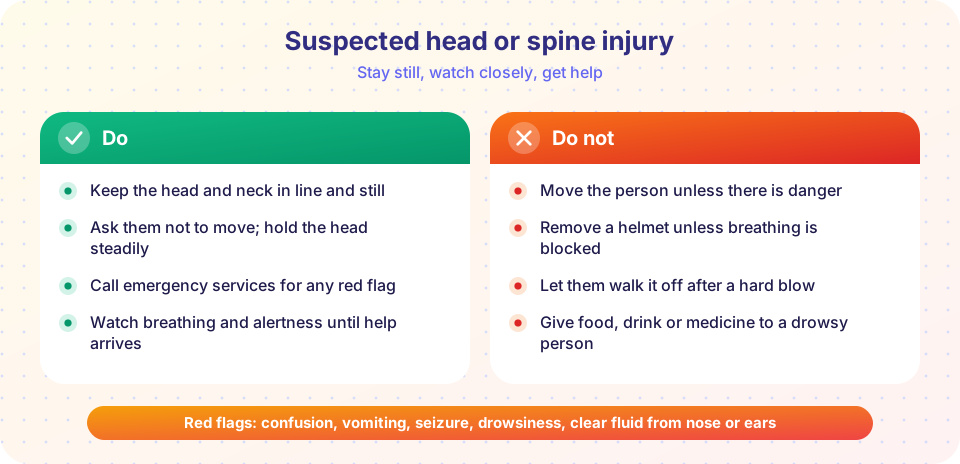
Call your emergency number if a person who has had a head injury shows any of these:
- Loss of consciousness, even briefly, and they are not fully back to normal, or they cannot be woken easily.
- Increasing drowsiness or confusion, strange behavior, or slurred speech.
- Repeated vomiting.
- A severe or worsening headache.
- A seizure (fit).
- Weakness, numbness, loss of balance, trouble walking, or unequal pupils.
- Clear or bloody fluid from the nose or an ear, or bruising around both eyes or behind an ear.
- A deep wound, a dent in the skull, or something embedded.
- Neck pain, or a high-force mechanism: a car crash, a fall from height, a diving or bike accident at speed.
- Being on blood-thinning medicines, or being very young or old, which raises the risk of bleeding.
Looking after a minor head injury
If there are no red flags, you can help as follows.
- Sit the person down and keep them calm. Ask simple questions (what is your name, where are you, what day is it?) to see if they are alert.
- Press a clean pad on a scalp wound for about ten minutes. If you suspect a depressed skull fracture (a dent), do not press on it; press around it.
- Hold a cold pack wrapped in cloth on a swelling. It reduces pain.
- Stay with them and watch for the first 24 hours. Many people sleep after a knock. It is generally fine to let them sleep, as long as someone can check on them and wake them if they seem different. Take advice if you are worried.
- Seek medical advice if symptoms persist, or if the injury happened in a child, an older adult or someone on blood thinners. Written head-injury advice from the hospital or clinic is helpful.
Concussion
A concussion is a short-lived change in how the brain works after a blow to the head, or to the body that shakes the head. Typical symptoms include headache, dizziness, nausea, confusion, memory gaps, sensitivity to light or noise, feeling foggy or slowed, and changes in mood or sleep. Most people with a concussion do not lose consciousness. So you cannot rule it out because the person "was not knocked out".
In sport the rule is simple: if in doubt, sit them out. A person with suspected concussion should stop playing immediately, should not be left alone, and should be seen by a health professional. Playing on increases the risk of further injury and slower recovery. Doctors and sport bodies publish consensus statements about concussion in sport; the most recent international consensus updated its advice in 2022, and it has the following broad shape.
- Short relative rest for a day or two, then gradual return to everyday activity as symptoms allow.
- A graduated return to sport in stages: symptom-limited activity, light aerobic exercise, sport-specific exercise, non-contact training drills, full-contact practice and finally match play.
- Each stage lasts at least about 24 hours, and a person moves back a stage if symptoms return.
- A return to school or work is usually ahead of a return to contact sport.
The details differ by country, age and sport. Follow the advice of a clinician and your sport's rules.
The neck and spine
The backbone is a stack of bones (vertebrae) with the spinal cord running through a channel inside it. A force that bends, twists or compresses the spine can break a vertebra or tear ligaments. The cord can be bruised or cut, causing weakness, loss of feeling or paralysis below the injury, and, in the neck, problems with breathing.
When to suspect a spine injury
Think of the possibility if there was a high-force mechanism (a car or motorbike crash, a fall from more than standing height, a diving accident, a heavy tackle) or if the person has any of these:
- Pain in the neck or back, or tenderness when you gently ask about it.
- Numbness, tingling or weakness in the arms or legs.
- Loss of control of the bladder or bowel.
- Difficulty breathing, or an odd position of the head or limbs.
- A head injury with reduced alertness. A person who is not fully alert cannot reliably tell you if their neck hurts.
What to do
- Tell them not to move and to stay as still as possible, including turning the head. Explain that you are supporting their neck and that help is coming.
- Call emergency services or send someone to call.
- Support the head by hand. Kneel behind or beside the head and hold it gently with both hands, one on each side, so that it stays in line with the body. Do not pull and do not twist. Keep this support until trained responders take over.
- Do not move the person unless there is immediate danger (fire, traffic, rising water) or you cannot keep the airway open or breathing going. Airway and breathing come first. If you must roll an unresponsive but breathing person to clear the airway, move the head, neck and body together as one unit if you can, with a helper.
- Keep them warm, watch breathing and alertness and keep reassuring them.
Current international first-aid guidelines suggest that people who are not trained should not apply rigid neck collars: a collar can cause problems, and hand support is preferred until professionals arrive. If you are trained in your workplace or sport to use one, follow that training.
Helmets
A helmet is left on by a first aider in most cases. Removal can move the neck. The exceptions are when the helmet blocks the airway or prevents you giving breaths or CPR, or when you cannot assess breathing. Removal is best done by two people, one holding the head while the other releases the helmet. Remove it only if you must, and only with the neck supported.
Common misconceptions
- "You must stay awake after a head injury." It is generally safe to sleep after a minor injury if someone can check on the person. Worsening drowsiness is the warning sign.
- "No knock-out means no concussion." Most people with a concussion are never unconscious.
- "They can walk it off and carry on playing." A concussed player should stop. Playing on risks further injury.
- "Always move someone to a safer place." In a suspected spine injury, you move them only if staying puts them in more danger.
Try it
First, a red-flag screen. Tick what you see and read the action. This is a study demonstration, not a diagnostic or triage tool: in a real situation, any doubt means calling for help.
Now the graduated return to sport, as a small stepper. It shows the shape of the stages only; a clinician decides when to progress.
Press Run (or Ctrl + Enter) to see the console output here.
No output.
Check your understanding
Quick check · 5 questions
of 5 answered You scored / 5 · perfect!
-
1. Which of these is a red flag after a head injury?
Vomiting repeatedly and getting drowsier suggest rising pressure inside the skull and need emergency care. -
2. Most people with a concussion:
Loss of consciousness is not needed for a concussion, and most people never lose it. -
3. How do you support a suspected neck injury?
Hold the head still and level with the body, without pulling or twisting. -
4. When should a first aider remove a motorcyclist's helmet?
Helmets stay on unless they stop you opening the airway or giving breaths and CPR. -
5. What is the rule in sport for a player who may have a concussion?
A player with suspected concussion stops immediately and returns only through a graduated plan cleared by a clinician.
Summary
- After a head injury, look for red flags: unconsciousness, drowsiness, repeated vomiting, severe headache, seizure, weakness, fluid from the nose or ears.
- A minor head injury needs a cold pack, calm monitoring for 24 hours and advice if symptoms continue.
- Concussion does not need a knock-out. Sit them out and return to activity in stages.
- For a suspected spine injury, call, keep the person still and hold the head in line; do not move them unless there is danger.
- Leave a helmet on unless it blocks the airway or breathing.
Next: Chapter 5 review
Track your progress
Create a free account to tick off lessons and pick up where you left off on any device.
of First Aid and Emergency Care lessons completed