


















Lesson 18 of 47 · Bleeding, Wounds and Shock
Chapter 4 Overview: Bleeding, Wounds and Shock
Overview of chapter 4: why blood loss is a threat to life, how circulation works, and what the lessons on severe bleeding, wound care and shock will teach.
Blood carries oxygen and nutrients to every cell. When blood is lost quickly, the body cannot make up the difference, and organs begin to fail. Severe bleeding can kill in minutes, yet it is one of the few threats to life that a bystander can often control with their bare hands and a piece of cloth. This chapter covers what to do about bleeding, how to look after wounds of every size, and how to recognize and support a person whose circulation is failing, a state called shock.
Educational information only. This chapter describes widely taught first-aid principles. It is not a substitute for a certified first-aid course, nor for medical care. Severe bleeding is an emergency: call your local emergency number first or at once.
What you will learn
- How the circulatory system works, in simple terms, and what blood loss does to it.
- What each lesson in the chapter covers.
- The first-aid priority: bleeding that threatens life is treated right after breathing.
Key terms
Circulation: the movement of blood around the body, driven by the heart through arteries, capillaries and veins.
Haemorrhage (US: hemorrhage): bleeding, especially heavy bleeding.
Direct pressure: pressing on the wound itself to slow and stop bleeding.
Tourniquet: a band tightened around a limb to stop blood flow past it.
Shock: a life-threatening state in which the circulation does not deliver enough blood to the organs.
How the circulation works
The heart is a muscular pump with two sides. The right side sends blood to the lungs to pick up oxygen; the left side sends oxygen-rich blood out through the arteries to the whole body. Arteries branch into tiny capillaries, where oxygen passes to the tissues, and the blood returns to the heart through veins. An average adult has around 70 mL of blood for every kilogram of body weight, which is about 5 liters for a 70 kg person. Children have a similar or slightly higher amount per kilogram but a much smaller total, so a loss that seems small in an adult can be serious in a child.
Not all bleeding is the same:
- Arterial bleeding comes from an artery. It is often bright red and may spurt with each heartbeat; it can be rapid and hard to control.
- Venous bleeding comes from a vein. It is darker and flows steadily, and can still be heavy.
- Capillary bleeding is a slow ooze from tiny vessels, as with a graze.
In practice you cannot always tell the types apart, and it does not change the first response: press on it.
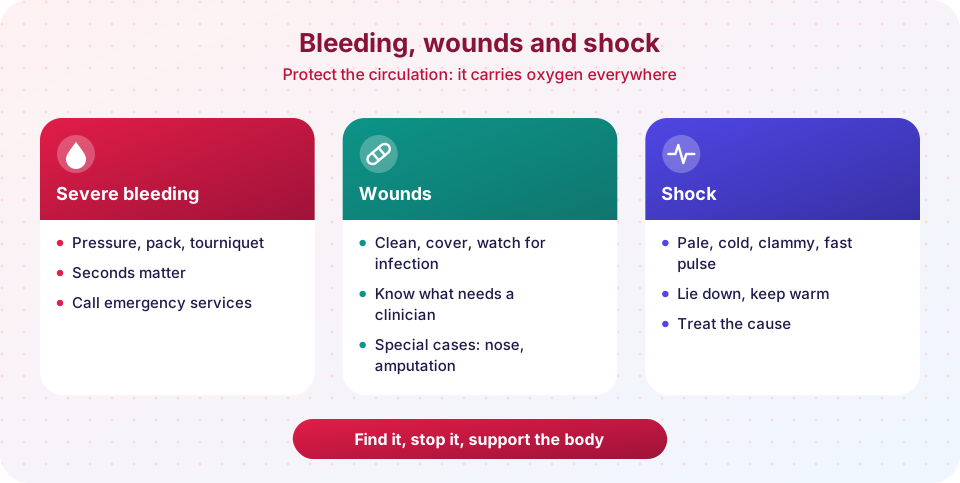
Three jobs in this chapter
Severe bleeding: the ladder
Shock: keep the person safe
Lessons in this chapter
- Controlling Severe Bleeding: direct pressure, packing, pressure bandages and tourniquets, with the reasoning and the evidence.
- Wounds, Dressings and Infection: types of wound, cleaning and covering, wound healing, signs of infection, nosebleeds and special cases.
- Shock: why the body goes into shock, how to recognize it and what to do.
- Chapter 4 Review: recap table, a picture summary and a ten-question quiz.
Priorities
In the primary survey you check for danger, response, airway and breathing. Many courses add a check for catastrophic bleeding at the very beginning: if you see blood pouring from a limb, treat that first, because a person can die from blood loss faster than from an airway problem. The acronym MARCH, used in military and trauma care, makes the order explicit: Massive hemorrhage, Airway, Respiration, Circulation, Head injury and hypothermia. First aiders can use the principle in a simple form: control life-threatening bleeding first, then check the airway and breathing.
Try it
A calculator turns body weight into an estimate of blood volume, so that you can see why a small child's margin is smaller. It uses rough average values and is a teaching illustration.
Press Run (or Ctrl + Enter) to see the console output here.
No output.
Check your understanding
Quick check · 4 questions
of 4 answered You scored / 4 · perfect!
-
1. How much blood does an average adult have per kilogram?
Roughly 70 mL per kg, which is about 5 liters for a 70 kg person. -
2. What is the first response to any visible heavy bleeding?
Direct pressure is the first and most useful step. -
3. What does MARCH stand for in trauma care?
It places massive bleeding first in the order of care. -
4. Which of these is a sign of arterial bleeding?
Arterial blood is often bright red and spurts with each heartbeat.
Summary
- Blood carries oxygen; fast blood loss can kill within minutes.
- Bleeding can be arterial, venous or capillary; the first response to heavy bleeding is the same: press.
- Control life-threatening bleeding first, then check airway and breathing.
- Shock follows severe blood loss and other causes; it needs early help.
Track your progress
Create a free account to tick off lessons and pick up where you left off on any device.
of First Aid and Emergency Care lessons completed